Global – October 29, 2026 -- Ninety-three percent of 350 senior telecom decision-makers surveyed globally by ST Engineering iDirect expect satellite to play a bigger role in their networks, and 88% plan to increase investment over the next five years.
Around 94% already classify satellite as essential or important to network strategy, and 85% highlight the importance of partnerships with satellite providers, according to the research cited by Shravan K Gaddam, VP Engineering in the company's CTO Office.
Operators want satellite to run inside the existing 5G core
Gaddam argues that operators do not want another network. They want 5G non-terrestrial networks (NTN) to reuse 5G core functions such as authentication, billing and policy control, and to deliver consistent service whether connectivity is terrestrial or satellite. Siloed systems with different operational models do not scale as networks grow more complex, he says.
Resilience, mobility and remote enterprise coverage lead early use cases
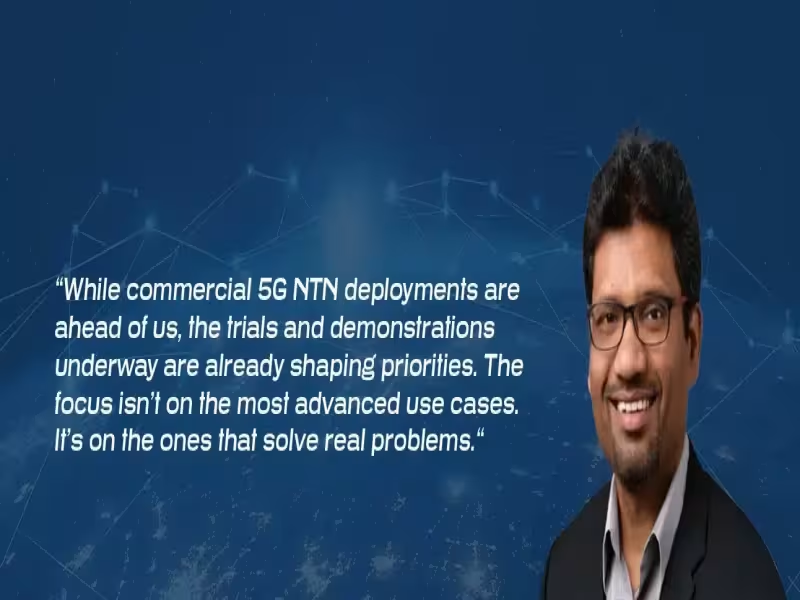
Commercial 5G NTN deployments are still ahead, but current trials focus on resilience for critical infrastructure such as energy networks, financial systems and public services. Mobility and enterprise connectivity in remote or hard-to-reach locations follow. Extending terrestrial networks into low-density areas remains expensive and often hard to justify commercially.
ST Engineering iDirect demonstrates 3GPP-compliant 5G core integration
Recent demonstrations by the company showed satellite networks integrating with the 5G core as fully 3GPP-compliant systems, operating as an extension of existing networks. Operators can start by integrating existing satellite capabilities into the 5G core and move to native 5G NTN over time, retaining existing infrastructure and waveform technologies.
Hybrid roaming must let devices move between terrestrial and satellite networks without disruption and, over time, across different satellite providers.
3GPP Releases 17 and 18 lay the standards groundwork
3GPP standards from Release 17 through Release 18 and beyond reduce complexity and support interoperability without locking operators into a single approach. Cloud-native ground systems, unified network management and advanced analytics are easing operations across multiple network layers, while work continues to reduce reliance on external positioning systems such as GNSS.
Latency, Doppler effects and mobility management remain unresolved challenges.