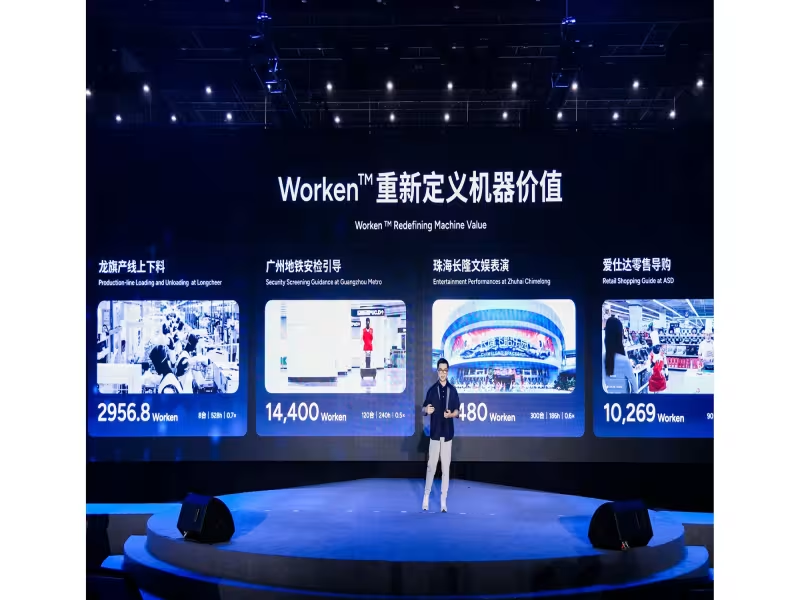
Shanghai – October 29, 2026 -- AGIBOT introduced Worken, a proposed framework that measures robots by the productive work they perform rather than by units built or delivered, at its Innovation Day 2026 event. The company also unveiled its AHA3 hardware platform, the GO-3 Preview foundation model and the G2 Max industrial robot.
Worken multiplies active robots, autonomous hours and output efficiency
AGIBOT defines Worken as "Effective Intelligent Work Hours": Number of Active Robots × Autonomous Working Hours × Output Efficiency Ratio. The first factor counts only robots performing tasks in real environments, excluding units in inventory. The second counts autonomous working time rather than total powered-on time. The third benchmarks output against a reference task, such as acceptable work completed by a human worker under established operating standards.
Co-founder, President and CTO Peng Zhihui framed the question for the industry as "how much productive work are they actually delivering?" AGIBOT argues that deployments with similar robot counts can differ in productivity, depending on how often human intervention is needed and how much acceptable work gets done.
The company also links the metric to robotics economics. Hardware depreciates, but software and AI model improvements may let the same machine do more useful work over its life. AGIBOT says measuring that output against total lifecycle costs could help businesses evaluate deployments. It calls Worken an evolving framework, to be refined through task-specific benchmarks and operational data.
The event also saw the release of the "2026 Embodied Intelligence Industry Innovation Report," compiled by China Economic Information Service and the Shanghai Industrial Innovation Center of the China Academy of Information and Communications Technology (CAICT). The report includes Worken and AGIBOT's deployment examples.
AHA3 platform integrates locomotion, interaction and task hardware
AHA3 (AGIBOT Humanoid Architecture) is the company's third-generation humanoid architecture and first commercial "Three Intelligences in One" platform. It combines motor-drive technology, integrated computing and high-speed connectivity, including Wi-Fi 6 and 5G. For continuous industrial operation, AGIBOT added a joint liquid-cooling system and joints with IP67-rated protection. The new dexterous-hand family comprises OmniHand 3 Lite, OmniHand 3 and OmniHand 3 Ultra, plus the OmniPicker 3 tactile gripper.
GO-3 Preview ranks first on three robotics benchmarks
GO-3 Preview is built on WRAM (World Reasoning Action Model), a unified reasoning, prediction and action framework. According to results presented at the event, it ranked first in task success rate and process score on RoboDojo, achieved the highest overall score on RoboTwin, and ranked first overall on RoboColiseum. AGIBOT also demonstrated zero-shot and few-shot capabilities.
The WITA-Omni interaction model combines vision, speech, real-time dialogue, facial expressions and physical actions. It supports full-duplex conversation and on-device deployment, and currently ranks first on multiple embodied-interaction benchmarks, including Daily-Omni. AGIBOT's AGILE motion framework gained a self-evolving agent capability intended to improve robot performance through real-world experience. For training data and simulation, the company cited AGIBOT WORLD 2026, the MEgo product family and Genie Sim 3.0.
G2 Max targets heavy material handling with 40 kg dual-arm capacity
AGIBOT launched G2 Max for manufacturing and logistics, alongside Link-U OS 1.0. The robot offers 21 degrees of freedom, dual-arm handling capacity of up to 40 kg and an adjustable working height from 0.1 to 2.5 meters. It features force-controlled manipulation, omnidirectional mobility and multiple safety features, designed for operation alongside existing industrial equipment and workflows.