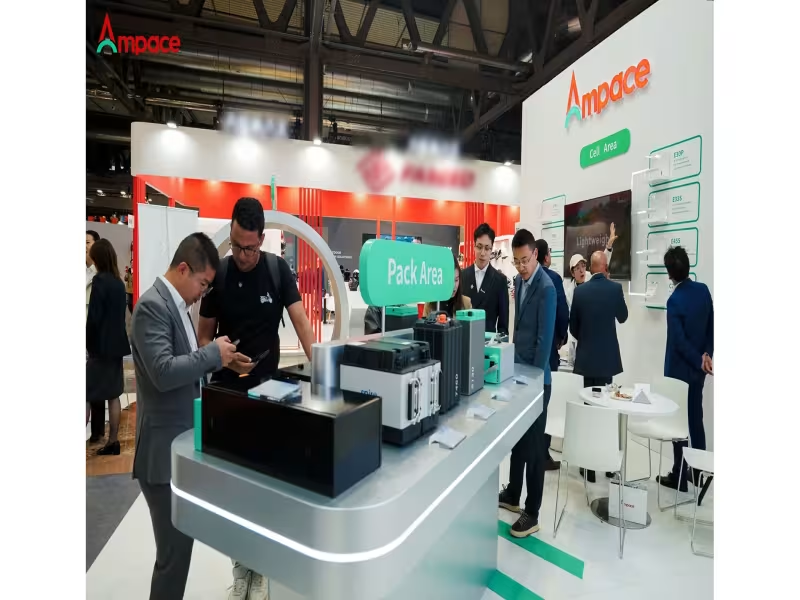
MILAN – November 04, 2026 -- Ampace reports that its battery-swapping packs in Africa have completed 17 million swaps over 2.5 years of commercial operation, averaging more than 1,000 cycles per pack under heavy, high-frequency use. The lithium battery supplier is presenting the figures at EICMA Milan alongside off-road cell technology for the European and global two-wheeler market.
Ampace's swapping network runs commercially across four regions
Ampace says its swapping network has scaled commercially in China, Southeast Asia, South America and Africa, while most competitors remain in pilot phases. Batteries are customized for local climate, road conditions and operating intensity. They serve high-frequency riders in Africa's heat and dust and on Latin America's bumpy roads.
Tabless design cuts internal resistance by 80% in off-road cells
Ampace is showing JP50 and EP65 21700 cylindrical off-road cells, plus custom high-energy-density pouch solutions. The company adapted the technology from its drone lithium batteries. The cells combine 9-series ultra-high-nickel cathodes with silicon-carbon anodes, which Ampace says maintains cycle life. The tabless design lowers internal resistance by 80% and improves thermal performance under high-current discharge.
Ampace says power output stays consistent across gradient climbs, high-speed cruising and hot-to-cold temperature swings, with no noticeable fade. The JP50 supports 3C+ fast charging. Ampace says both cells also suit European e-bikes for long-distance, commuting and leisure use.
Ampace's 7460 pack runs after 24 hours under 3 meters of water
An off-road e-motorcycle fitted with Ampace's 7460 battery pack operated normally after 24 hours of submersion in 3-meter-deep water. Ampace uses this test and its swapping field data to argue that two-wheeler electrification is shifting from specification competition to reliability competition.