Shanghai – September 11, 2026 -- CorrectSequence Therapeutics (Correctseq) reported that its transformer Base Editor (tBE) therapy CS-101/CS-206 achieved full transfusion independence or elimination of vaso-occlusive crises (VOC) in four new patients from Nigeria, Laos, Malaysia and Pakistan, expanding on earlier results in five Chinese patients who all reached transfusion independence. The findings, published September 7, 2026 in Cell Stem Cell, cover patients with sickle cell disease (SCD) and transfusion-dependent beta-thalassemia (TDT) carrying distinct genotypes, including βS/βS, β0/βE, and two β0/β0 variants.
Nigerian SCD patient shows zero vaso-occlusive crises after 15.5 months
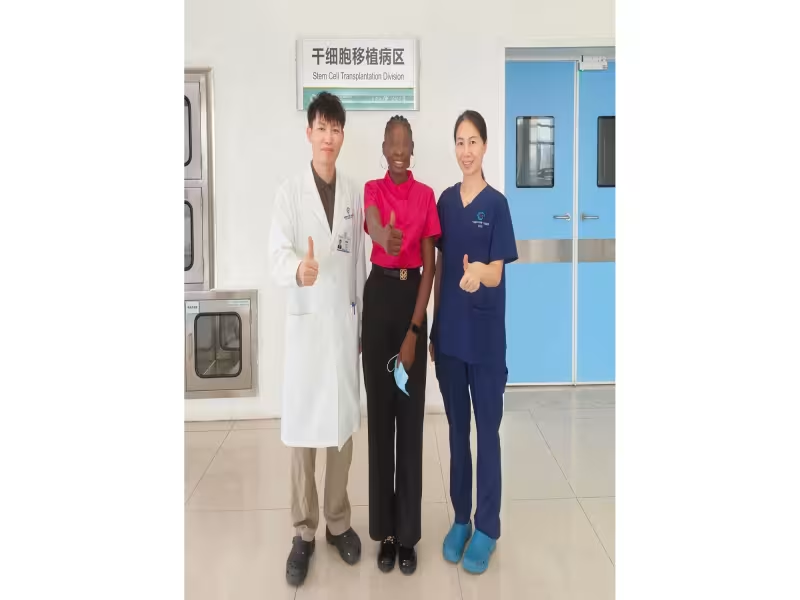
A 21-year-old woman from Nigeria who had experienced more than four VOC episodes in the year before enrollment achieved neutrophil engraftment on day 13 and platelet engraftment on day 21 post-infusion. Total hemoglobin rose from 7.7 g/dL at baseline to 12.9 g/dL at three months and remained above 11 g/dL. Fetal hemoglobin (HbF) increased from 3.5% to 62.2%, while sickle hemoglobin (HbS) fell from 76.1% to 31.6%, stabilizing near a 6:4 ratio. No VOC events were reported over 15.5 months of follow-up.
Three TDT patients reach durable transfusion independence with no off-target edits
Patients aged 3 to 29 from Laos, Malaysia and Pakistan showed median neutrophil engraftment at 13 days and platelet engraftment at 27 days. Mean total hemoglobin reached 11.6 ± 1.2 g/dL, with mean HbF climbing to 9.8 g/dL by month three. Over a median follow-up of 17.5 months, all three achieved durable transfusion independence with no detectable off-target edits or product-related adverse events.
tBE outperforms nuclease-based Cas9 and Cas12a on engraftment speed and HbF levels
In SCD trials, tBE produced faster neutrophil engraftment (13 days) than Cas9 (27 days) and Cas12a (23 days), and faster platelet engraftment (21 days) versus Cas9 (35 days) and Cas12a (25 days). tBE sustained HbF above 60% of total hemoglobin, exceeding the sub-50% levels reported for Cas9 and Cas12a therapies. Unlike nuclease-based approaches that rely on double-strand DNA breaks, tBE performs precise base conversion without cutting DNA, avoiding p53 activation, apoptosis, large deletions and chromosomal rearrangements. A dual-guide RNA, lock-and-key design further limits off-target activity by keeping the editor inactive except at target sites.
CS-101 has treated over 30 patients across four regions since first dosing in October 2023
CS-101 and CS-206 have now treated more than 30 patients across China, Africa, Southeast Asia and South Asia, with 100% achieving transfusion independence or VOC-free status alongside sustained high hemoglobin expression. CS-101, the first base-editing candidate globally to enter clinical development, has completed Phase I and moved into pivotal trials. All Phase I patients remained transfusion-independent for more than a year, with the longest duration approaching three years.
Correctseq founder Chen Jia, director of the Gene Editing Center at ShanghaiTech University, said the Cell Stem Cell publication confirms tBE's broad applicability across genetic backgrounds and completes the transfer from foundational research to global clinical application. Correctseq CEO Mou Xiaodun said the company is extending the platform to metabolic and cardiovascular indications, including hypertriglyceridemia, familial chylomicronemia syndrome, atherosclerotic cardiovascular disease, homozygous familial hypercholesterolemia and MASH, while preparing multiple global IND filings.