San Francisco – October 15, 2026 -- Benchling launched Science Foundries, a product that lets R&D teams run entire scientific processes with agents and scientists working from the same data, and made it available to its customers the same day.
Teams select a process or goal, such as producing proteins, optimizing a lead or improving a manufacturing process. They then define which steps agents run and where scientists must approve. Agents execute and monitor work, coordinate handoffs and flag key decisions to scientists.
Benchling has spent the past 18 months building AI into its platform. The company says agents are the fastest-growing capability it has released. Science Foundries extend agents from individual tasks to complete workflows.
Antibody Foundry replaces manual data handoffs between design, CRO and lab steps
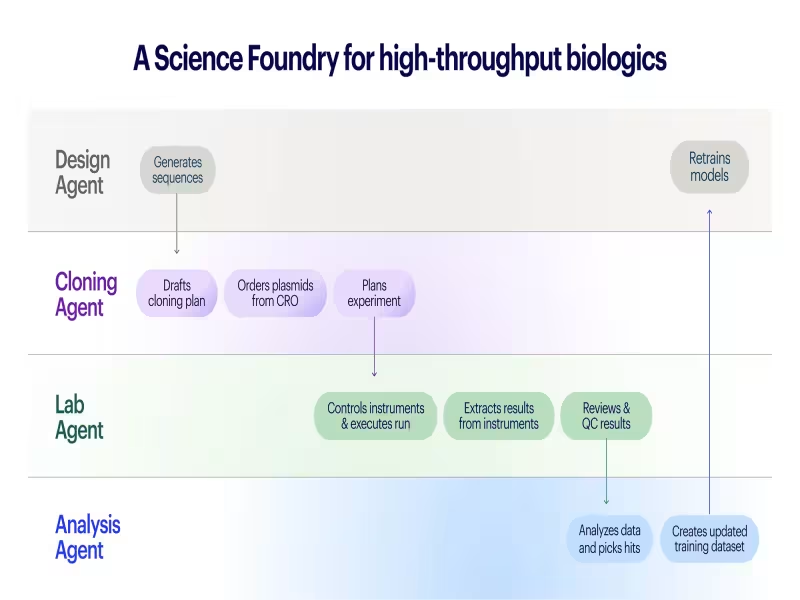
Benchling built one Foundry with a pharma team that designs, produces and tests antibodies at high throughput. The team uses models to design sequences, CROs to synthesize constructs and lab automation for production and assays. Scientists previously processed data by hand and fed it from one step to the next. The Foundry now automates that chain with four agents:
- A design agent generates and evaluates sequences using scientific models.
- A cloning agent drafts the assembly strategy and places orders with a CRO.
- A lab agent sends instructions to workcells, captures data and performs QC.
- An analysis agent interprets results and updates training datasets.
Speed is the main gain. When an assay finishes at 11pm, agents pick up the results and have an analysis ready by the time the scientist starts the day. According to Benchling, starting each experiment a day sooner can add up to months across a program.
Scale of exploration also changes. A design round previously tested one strategy at a time because each needed a scientist to set it up and track it. Agents can now run several strategies against the same goal in parallel, each with its own constructs, runs and analysis, and compare them side by side.
Parabilis Medicines moves from chat to standalone agents to full Foundries
Parabilis Medicines, a clinical-stage biopharma developing alpha-helical peptides, runs several programs in parallel with a lean scientific team. It began with individual agents for candidate-target profiles, experimental design and SPR analysis. It is now deploying Foundries for protein production, screening and lead optimization.
John McGee, Parabilis scientific co-founder and head of platform, said Foundries complement automated labs by keeping science moving around the clock through automated data capture, analysis and handoffs.
Benchling plans Foundries for three R&D functions
- Therapeutic Areas: searching literature to define target candidate profiles, suggesting assays to reuse or adapt from past programs, and designing and orchestrating assay cascades.
- Preclinical: reviewing in vivo study designs, processing CRO data, presenting analyzed results and writing study reports.
- Process Development: proposing design of experiments (DoE), processing bioreactor data, orchestrating analytical requests and writing study documentation.
Ashu Singhal, Benchling co-founder and president, said lab automation, CROs and generative models each form a key piece of the picture, and that running them in parallel toward one scientific goal is a new challenge.
Benchling customers can set up their own Foundries starting today. Each engagement begins with the process most critical to accelerating the organization, such as protein production, screening, assay development, method development or in vivo work. Customers then use Benchling AI to build their first Foundry. Benchling offers a free consultation on deployment.