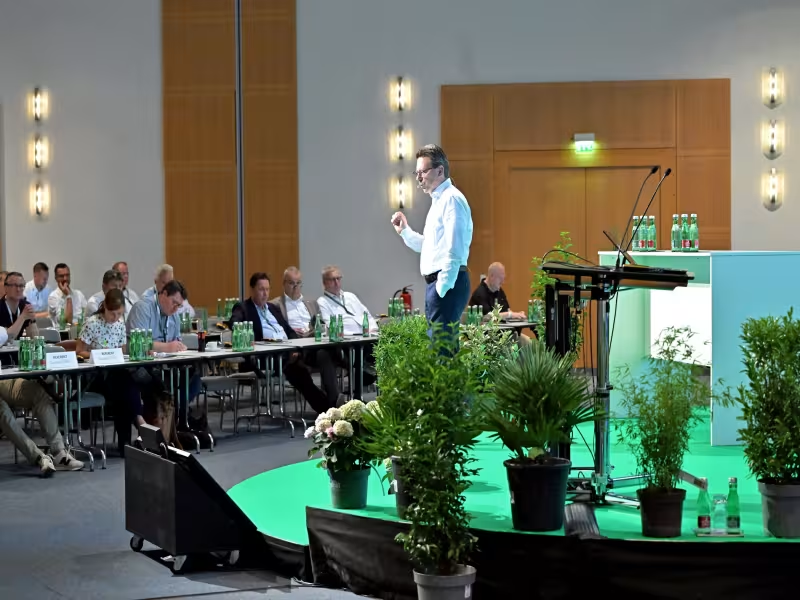
SHERIDAN, WYOMING -- June 24, 2026 -- The BHB GardenSummit convened for the eleventh time at the spoga+gafa trade fair in Cologne, bringing together senior executives and industry experts from across the garden retail and home improvement sector to assess market conditions and chart strategy for turbulent times. This year's event introduced a notable format change — shifting from the fair's final day to the second day — and closed with a joint garden party hosted by BHB and partner association IVG. The summit covered ground from hard sales data and consumer sentiment to brand management, staff development, and the documented mental health benefits of green space.
Garden Segment Enters 2026 With a -1.7% Revenue Decline Through May
Germany's garden category recorded sales of 1.79 billion euros in the first five months of 2026, down 1.7 percent against the same period a year earlier. DIY stores and garden centers still account for 55 percent of that volume, but they lost 3.2 percentage points of market share — ground that moved to food retailers and online channels. The picture for branded products is sharper still: value declined by 2.1 percent, while unit volume dropped 8.4 percent. That gap reveals a consumer base that is actively trading down on price.
Christiane Klietz and Alexander Theile from GfK/NiQ presented the data at the summit. Their key message was that the garden category — long considered a stable retail anchor — has become notably price-sensitive. Consumer confidence has settled at a persistently low level, and households are adjusting their spending accordingly. There is little in the near-term data to suggest a quick reversal.
Robotic Mowers and Gas Grills Lead the Exceptions
Not every subcategory moved against retailers. Robotic mowers posted growth of 18 percent, and gas grills rose 10 percent in the period reviewed. Both categories attracted strong consumer interest — though even here, average price points have been declining. Volume is growing; unit revenue is being compressed.
GfK/NiQ flagged a further trend that the summit audience was urged to act on. Refurbished goods are gaining real traction among younger shoppers, driven either by budget constraints or sustainability preference — or both. For retailers, the message was direct: this is a channel and a category that deserves active attention, not passive observation.
OBI Doubles Down on Garden as a Year-Round Strategic Anchor
Katrin Beyer, Vice President Division Garden at OBI, outlined how the DIY chain plans to develop its garden offering beyond the traditional seasonal push. OBI sells more than 46 million plants a year in Germany alone, and the company treats this not as a transactional category but as a relationship-building one. Garden gives OBI the opportunity to engage the same customer across all twelve months, not just spring.
Two elements are central to OBI's forward plan. The private label Grow by OBI is being positioned around a full-system approach — one supplier, one ecosystem, everything coordinated. Alongside that, an in-store garden planner integrates retail media, a companion app, and a redesigned floor layout with designated advisory zones where customers can try products and get guidance. OBI is also active in sustainability programs including a peat-phase-out initiative and the Too Good to Go food waste concept, which Beyer described as genuine commitments rather than marketing gestures.
Keynote Speaker Warns That spoga+gafa Needs Clearer Direction
Jochen Ludwig, COO of OBI and a member of the BHB board, delivered the opening keynote and did not soften his assessment of the sector's flagship trade fair. He described the event as trending downward — fewer exhibitors, repeated changes to hall configurations, and ongoing uncertainty over scheduling. The current plan places the next fair in September 2027, but Ludwig argued that constant date shifts damage trust and make planning harder for exhibitors and visitors alike.
He called on fair organizers to adopt the same principles that have made the BHB congress reliable: a fixed date, a fixed venue, and a concept that participants can count on year after year. At the same time, Ludwig addressed the broader industry, saying everyone in the sector shares responsibility for the fair's future. Spoga+gafa remains important as a forum for conversations, product discovery, and supplier meetings — but its relevance, he said, cannot be taken for granted.
Brand Strategist Cautions That Loyalty Erodes Faster Than Most Leaders Notice
Hans-Jürgen Herr, a former Vice President at Weber-Stephen who now advises early-stage companies, presented a session on brand maintenance under pressure. His central argument: success creates complacency. Brands that stop questioning their own assumptions tend not to notice market erosion until it is well underway. By then, recovery is slow and expensive.
He used Microsoft as a reference point — a company that pivoted deliberately away from a profitable legacy position rather than waiting to be displaced. Herr framed this as a deliberate structural practice he calls the Pit Stop: a scheduled, structured pause in which leadership examines competitive threats, tests long-held assumptions, and actively solicits critical input from staff and stakeholders. A Pit Stop is not a retrospective report, he said. It is a forward-looking exercise designed to surface problems before they become crises. He closed with a direct warning: if a company only responds to internal dissent when market share is already falling, it is years behind where it should be.
Research Links Green Space to Measurable Mental Health Outcomes
The summit closed on a dimension rarely addressed in garden retail forums. Prof. Dr. Mazda Adli, chief physician at the Fliedner Klinik and affiliated with the Charité Berlin, presented findings from his research on the relationship between urban environments and brain health. City living — characterized by social density, social isolation, and exposure to climate-related stressors — is associated not just with elevated stress, but with higher rates of serious mental health conditions and, in aggregate, earlier mortality.
His research demonstrated that access to green space generates measurable protective effects. Outcomes studied ranged from improved concentration in children to lower suicide rates in areas with higher green coverage. The garden's value, Adli argued, comes not only from looking at it but from actively shaping it. For an industry that tends to lead with seasonal product cycles, this framing offers a different kind of sales argument: one grounded in public health evidence.
A full program overview and membership information for BHB — Handelsverband Heimwerken, Bauen und Garten e.V. are available at BHB