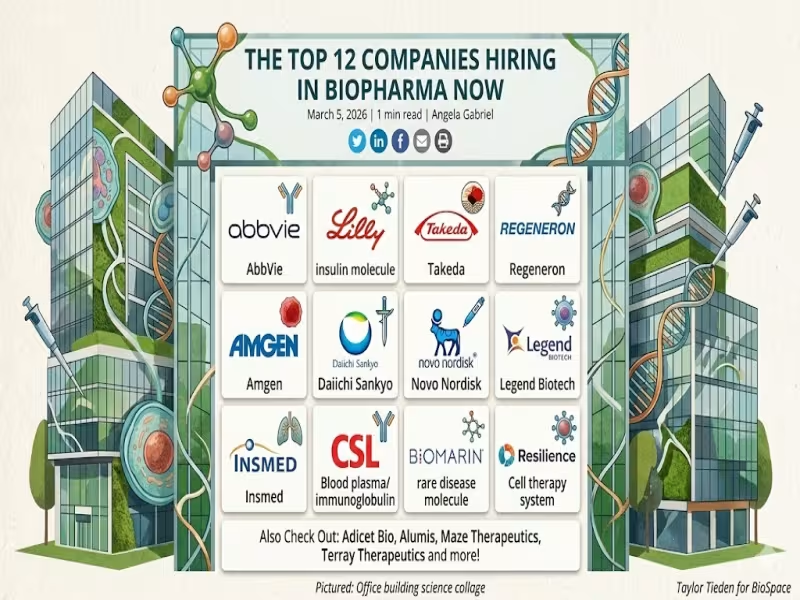
SHERIDAN, WYOMING - March 04, 2026 - Hiring signals in biopharma remain mixed but usable for employers and candidates: overall job-posting activity is described as lower year over year, yet slightly higher month over month, and a late-2025 survey cited in the source suggests a meaningful share of companies expect open roles to rise in 2026. For the market, the key message is not "boom or bust," but that recruiting is still happening-especially at scale players that must protect execution capacity across late-stage development, manufacturing, commercial operations, and enabling functions. For job seekers, this translates into real pharma and biotech opportunity concentrated in employers that are still running active pipelines.
What the hiring signal actually means for the sector
The source describes a job market that is still cautious on a year-over-year basis but showing a small month-over-month improvement. In practical terms, that usually indicates that leadership teams are not broadly expanding headcount everywhere, but they are still approving roles that directly protect delivery: clinical execution, manufacturing reliability, quality and compliance, and revenue-critical commercial work.
For operators, this kind of environment tends to produce two parallel realities:
- Companies become more selective about which roles they open, but they move faster on the roles they consider "must-fill."
- Hiring becomes more function-specific and program-specific, often tied to near-term milestones, launches, inspections, or scaling needs.
Where the opportunity concentrates: 12 employers with visible hiring momentum
The companies listed as hiring now are:
- AbbVie
- Eli Lilly
- Takeda
- Regeneron
- Amgen
- Daiichi Sankyo
- Novo Nordisk
- Legend Biotech
- Insmed
- CSL
- BioMarin
- Resilience
For candidates, the operational implication is straightforward: when multiple large employers are actively recruiting at the same time, there is usually a steady flow of open requisitions across core job families. For competitors, it can also mean heightened talent competition and retention pressure in specialized roles.
How to interpret "hiring now" without over-reading the list
A hiring list is a directional indicator, not a guarantee of easy offers. Posting volume can reflect expansion, backfills, or pipeline building. Still, it's useful because it highlights employers that are actively investing time and process bandwidth in recruiting.
In a cautious market, the companies that keep hiring typically do so for roles that protect operational throughput. That often correlates with:
- Late-stage program execution (trial operations, regulatory writing, medical affairs readiness)
- Manufacturing continuity (process engineering, supply planning, quality, validation)
- Commercial durability (market access, field effectiveness, lifecycle planning)
- Platform modernization (data, analytics, automation, and core IT execution)
Why large pharma and established biotechs keep hiring in softer cycles
Even when job markets cool, large pharma and mature biotechs rarely stop hiring completely, because they have ongoing commitments that cannot pause:
- Trials must keep running, and sites must stay supported.
- Manufacturing must remain reliable and inspection-ready.
- Commercial organizations must sustain demand and manage competition.
- Core functions must meet compliance obligations, documentation standards, and reporting cadence.
This is why "opportunity" in biopharma often persists even when overall volumes are down-hiring becomes more targeted, not nonexistent.
What this means for job seekers: how to position for real opportunity
In a market like this, candidates get better outcomes when they align with execution needs rather than only broad "innovation" themes. Practical positioning tends to work best when you can show evidence of:
- Delivering under regulated constraints (GxP, quality systems, documentation discipline)
- Working across interfaces (clinical-to-regulatory, CMC-to-quality, commercial-to-market access)
- Reducing operational risk (deviation reduction, cycle-time improvements, inspection readiness)
- Scaling work without chaos (repeatable processes, clear handoffs, measurable outcomes)
If you are early-career, the same principle applies: focus on roles that sit close to delivery. Hiring managers in cautious periods often prioritize "can this person help us execute safely and predictably?"
What this means for employers: recruiting strategy in 2026 conditions
If peers are actively hiring, competition will show up in speed and clarity. Companies that win talent in this environment usually do three things well:
- Define the role narrowly enough that screening is fast and consistent.
- Keep interview loops short and decision rights clear.
- Communicate the mission and the operating reality (what success looks like in 90-180 days).
This matters because strong candidates will often be in multiple processes at once when several major employers are hiring in parallel.
Bottom line: pharma and biotech opportunity is real, but execution-led
The list of hiring employers suggests the sector is still building and protecting capacity in key areas. The year-over-year softness implies selectivity, while the modest month-over-month improvement suggests recruiting engines are still running and may be stabilizing. For candidates, the most reliable opportunities are likely to be roles tied to delivery-clinical, quality, manufacturing, and commercialization-where organizations cannot afford operational gaps.