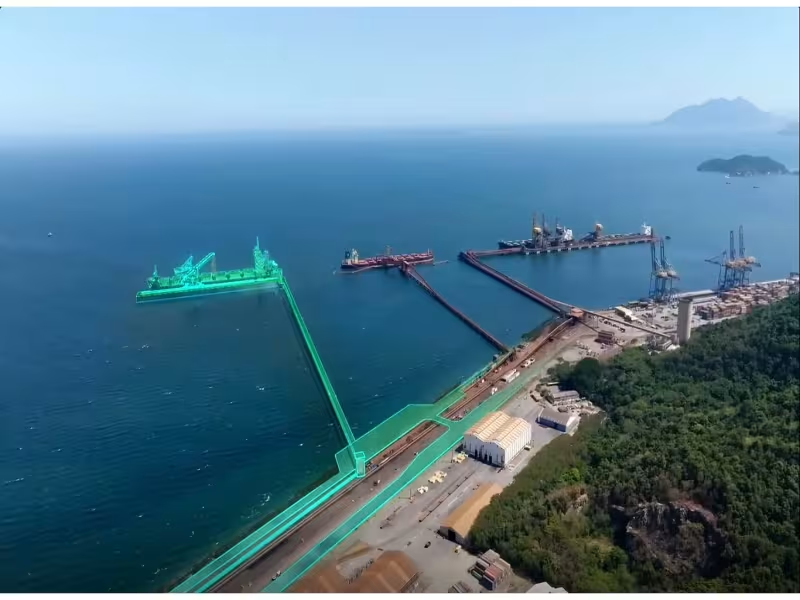
Belo Horizonte – October 15, 2026 -- Cedro Participações has cleared the main regulatory hurdle for Porto do Meio, a R$3.6 billion iron ore terminal planned at the Port of Itaguaí in Greater Rio de Janeiro. The State Environmental Control Commission (CECA) approved issuance of the Integrated Environmental License (LAI) on Tuesday, October 13.
The company describes the decision as the project's most significant milestone so far. It confirms the terminal's environmental feasibility and allows Cedro to move into the next project phases.
License covers initial handling volumes below 15 million tonnes per year
In this first phase, the license covers throughput of less than 15 million tonnes annually. Cedro won the federal auction for the ITG02 area in December 2024 and signed a 35-year lease, renewable for an equal period.
Terminal will sit between Vale and CSN facilities on a 250,000 sqm site
Porto do Meio takes its name from its location between the Vale and CSN terminals in Itaguaí. The site will cover roughly 250,000 square meters, including a stockyard and a berth for vessels needing water depths of up to 20 meters.
The terminal will connect to the MRS Logística rail network, which links the Iron Quadrangle in Minas Gerais to the Rio de Janeiro coast. Cedro says this creates a new iron ore transport corridor.
Three-year build is expected to employ about 3,000 workers at peak
Construction is scheduled to take three years. The scope covers civil engineering, dredging, supply and installation of port equipment, and electromechanical assembly. Peak construction should generate approximately 3,000 direct and indirect jobs.
Once operating, the terminal will directly employ 256 people. Cedro estimates it will generate R$1.2 billion in municipal tax revenue.
Open-access design targets mid-sized miners reliant on large groups' terminals
The terminal is designed for Cedro's own production but will also serve third parties. Mid-sized miners that now export through Itaguaí via terminals run by large groups or trading companies would gain direct access to international markets. Cedro cites fewer intermediaries, long-term contracts, greater predictability and competitive logistics costs, owing to proximity to the Iron Quadrangle and the rail link.
José Carlos Martins, Chairman of the Board of Directors of Cedro Participações, said the terminal is essential to the company's growth plan through the start of the next decade, "giving Cedro independence in iron ore exports."