Philips

Philips VeriSight Pro 3D ICE Brings Real-Time Imaging Inside the Heart to Advance Minimally Invasive Structural Procedures

Image
Philips VeriSight Pro 3D ICE Brings Real-Time Imaging Inside the Heart to Advance Minimally Invasive Structural Procedures

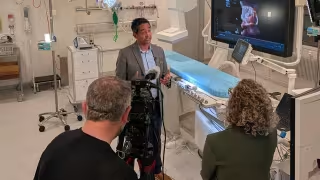
SHERIDAN, WYOMING -- June 9, 2026 -- Philips has put its VeriSight Pro 3D intracardiac echocardiography (ICE) technology in front of a wider audience through a feature on the BBC's technology program Tech Now, filmed during a live structural heart procedure in Copenhagen. The technology places a miniature ultrasound probe on the tip of a catheter, threading it through a vein into the heart to deliver real-time three-dimensional images of anatomy, valves, and treatment devices. For interventional teams, it offers an alternative to passing a larger probe down the patient's esophagus under general anaesthesia. The result is a more precise and less invasive route to treating structural heart disease.

Philips Future Health Index 2026 Finds AI Saving Clinicians 16 Working Days a Year as Training Gaps Persist

Image
Philips Future Health Index 2026 Finds AI Saving Clinicians 16 Working Days a Year as Training Gaps Persist

SHERIDAN, WYOMING -- June 9, 2026 -- Philips has released its Future Health Index 2026, the 11th edition of its annual global study, drawing on responses from more than 2,000 healthcare professionals and over 20,000 patients across 10 countries. The findings show that artificial intelligence already saves clinicians the equivalent of more than 16 working days each year and is helping many of them treat additional patients. At the same time, the report warns that inadequate training and fragmented IT infrastructure could leave some health systems behind. For hospital leaders and care providers, the results frame AI less as a future prospect and more as an operational tool already reshaping daily workloads.

Philips Launches SmartIQ to Reduce Radiation-Image Quality Trade-Off in Coronary Interventions

Image
Philips Launches SmartIQ to Reduce Radiation-Image Quality Trade-Off in Coronary Interventions

SHERIDAN, WYOMING - May 19, 2026 - Royal Philips has introduced SmartIQ, a new coronary imaging technology integrated into its Azurion image-guided therapy platform, designed to address a long-standing clinical challenge in interventional cardiology: balancing high image quality with reduced radiation exposure. The system was developed with cardiovascular centers and focuses on ultra-low dose imaging protocols that maintain diagnostic clarity while lowering X-ray exposure for patients and clinical staff. Philips is positioning the technology as part of a broader strategy to strengthen workflow consistency, evidence generation, and dose optimization in coronary procedures, with initial clinical validation already underway through published pilot studies and ongoing multicenter research programs.

Philips Expands AI-Guided Cardiology Workflow Strategy With Low-Dose Imaging Innovations at EuroPCR 2026

Image
Philips Expands AI-Guided Cardiology Workflow Strategy With Low-Dose Imaging Innovations at EuroPCR 2026

SHERIDAN, WYOMING - May 19, 2026 - Royal Philips is using EuroPCR 2026 in Paris to present an expanded portfolio of imaging, physiology and AI-enabled workflow technologies aimed at supporting increasingly complex percutaneous coronary intervention (PCI) and structural heart procedures. The company's latest developments focus on integrating imaging systems, physiological assessment tools and procedural guidance into a unified interventional cardiology workflow while also addressing radiation exposure concerns in catheterization laboratories. Philips is positioning the strategy around operational efficiency, procedural confidence and lower-dose imaging as healthcare providers manage rising procedural complexity and increased pressure on cath lab performance.

Clinical scope

Image

SHERIDAN, WYOMING - March 31, 2026 - European hospitals evaluating 2026 imaging, intervention, and workforce plans now have a new validation pathway for AI-assisted neurovascular and oncology procedures as the SHERPA consortium starts seven clinical studies focused on workflow automation, precision support, and staff-pressure reduction in minimally invasive care. The four-year project has a total budget of EUR 21.5 million, is coordinated by Philips, and is co-funded by the EU Innovative Health Initiative and industry partners. Its work targets minimally invasive treatment workflows for brain aneurysms, liver tumors, and lung biopsy settings where specialized expertise is limited and procedure complexity is high.