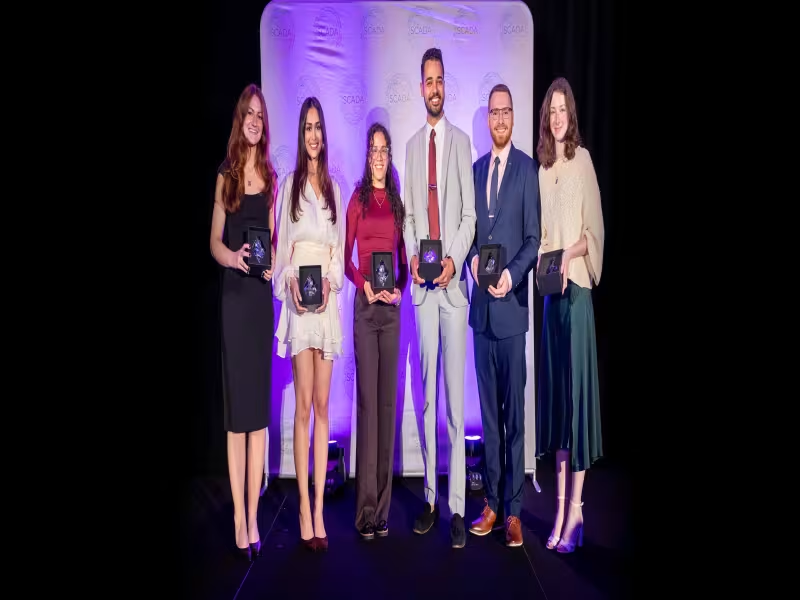
SHERIDAN, WYOMING - May 13, 2026 - Dentsply Sirona and the American Association for Dental, Oral, and Craniofacial Research (AADOCR) have announced the winners of the 2026 Student Competition for Advancing Dental Research and its Application (SCADA) Awards, recognizing pre-doctoral dental students for research excellence across clinical and basic science disciplines. The awards were presented during the 55th Annual Meeting of AADOCR, held in conjunction with the 104th General Session and Exhibition of the IADR and the 50th Annual Meeting of the Canadian Association for Dental Research, at the San Diego Convention Center from March 25 to 28, 2026. This year's competition drew 61 dental students from across the United States and seven international finalists from Canada, France, Thailand, Taiwan, South Korea, and Japan.
Competition Format and Participant Support
The SCADA program, which Dentsply Sirona has supported since 1959, is structured to expose pre-doctoral students to the professional environment of dental research at a major international congress. All participants in the 2026 competition received travel and accommodation support to attend the AADOCR Annual Meeting and were invited to present their research on March 26, 2026.
Winners were evaluated across three dimensions: the quality of their submitted abstract, the clarity and rigor of their oral presentation, and their performance during a question-and-answer session with a panel of judges. The competition is organized into two research categories - Clinical Research and Public Health, and Basic and Translational Science Research - reflecting the breadth of disciplines that define dental and oral health research today.
For dental schools and academic institutions, SCADA represents a structured pipeline initiative, connecting students to senior researchers, clinicians, and industry stakeholders at a formative stage of their professional development.
Clinical Research and Public Health Category Results
Three projects were recognized in the Clinical Research and Public Health category, each addressing applied challenges with direct implications for dental practice and patient outcomes.
- First place: Edson DeSousa, Harvard School of Dental Medicine - Metabolic Syndrome and Dyslipidemia May Influence Periodontal Treatment Outcomes
- Second place: Evan Heidenreich, Kansas City University - VR and Haptic Simulation in Teaching Dental Local Anesthetic Delivery
- Third place: Alyssa Saltz, University of Kentucky - Guideline Adherence to Dental Opioid Prescribing Recommendations in Kentucky
The range of topics - from systemic disease interaction with periodontal treatment to simulation-based clinical training and opioid prescribing compliance - reflects the increasingly interdisciplinary nature of clinical dental research. For dental educators and healthcare operators, the opioid prescribing and VR simulation projects in particular address operational and compliance questions that have direct relevance to clinical training program design.
"It was truly an incredible and inspiring week. Being surrounded by so many passionate clinician-researchers and having the opportunity to present was an honor, and the experience has left a lasting impact on me. I feel even more motivated and encouraged to keep pursuing clinical research and academic dentistry. SCADA was such a meaningful reminder of why I chose this path, and I'm very grateful to have been part of it."
Basic and Translational Science Research Category Results
The Basic and Translational Science Research category recognized three projects advancing molecular and microbiological understanding of oral and craniofacial conditions.
- First place: Elizabeth Leon, Nova Southeastern University - Porphyromonas gingivalis Vesicles Control Osteoclast-Macrophage Lineage Fate
- Second place: Fatemeh Ebrahimi, University of Texas School of Dentistry - Molecular Regulation of Facial Symmetry: Implications for Orofacial Cleft Pathogenesis
- Third place: Hannah Herzog, University of California, San Francisco - Gut Microbiome Ablation with Antibiotics Attenuates Genetic Heterotopic Ossification
The first-place project addresses the mechanism by which Porphyromonas gingivalis - a key periodontal pathogen - influences bone cell lineage decisions, a line of inquiry with implications for understanding and potentially disrupting periodontal bone loss. The second and third place projects examine craniofacial developmental biology and the systemic microbiome's role in bone formation, respectively, extending the scientific scope of the competition well beyond conventional clinical dentistry.
"I am extremely grateful to Dentsply Sirona and AADOCR for the opportunity to attend the conference, present our research and meet students, clinicians, and researchers from all over the country and beyond. It was such a fun time in San Diego and an encouraging experience to pursue careers as research clinicians and share our passion for learning and discovery."
Inaugural AADOCR SCADA/Dentsply Sirona Research Award Established
The 2026 meeting also marked the launch of a new recognition instrument: the inaugural AADOCR SCADA/Dentsply Sirona Research Award. The award was presented during the Opening Ceremony of the Congress to Dr. Jacqueline Mays, a mucosal immunologist and clinical trials dentist at the National Institute of Dental and Craniofacial Research (NIDCR).
Dr. Mays leads the Oral Immunobiology Unit within the Division of Intramural Research at NIDCR, holds the distinction of Lasker Clinical Research Scholar at the National Institutes of Health, and directs the NIDCR Dental Clinical Research Fellowship program. Her research focuses on chronic graft-versus-host disease affecting the salivary glands and oral mucosa - a clinically significant complication in transplant patients with limited treatment options.
The new award is designed to support early-stage dentist-scientists, including SCADA alumni, at the post-doctoral and pre-tenure faculty stages of their careers. The long-term objective is to increase the number of successfully funded dentist-scientists advancing through academic and research institutions in dental, oral, and craniofacial biology. Funding for the award comes from a donation by the SCADA Alumni Association with matching funds from AADOCR.
Institutional Significance for Dental Research Development
The SCADA program occupies a specific structural role in the dental research workforce pipeline. By providing pre-doctoral students with access to a major international congress, competitive peer review and professional networking, it addresses a recognized gap between dental school training and active research career entry.
"We are so proud to support aspiring dental researchers and dentist-scientists early in their careers and to have given them the opportunity to present their projects and build new connections. Scientific discovery in the field of oral healthcare is a noble pursuit and critical to improving dentistry and outcomes for patients in the future."
For dental schools, research institutions and industry partners evaluating engagement with the dental research pipeline, the SCADA program's combination of competitive recognition, professional development support and now a dedicated early-career award reflects an increasingly structured approach to research workforce development in dentistry. The awards ceremony on March 25, 2026, at the Hilton Bayfront Hotel drew approximately 160 guests, underscoring the program's standing within the professional community.