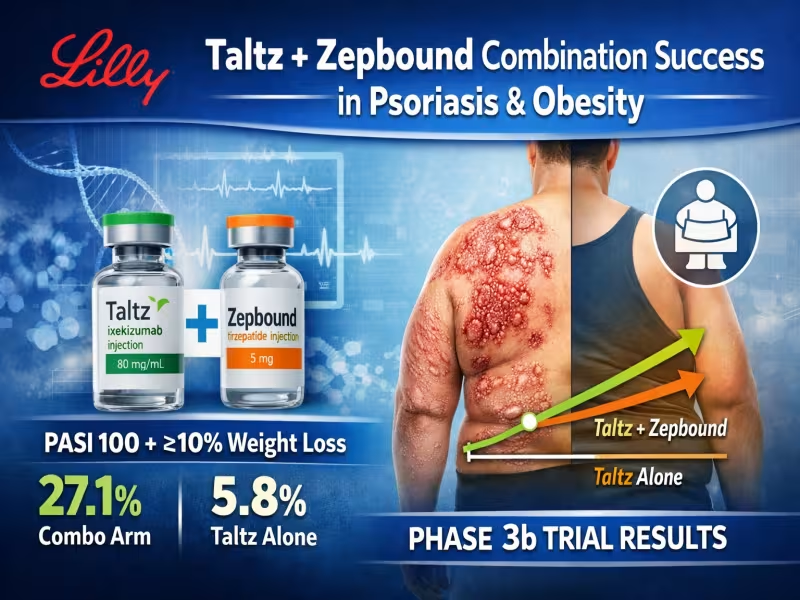
SHERIDAN, WYOMING - March 13, 2026 - Eli Lilly and Company has reported positive topline results from the Phase 3b TOGETHER-PsO trial, showing that concomitant use of Taltz and Zepbound outperformed Taltz monotherapy in adults with moderate-to-severe plaque psoriasis and obesity or overweight with at least one additional weight-related comorbid condition. At 36 weeks, the combination met the primary endpoint and all key secondary endpoints, linking deeper skin clearance with clinically meaningful weight reduction in a patient population with high disease burden. For clinicians, payers, and commercial stakeholders in immunology and obesity care, the readout is significant because it supports a more integrated treatment model for patients whose outcomes may be affected by both inflammatory disease and elevated body weight. It also extends Lilly's argument that obesity management may influence psoriasis outcomes in difficult-to-treat populations.
Combination therapy met the primary endpoint at 36 weeks
Lilly said 27.1% of participants receiving Taltz and Zepbound achieved both complete skin clearance, measured as PASI 100, and at least 10% weight loss at Week 36. By comparison, 5.8% of patients treated with Taltz alone reached that combined outcome. According to the company, the difference met the primary endpoint with statistical significance.
The result matters because the trial was designed around a dual-outcome framework rather than a psoriasis endpoint alone. That approach aligns with the profile of the enrolled population, where psoriasis and obesity or overweight were both clinically relevant. For the market, the study adds evidence around a combined treatment strategy in patients whose disease burden may not be well addressed by treating skin symptoms in isolation.
Key secondary endpoint strengthens the efficacy case
In a key secondary endpoint, Lilly said patients receiving Taltz plus Zepbound were 40% more likely to achieve PASI 100 than those on Taltz alone. The company reported PASI 100 rates of 40.6% in the concomitant treatment arm versus 29.0% in the Taltz monotherapy arm, with p<0.05. Lilly said the finding demonstrated that treatment of obesity or overweight with Zepbound reduced the burden of psoriasis.
That secondary endpoint is commercially important because it goes beyond weight reduction and speaks directly to skin outcomes. For prescribers and treatment planners, the readout suggests that obesity management may have practical implications for efficacy in psoriasis patients with elevated BMI. For Lilly, the data also support broader positioning around a more comprehensive treatment approach spanning immunology and obesity care.
Study population reflects a difficult-to-treat segment
Lilly emphasized that the trial enrolled a population with a high burden of disease that is often associated with poorer treatment outcomes. Across both treatment arms, the average BMI was reported as more than 39 kg/m2, which the company said was approximately 9-10 kg/m2 higher than any population studied to date in Phase 3 pivotal trials of a psoriasis biologic. The company also noted that most patients had extensive skin involvement, with about 25% of body surface area affected.
In addition, Lilly said 97% of participants had psoriasis affecting high-impact body areas such as the face, scalp, or genitals. That detail matters because these sites are linked to significant morbidity, itch, and skin pain, making treatment success more meaningful from both clinical and quality-of-life perspectives. From a market standpoint, strong results in a harder-to-treat population can carry greater strategic weight than efficacy in a less complex cohort.
Lilly is positioning Taltz within a broader treatment framework
Lilly said Taltz is now the only biologic with data supporting a comprehensive treatment approach alongside an incretin therapy for people with psoriasis or psoriatic arthritis who also have obesity or overweight. The company linked the TOGETHER-PsO readout to earlier positive topline data from the TOGETHER-PsA study, strengthening its effort to frame Taltz as part of a broader cross-therapy strategy. Zepbound, meanwhile, is described in the release as the only FDA-approved dual GIP and GLP-1 receptor agonist obesity management medication.
"Psoriasis and obesity can profoundly impact how people feel, how they are seen, and how they live," said Adrienne Brown, executive vice president and president, Lilly Immunology. "For people living at the intersection of these chronic inflammatory diseases, these PASI 100 results represent far more than a clinical milestone-they demonstrate what becomes possible when we address both simultaneously. Taltz has a decade of proven efficacy in psoriasis, and the superior outcomes achieved when Zepbound was used concomitantly for obesity signal a potential advance in treatment for patients who deserve nothing less."
From a portfolio perspective, the study gives Lilly a way to connect assets across therapeutic areas using one high-need patient segment. That has implications not only for clinical messaging but also for how the company frames value in specialty care, particularly when comorbid conditions may influence response rates.
Safety profile was generally consistent with known profiles
Lilly said adverse events in participants treated with concomitant Taltz and Zepbound were generally mild to moderate. The company also said the types of adverse events were generally consistent with the known safety profile of each medicine. In the combination arm, the most common adverse events occurring in at least 5% of participants were nausea, diarrhea, constipation, injection site reaction, dosing error, vomiting, and dizziness.
In the Taltz monotherapy arm, the most common adverse events occurring in at least 5% of participants were injection site reaction, dosing error, and nasopharyngitis. These details matter because combination strategies often face higher scrutiny on tolerability and treatment burden. For stakeholders evaluating the practical viability of concomitant use, consistency with known safety profiles is an important part of the commercial and regulatory narrative.
Next steps will determine how far the positioning can go
Lilly said detailed 36-week results from TOGETHER-PsO will be published in a peer-reviewed journal and discussed with regulators. That means the current announcement remains a topline data release rather than a full clinical dataset, and external interpretation will depend on the detailed publication and any subsequent regulatory engagement. Even so, the readout gives Lilly an early advantage in defining psoriasis with obesity or overweight as a treatment context that may warrant more coordinated therapeutic management.
"Psoriasis and obesity share underlying inflammatory pathways, yet they are too often treated in silos despite psoriasis treatment guidelines calling for obesity management," said Mark Lebwohl, M.D., Dean for Clinical Therapeutics, and Professor and Chairman Emeritus of the Department of Dermatology at the Icahn School of Medicine at Mount Sinai, and TOGETHER-PsO principal investigator. "This study involved patients with particularly high BMI and difficult-to-treat psoriasis, making the PASI 100 results with Taltz plus Zepbound especially remarkable. The findings show that treating psoriasis and obesity or overweight at the same time significantly improved outcomes, reinforcing psoriasis as an obesity-related condition and supporting a potential comprehensive approach to care."
For the immunology and obesity markets, the broader implication is that Lilly is not presenting these medicines only as separate category assets. It is also testing whether combined use can support a more expansive treatment proposition in patient groups where comorbidity is central to disease burden and treatment response.