Atlanta – September 28, 2026 -- The three-year widening of America's K-shaped economy paused in the second quarter of 2026, according to new data from Equifax, as top-tier consumers gained ground while the most financially strained households pulled back sharply.
Thrivers gain 3.2% while Strivers contract 4.2%, the sharpest drop since Q4 2023
The Equifax Market Pulse Index recorded a 3.2% quarterly increase among Thrivers (Index above 80), a 0.9% rise in the Middle segment (Index 50-79), which represents nearly 70% of the U.S. population, and a 4.2% contraction among Strivers (Index of 49 and below). "For the last three years, we have watched the gap between the top and the bottom of the 'K' widen, while the middle class shrank. In the second quarter of 2026, that pattern paused," said Emmaline Aliff, Advisory Leader at Equifax.
Assets, not income, separate 78% of Thrivers from 97% of Strivers
Nearly 78% of Thrivers hold more than $1 million in assets, classifying them as Affluent, while over 97% of Strivers are Mass Market with less than $100,000 in assets and none reach Affluent status. Within the Middle segment, 32.4% of all U.S. consumers qualify as Mass Affluent, holding $100,000 to $1 million in assets, with that group nearly evenly split between Mass Affluent (46.8%) and Mass Market (42.9%) households.
Every generation improved for the first time since Q3 2025
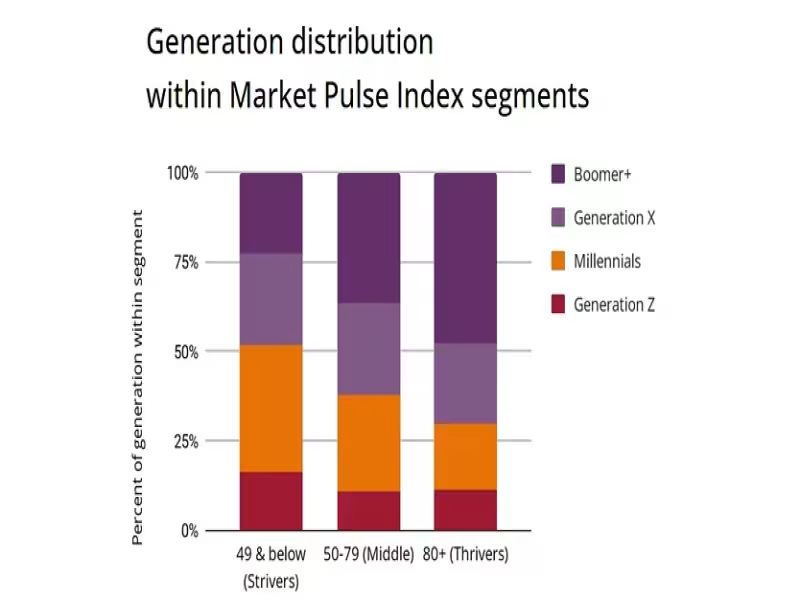
Millennials led with a 1.0% quarterly gain to an average Index of 58.7 and posted the largest drop in Striver share, down 1.4 points, though they still account for 35.7% of all Strivers. Generation Z rose 0.6% to 59.3 and recorded the largest Thriver gain of any generation at 0.7 points. Generation X increased 0.8% to 60.8, while Boomers+ remained the most stable group at an average Index of 64.5, comprising 36.6% of the Middle and 47.8% of Thrivers.
Consumer sentiment hits record low even as financial data improves
The University of Michigan Survey of Consumers fell to 49.5 in the second quarter, its lowest reading since tracking began, despite the Market Pulse Index rising and late debt payments improving from 2.1% to 1.9%.
Credit scores fail to distinguish financial capacity across segments
Prime borrowers (scores of 661-780) represent nearly identical shares across all three groups: 30.0% of Strivers, 30.7% of the Middle, and 23.9% of Thrivers. Meanwhile, 9.3% of Thrivers carry scores below 660, and 43.5% of Strivers hold prime or super-prime credit (781-850), with super-prime consumers making up 38.4% of the entire U.S. population. Income remains the defining constraint: 81% of Strivers earn under $65,000 annually, while nearly 88% of Thrivers earn more than $100,000.