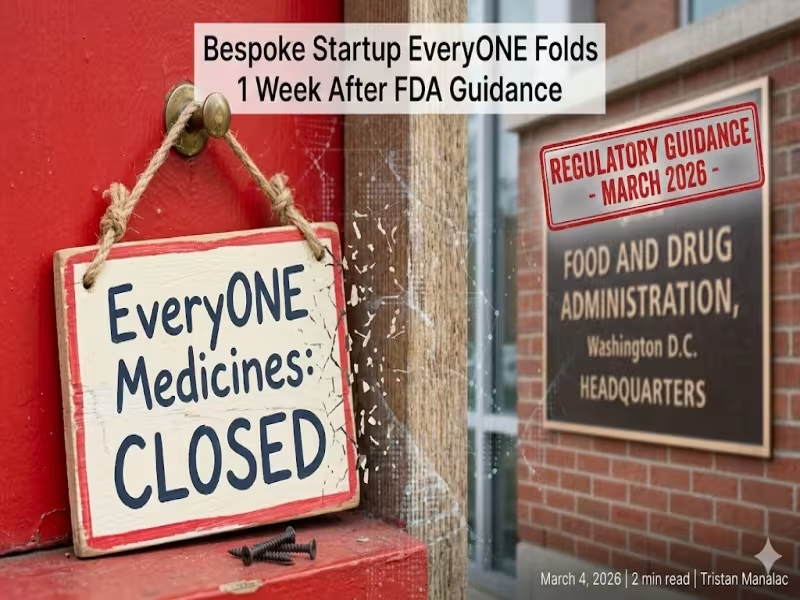
SHERIDAN, WYOMING - March 04, 2026 - EveryONE Medicines has decided to close, shortly after the FDA released draft guidance intended to help drugmakers advancing personalized genetic medicines under a bespoke framework. Reporting cited an anonymous source who said the pathway was insufficient and difficult to work with for commercializing treatments aimed at exceedingly small patient populations, while a U.S. Department of Health and Human Services spokesperson rejected the idea that the FDA framework caused the shutdown. For rare-disease operators and investors, the development spotlights a core execution constraint in individualized medicines: whether regulatory expectations can be met repeatedly and economically when each therapy is effectively a one-off product.
What the FDA draft guidance asks sponsors to demonstrate
The regulator's draft guidance is framed as an attempt to clarify an easier path to market for personalized genetic medicines. Under the recommendations described, the FDA expects companies to clearly explain the underlying biologic cause of a disease and to design the drug candidate to target that pathway.
The guidance also points to evidentiary approaches for demonstrating program efficacy, including the use of well-characterized natural history untreated controls and showing clear improvements in clinical outcomes. For teams building bespoke programs, that language matters because it signals where the agency expects rigor and comparability when conventional randomized trials may be impractical.
Where the friction point appears: product-by-product submissions
A key critique attributed to the anonymous source is the absence of a process-based approval model in the FDA framework. The operational concern is that each individualized medicine is treated as a discrete application, requiring a submission package built from the ground up each time.
For smaller companies, that structure can create compounding workload across regulatory, CMC, quality, and clinical documentation, especially if the goal is to serve very small populations with repeated, individualized builds. In practical terms, the burden can shift from scientific feasibility to repeatable compliance execution-how many "full dossiers" a lean organization can assemble and maintain.
Comparison point: U.K. process-level approvals and platform economics
The source contrasts the FDA approach with a pathway in the U.K. described as enabling "process-level approvals," supporting "platform-based technologies and individualized medicines." Under that approach, regulators can grant approval for drug testing and manufacturing processes, which can simplify later submissions for different medicines that rely on those same processes.
For individualized medicines, this distinction is not academic: approving the process can reduce repetitive validation work and allow scale through standardization. Treating each medicine as a fresh application, by contrast, can impose repeated end-to-end regulatory build costs that are difficult to amortize across ultra-small cohorts.
Company mission and founder context shaping the operating model
EveryONE Medicines is described as focusing on standardized, scalable pathways for individualized medicines, aiming to enable drug development for diseases affecting small patient populations. The company was launched in 2024 by CEO Julia Vitarello after her daughter died from Batten disease, which the source describes as a rare and fatal condition associated with neurological symptoms.
In operational terms, the company's stated focus implies a platform mindset: repeatable design, testing, and manufacturing approaches that can be reused across individualized therapies. The reported shutdown therefore lands as a test case for whether the current U.S. bespoke framework can support that platform ambition for small organizations.
"a significantly better place than we were even a year ago."
Government response: pushback on attributing causality to FDA policy
The report notes that an HHS spokesperson challenged the suggestion that the FDA individualized therapy framework triggered the closure. This matters for industry interpretation because it separates two questions: whether the framework is workable as written, and whether a specific company's outcome can be pinned on the framework alone.
Even with the pushback, the episode is likely to concentrate attention on the practical details that determine viability for individualized-medicine developers: how much can be standardized, what can be reused, and how often sponsors must rebuild regulatory packages from scratch.
"Any suggestion that FDA's individualized therapy framework caused a private company's shutdown is baseless and would be completely false reporting," Nixon told Endpoints.
Implications for operators building bespoke genetic medicine programs
Based on the information provided, the key execution pressure point is repeatability under regulatory expectations. If each individualized medicine requires a full submission package built anew, then commercial viability hinges on how efficiently sponsors can industrialize documentation, quality systems, testing, and manufacturing controls while still meeting evidentiary standards tied to biologic plausibility and clinical outcomes.
For larger organizations, the constraint may be capacity allocation and governance; for smaller companies, it is often survival economics. The broader signal is that "bespoke" pathways still need operational primitives-templates, standard modules, and re-usable process approvals-to make individualized medicines scalable rather than heroic one-offs.