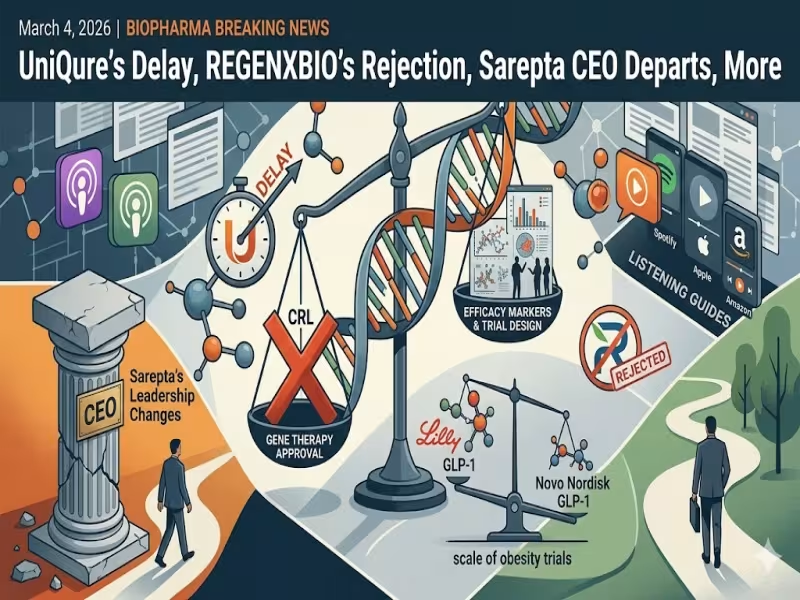
SHERIDAN, WYOMING - March 04, 2026 - A cluster of U.S. FDA-driven developments is reshaping near-term operating plans across gene therapy developers, with uniQure disclosing a new Phase 3 requirement, REGENXBIO facing a complete response letter for its Hunter syndrome program, and Sarepta Therapeutics managing a leadership change alongside conservative 2026 sales expectations for Elevidys. The same news cycle also includes broader questions from regulatory experts about how decisions are being made inside the agency, including scrutiny around CBER leadership. For clinical, regulatory, and finance teams, the immediate takeaway is execution risk: trial design expectations, control strategy, and evidentiary standards are moving targets that can directly change timelines and cost.
FDA decision signals: stricter Phase 3 expectations for uniQure
Days after FDA Commissioner Marty Makary appeared to question uniQure's gene therapy candidate for Huntington's disease, the company said the agency will require a randomized, double-blind, sham surgery-controlled Phase 3 study. Operationally, that requirement tightens the bar on study design and raises practical complexity around site readiness, patient recruitment, procedure logistics, and trial oversight.
For sponsors, the main implication is not just the label "Phase 3," but the control structure. A sham surgery-controlled design can require additional training, monitoring, and consistent execution across sites to avoid variability that complicates interpretation. It also can affect budget planning because more rigorous controls tend to increase per-patient costs and time-in-trial.
REGENXBIO CRL highlights evidentiary friction points
The FDA published another complete response letter for REGENXBIO's gene therapy for Hunter syndrome. The document cited issues tied to the study's population, controls, and the use of surrogate markers to measure efficacy. Even without adding assumptions beyond the source, those three areas map to common fault lines in rare-disease development: who is in the dataset, what comparator is acceptable, and whether endpoints are persuasive enough to support approval.
From a program operations perspective, a CRL does not only slow regulatory timing; it can force a rework of evidence strategy that cascades into manufacturing planning, patient engagement, and how sponsors sequence follow-on studies. It also tends to intensify internal governance, because teams must decide whether to adjust designs, add data, or reset the regulatory pathway.
Industry reaction: concerns about predictability and internal process
Regulatory experts cited in the source voiced concerns that the FDA's "circle of trust" is shrinking, making many decisions feel like:
"fiat"
The same section reports that the FDA has initiated a probe into complaints that a toxic workplace is fostered by CBER director Vinay Prasad, who is described as being at the heart of many of these decisions. In parallel, the biopharma industry continues reacting to an FDA pivot from two pivotal trials to one for approval, asking why now, what the risks are, and what exactly the agency expects from that one trial.
For operators, these points converge on predictability. When expectations around controls, endpoints, and "how much evidence is enough" shift, planning becomes harder-especially for small and mid-sized teams that have limited capacity to run iterative trial programs. The practical business question becomes: how do you design a dossier that stays acceptable even if internal interpretive standards tighten?
Sarepta leadership change and 2026 outlook for Elevidys
Sarepta Therapeutics CEO Doug Ingram stepped down last week to spend more time with family, according to the source. Separately, during Sarepta's fourth quarter earnings call, the company projected that sales of its Duchenne muscular dystrophy gene therapy Elevidys will be flat or down as far as 15% in 2026.
For commercial and finance leaders, a range that includes "flat" through "down" is typically a signal to manage for downside: tighter forecasting discipline, closer channel monitoring, and careful expense governance. For operational teams, it can also imply heightened attention to execution fundamentals-supply reliability, field effectiveness, and stakeholder communication-because market confidence is often sensitive when products are described as embattled.
Other pipeline and market signals: obesity trial results and BD pace
Outside gene therapy, the source notes that Eli Lilly topped Novo Nordisk again in a weight loss trial, this time in a Lilly-sponsored study of patients with type 2 diabetes. It also notes Novo is actively seeking new obesity assets and recently linked with Boston's Vivtex to advance novel weight loss pills.
While the source does not provide trial details beyond the headline outcome, the strategic implication for sector decision-makers is continued competitive pressure and deal activity in metabolic disease. For BD teams, the message is that asset scouting remains active even amid mixed markets, and competitive trial readouts can accelerate partnering urgency.
Broader business context: top-selling assets and new company formation
The roundup also flags BioPham Executive coverage of 2025's top-selling assets, stating that Merck's Keytruda remained number one. It further notes that former 2seventy exec Chip Baird took a new CEO role at recently launched Poplar Therapeutics, which secured a $45 million series A extension this week.
Taken together, these items reinforce a split-screen reality for the sector: regulatory volatility and evidentiary friction on one side, and ongoing capital formation and leadership movement on the other. For operators, the main execution lesson is to separate what can be controlled-trial operations quality, documentation rigor, manufacturing readiness-from what cannot, while keeping optionality in development plans.