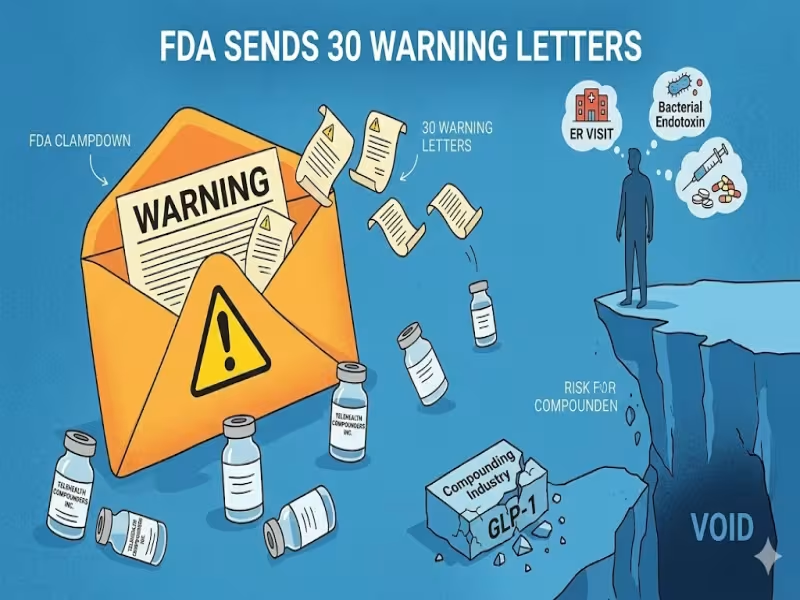
SHERIDAN, WYOMING - March 04, 2026 - The U.S. Food and Drug Administration has issued 30 warning letters to telehealth companies over compounded GLP-1 products promoted on their websites, extending an enforcement campaign that previously targeted larger players in the channel. FDA officials allege some companies made false or misleading claims, implied compounded products are the same as approved medicines, or obscured product sourcing by branding drugs with their own names or trademarks. The agency also flagged manufacturing and quality concerns at one compounder, GenoGenix, including conditions that could create contamination risk and reports of multiple emergency room visits tied to a compounded product.
FDA's latest action targets telehealth promotion practices
The FDA's warning-letter wave focuses on how compounded GLP-1 products are marketed and represented online. According to the source, agency officials accused companies of making false or misleading claims about compounded GLP-1 products and of implying their offerings are equivalent to FDA-approved medicines.
The regulator also found that some companies obscured sourcing by advertising drugs branded with their company name or trademark without qualification, which the FDA said could imply the telehealth company is the compounder. For compliance, legal, and commercial leaders, these allegations point to a clear operational risk: promotional language and labeling conventions that blur distinctions between compounded and approved products can trigger enforcement, even before questions of clinical performance arise.
Why compounded GLP-1s remain a pressure point
Compounding pharmacies became a major source of GLP-1 medicines when patients struggled to access or afford branded products from Novo Nordisk and Eli Lilly in the early stages of the launches. The source says the issue has persisted even as supply improved and prices came down, and it notes that Novo estimated 1 million people were taking a compounded GLP-1 medicine last year. Novo has repeatedly described the compounding channel as a barrier to growth and has raised doubts about the quality of compounded drugs, which are not reviewed premarket by the FDA.
For operators across manufacturers, payers, and telehealth platforms, this is not simply a demand issue. It is a system integrity issue: patient expectations, access economics, and regulatory boundaries are colliding in a category where product quality and sourcing transparency are central to trust.
GenoGenix case: repackaging allegations and non-eligible compounds
In one detailed example, the FDA accused GenoGenix of repackaging semaglutide, tirzepatide, and retatrutide. The source identifies semaglutide as the GLP-1 receptor agonist Novo sells as Ozempic and Wegovy, and tirzepatide as the GLP-1/GIP drug Lilly sells as Mounjaro and Zepbound. Retatrutide is described as a next-generation GLP-1 medicine in development at Lilly.
The FDA also reported that GenoGenix compounded medicines including 5-amino-1-methylquinolinium iodide (5-Amino-1MQ) and nicotinamide adenine dinucleotide (NAD+), which the agency said are ineligible for exemptions under section 503B. In compliance terms, that elevates the risk profile beyond marketing claims into questions of what products can be legally compounded under the cited framework.
Manufacturing observations and contamination risk framing
FDA inspectors found fault with manufacturing practices at GenoGenix's facility, including unsanitary conditions and operational practices that could compromise aseptic processing. The source describes inspectors observing failures to disinfect materials and personnel engaging in aseptic processing while exposing skin, plus facility design issues that could compromise cleanroom integrity. Inspectors also flagged violations related to establishing written procedures.
From a quality-systems standpoint, these points map to common breakdown categories that regulators treat as high-severity because they can directly undermine sterility assurance and batch reliability:
- Environmental and facility controls, including cleanroom integrity
- Aseptic technique execution, including personnel practices and material handling
- Written procedures and documentation discipline to ensure repeatability and accountability
The FDA said the conditions created the risk that the products "could be contaminated with filth or rendered injurious to health."
Patient safety signal: ER visits and endotoxin finding
The FDA documented three emergency room visits after patients took a product containing NAD+ compounded by GenoGenix. The patients experienced low blood pressure, uncontrollable shaking, shivers, and body aches, according to the source. The FDA also said an unopened vial from the same lot contained excessive bacterial endotoxins.
Operationally, this combination-a patient safety signal plus a corroborating quality finding-tends to intensify regulatory scrutiny and raises immediate expectations for corrective and preventive actions, including root-cause analysis, containment steps, and demonstrable improvements in facility and process controls.
Implications for telehealth operators, compounders, and brand manufacturers
The FDA's action signals that compounded GLP-1 enforcement is expanding from a small set of high-profile targets to a broader long tail of telehealth marketers. For telehealth operators, risk concentrates in claim substantiation, product representation, and sourcing transparency. For compounders, the GenoGenix example underlines that quality system maturity and facility controls are not optional when products are used at scale.
For brand manufacturers, the situation remains commercially material because the compounding channel can influence demand, patient behavior, and trust in the broader GLP-1 category. The enforcement posture described in the source suggests that regulatory activity will remain an operational variable that stakeholders must plan around, not a one-time event.