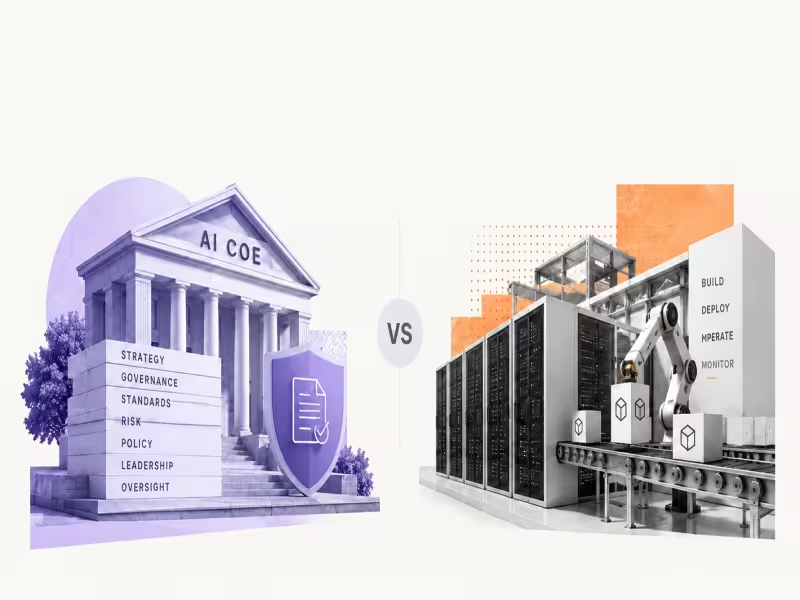
Global – October 29, 2026 -- Roughly 50% of generative AI proof-of-concept projects will be scrapped before reaching production, according to Gartner. Enterprises are responding with a two-function operating model that pairs an AI Center of Excellence (CoE) with an AI Factory.
Unclear ownership, not model quality, drives the failures
The causes are rarely the models themselves. Unclear ownership, inconsistent governance, fragmented data and the lack of a repeatable path from prototype to deployed system stall most projects, according to AppsTek, the IT services provider that published the framework guide.
The CoE sets rules while the AI Factory builds and runs systems
The AI CoE writes no software. It sets enterprise AI strategy, approves cloud platforms and vendors, defines data privacy and compliance standards, sets bias and transparency review criteria, runs upskilling programs and decides which projects get funded. It is staffed by a Chief AI Officer or equivalent sponsor, data governance and privacy leads, legal and compliance analysts, and business strategists and risk officers. Its success metrics are policy adoption rate, share of projects following approved standards, reduced unsanctioned "shadow AI" use and regulatory compliance scores.
The AI Factory takes approved use cases into production. It owns CI/CD pipelines, feature stores, model registries, containerized compute, and monitoring for model drift, data degradation and latency. Machine learning engineers, data scientists, MLOps and software engineers, and product managers staff it. It is measured on time to deployment, model uptime, inference latency, deployment frequency and return on investment.
Four-step loop connects governance to delivery
Neither function works alone, the guide argues. A CoE without a Factory produces policy documents but no shipped software. A Factory without a CoE ships quickly but accumulates compliance risk, technical debt and inconsistent standards.
The model runs as a loop: the CoE prioritizes opportunities by business value, risk and feasibility; the Factory builds on standardized architecture; the Factory deploys and tracks performance, cost, reliability and risk; and production data returns to the CoE to refine policy and investment decisions.
Rollout runs in four phases
Phase 1 audits data infrastructure, technical talent and security posture, and sets governance ground rules before any project starts. Phase 2 staffs the Factory and funds MLOps tooling, scalable cloud infrastructure, automated testing pipelines and model registries. Phase 3 runs the CoE and Factory in parallel across business units while building enterprise-wide digital literacy. Phase 4 tracks ROI, latency, deployment speed and uptime on the delivery side, and compliance rates and risk metrics on the governance side.
Smaller organizations can combine governance and delivery in fewer roles, the guide says, but approval criteria, standards and a repeatable build-and-deploy process still need a named owner.