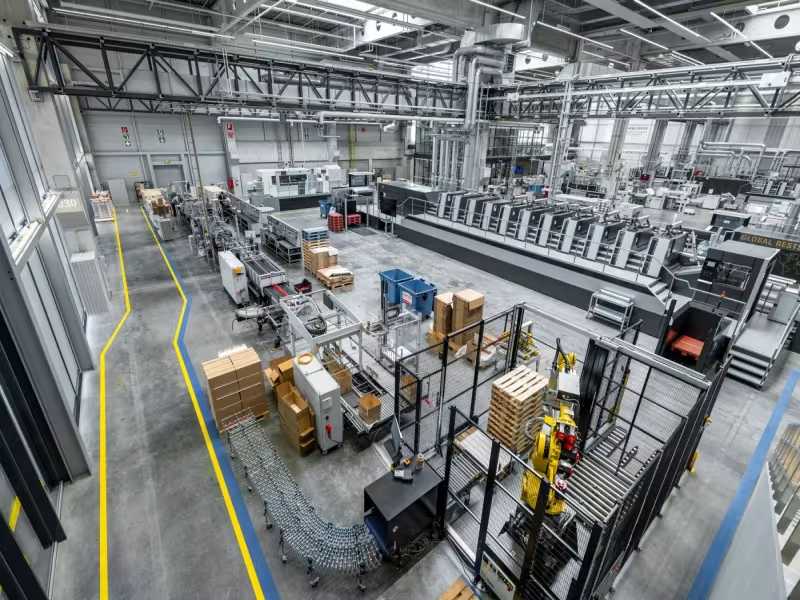
SHERIDAN, WYOMING -- June 18, 2026 -- Heidelberger Druckmaschinen AG (HEIDELBERG) has reported sales of €2,293 million for financial year 2025/2026, a slight increase on the prior year's €2,280 million, alongside a net result after taxes that tripled to €15 million from €5 million. The figures arrive as the company accelerates a strategic transformation beyond its printing machinery roots, consolidating its defense, energy, charging infrastructure, and industrial system activities under a new subsidiary, HD Advanced Technologies GmbH. The adjusted EBITDA margin came in at 6.6 percent — below the previous year's 7.1 percent — reflecting deliberate front-loaded investment in new business areas. For buyers and partners tracking HEIDELBERG's market position, the numbers confirm a company in active structural transition, not decline.
HD Advanced Technologies GmbH Becomes the Home for Dual-Use Expansion
HEIDELBERG has grouped its defense, security, energy, charging infrastructure, and industrial system solutions activities under a single entity: HD Advanced Technologies GmbH. The rationale is explicit — the company wants to apply its existing mechanical engineering precision to markets that are growing faster than commercial print. That expertise, built over more than 175 years, is the stated competitive asset being redeployed.
The approach is already producing structural outcomes. ONBERG, a joint venture formed with the US-Israeli technology company Ondas, is developing autonomous anti-drone defense and security systems. The plan assigns the Brandenburg site as the initial base for sales and distribution of these systems, with series production intended to follow. A further Memorandum of Understanding between ONBERG and a Ukrainian drone business, covering a potential partnership, is due to be announced at the ILA Berlin Air Show.
CEO Jürgen Otto is direct about the direction:
"We are one of the world's top companies when it comes to complex, high-precision mechanical engineering. With HD Advanced Technologies and our focus on dual-use technologies, we are leveraging this expertise and capacity to create additional, attractive areas of business alongside our core business in printing and packaging."
Core Print and Packaging Business Holds Steady
Print and packaging remain HEIDELBERG's largest revenue source. The company is expanding in two directions within that segment: digital printing, led by inkjet ramp-up, and systems integration across the full packaging production chain. The packaging side is particularly active. HEIDELBERG extended its strategic postpress packaging partnership with Chinese manufacturer Masterwork, moving the collaboration beyond its previous sales and distribution scope. The company also acquired the brand rights of Polar, adding to the portfolio without a disclosed acquisition price in the source material.
Geographic expansion continues in parallel. Latin America, Vietnam, and India are named as growth regions receiving focused attention. EMEA and Americas both recorded sales increases in financial year 2025/2026.
Chief Technology and Sales Officer Dr. David Schmedding frames the packaging opportunity in structural terms:
"The packaging market is a key growth engine for HEIDELBERG, because it is being driven by global trends such as population growth, urbanization, and the necessity for sustainable business practices. We are systematically extending our solutions to cover the entire manufacturing process in packaging production – from substrate selection, printing, postpress operations, and logistics all the way through to digital integration."
Production Relocated, New Site in North Macedonia Reduces Cost Base
HEIDELBERG has taken two significant steps on cost structure. Production of the Speedmaster CX104 has been fully relocated to China. A new manufacturing site has opened in North Macedonia, targeting lower future production costs for specific product groups. Both moves are part of a broader efficiency program the company says is performing ahead of plan at its German sites, with personnel cost adjustments playing a central role. These steps supported EBITDA improvement even as the overall margin came under pressure from external factors.
Margin Decline Driven by New Investment, Not Core Deterioration
The adjusted EBITDA margin of 6.6 percent — against 6.6 percent guidance and 7.1 percent the prior year — requires context. HEIDELBERG attributes the decline primarily to front-loaded investment in security and defense activities, negative exchange rate effects of around €20 million on EBITDA, tariff impacts, and a less favourable product mix. Geopolitical turbulence — specifically, the onset of war in the Middle East — brought a sudden drop in investment demand and caused supply bottlenecks and order delays.
Incoming orders for the full year totalled €2,246 million, down from €2,433 million in the prior year. Exchange rate effects accounted for approximately €71 million of that reduction. Q4 incoming orders of €619 million were the highest of the reporting year and exceeded the equivalent prior-year quarter — a detail the company points to as a signal of stabilising demand. Free cash flow came in at €-19 million against €51 million in the prior year, reflecting investment outflows. The equity ratio improved to 27 percent from 25 percent.
Outlook Calls for Stable Sales and Margin Recovery in 2026/2027
For financial year 2026/2027 — running April 1, 2026 to March 31, 2027 — HEIDELBERG forecasts Group sales at broadly the same level as the prior year and a noticeable improvement in the adjusted EBITDA margin. The forecast assumes no substantial changes in exchange rates relevant to business activities and continued global economic growth at least in line with current projections from economic research institutions. The HEIDELBERG Technology segment, which houses the dual-use and new-market activities, is expected to expand systematically in the coming year.
Investors and partners seeking further detail on HEIDELBERG's technology strategy, financial results, and portfolio development can access the full annual documentation at Heidelberg