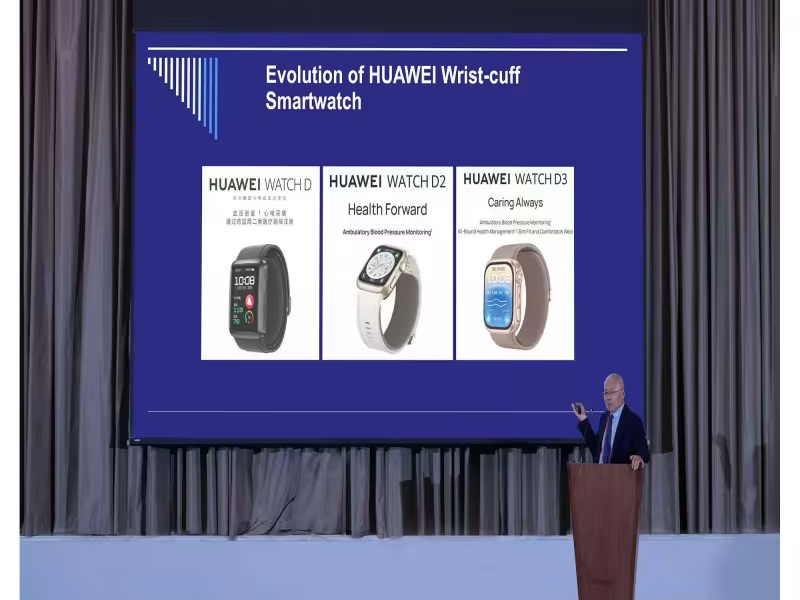
Dubai – October 29, 2026 -- Huawei's new HUAWEI WATCH D3 wrist-worn blood pressure monitor includes a pre- and post-exercise measurement mode that is the first of its kind in the industry to receive EU CE certification under the Medical Device Regulation (MDR) and Class II medical device registration in China. The company showcased the device at the 31st International Society of Hypertension Scientific Meeting and 17th Emirates Cardiac Society Annual Conference (ISH-ECS 2026), held in Dubai from 22 to 25 October.
Huawei and ISH select first three projects from more than 80 funding applications
Huawei, a member of the International Society of Hypertension (ISH), set up the Wearable Blood Pressure Technology Innovation Fund together with the society. The fund targets two areas: wearable blood pressure measurement and wearable blood pressure management.
The first three funded projects involve the University of Colombo in Sri Lanka, the University of Edinburgh and the University of Cambridge in the UK, and Peking University People's Hospital in China. They will study blood pressure management with HUAWEI WATCH D series devices.
Guidelines in Europe, Asia and China now address wrist-worn oscillometric monitors
Wrist-worn monitors that use inflatable cuffs and oscillometric measurement appear in several international documents. These include the European Society of Hypertension's consensus statement on wrist-watch type cuff devices, the 2026 ISH Global Hypertension Practice Guidelines and the HOPE Asia Network Asian Hypertension Guidelines. The publications recognise a potential role for validated devices in blood pressure self-monitoring.
China's 2024 hypertension guidelines included wrist-worn oscillometric monitoring for the first time. Separate Chinese expert recommendations endorse smart wearables validated against international standards for ambulatory blood pressure monitoring.
ISH President George Stergiou called the WATCH D3 a novel, reliable device that gives insight into blood pressure profiles and patterns. He said the ESH and ISH encourage clinical use of validated wrist-cuff monitors but called for more research on implementation in clinical practice.
Huawei study aims to cut ambulatory cuff readings from 27 to 7
The third-generation WATCH D3 uses ultra-narrow airbag oscillometric measurement. Huawei is running the Minimally Disruptive ABPM Study with Ruijin Hospital, affiliated with Shanghai Jiao Tong University School of Medicine, and plans to extend it to countries including Saudi Arabia and Malaysia through local research institutions.
The study combines all-day photoplethysmography (PPG) monitoring with airbag-based oscillometric readings for calibration. That approach would reduce required cuff measurements from 27 to 7. Users also receive 24-hour, daytime and night-time averages, plus charts of blood pressure changes through the day.
Professor Wang Jiguang, President of the Chinese Hypertension Association, said such innovations may inspire how blood pressure management becomes automated and "seamlessly embedded into daily life."
Dubai Health and Huawei test wearables for earlier diabetes risk detection
Professor Maryam Al Saeed of Mohammed Bin Rashid University of Medicine and Health Sciences said Dubai Health and Huawei are running a clinical research initiative. It evaluates non-invasive wearable technology for earlier detection of diabetes risk, using real-world health data.
Gong Yuansong, Vice President of Huawei's Smart Wearable and Sports Health Product Line (Solutions and Ecosystem), gave the keynote. He said users are shifting from treatment toward proactive monitoring and early prevention, and cited health glance, trends and readiness scores as tools for improving health span.