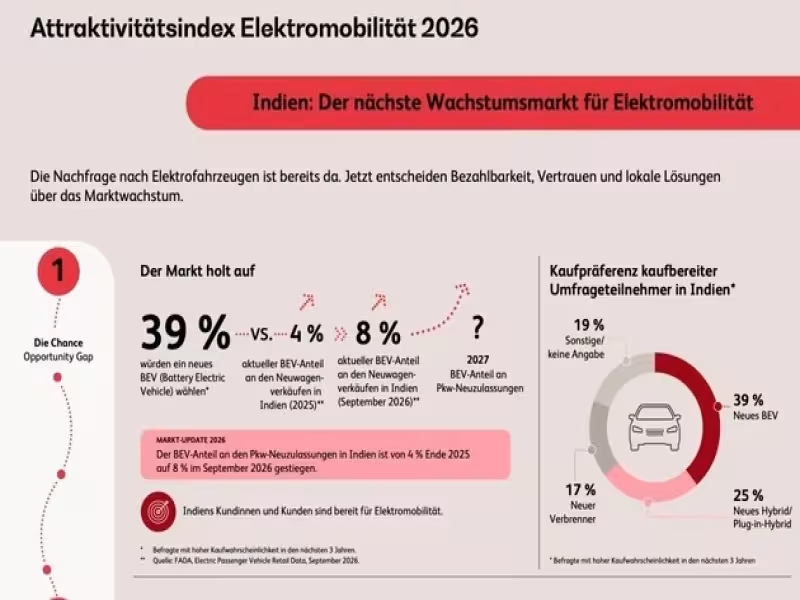
Frankfurt – November 03, 2026 -- Battery-electric vehicles took more than 8% of Indian passenger car registrations in September 2026, and BEV registrations nearly doubled from a year earlier, according to FADA data cited by consultancy BearingPoint. Tata Motors and Mahindra & Mahindra together captured about 63% of those BEV registrations, narrowing the window for European carmakers to build a position.
The share of electric vehicles in Indian new-car registrations stood at just 4% at the end of 2025, per FADA. It has climbed steadily through 2026 and is approaching the 10% mark.
Urban buyers favor BEVs 39% to 17% over combustion cars
BearingPoint's international e-mobility study shows a gap between purchase intent and market reality. Among urban respondents likely to buy a vehicle within three years, 39% prefer a new BEV and 25% a hybrid or plug-in hybrid. Only 17% want a new petrol or diesel car.
Manuel Schuler, global head of automotive at BearingPoint, said German and European manufacturers are focused on China and the US while India could become the next major growth engine. He warned that carmakers without a robust local position risk missing a decisive part of the growth phase.
Financing outranks cash purchases at 43% versus 34%
India is the only surveyed market where financing (43%) beats cash purchases (34%). Car subscriptions, at over 6%, reach the highest level of any country in the study. BearingPoint says monthly cost matters as much as sticker price, and recommends battery-as-a-service, separate financing for vehicle and battery, and battery-swapping systems.
Trust factors favor Tata and Mahindra over global brands
Indian buyers rank classic trust criteria above technology: vehicle safety (66%), warranty coverage (63%), battery repairability (62%), brand quality (61%) and maintenance and repair costs (61%). Digital features, technological lead and design carry far less weight.
Tata Motors and Mahindra & Mahindra also top the respondents' brand ranking. BearingPoint concludes that local trust, proximity and service ecosystems currently outweigh global brand recognition.
Used EVs rate "very attractive" for 27% of Indian respondents
That share is well above Germany, the US and the UK. Battery trust remains the hurdle: 44% say a certified battery health report would raise their likelihood of buying a used EV. BearingPoint points to battery certificates, warranties and professional used-car programs as emerging business models.
Local production and partnerships become entry requirements
Exporting EVs to India is not sufficient, BearingPoint argues. Local production capacity, regional partnerships and integration into emerging Indian value networks are gaining importance. Schuler compared the situation with the early growth years of China's EV market, where German and European makers profited from market access, scale effects and profitable joint ventures. Those partnerships also helped build an increasingly independent, globally competitive local auto ecosystem. Whether India follows the same path remains open, he said.
Survey covers about 10,000 respondents in five countries
The online survey ran between late January and late March 2026 in Germany, the UK, the US, China and India, and covered roughly 10,000 drivers and prospective buyers. The Indian sample has an urban focus, so results reflect urban consumers.