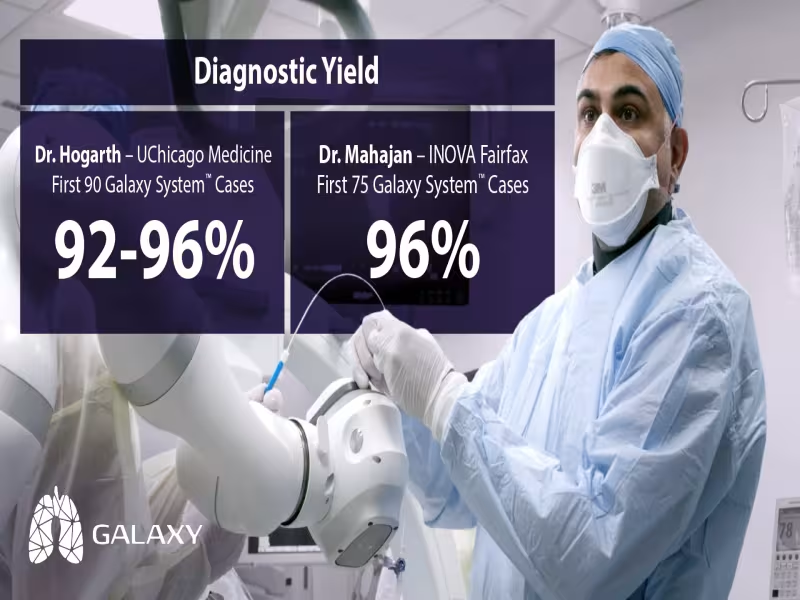
San Carlos – October 12, 2026 -- Noah Medical's Galaxy System achieved a diagnostic yield of 92-96% in one hospital's early field experience and 96% in another's, according to whitepapers covering 165 patient procedures and 190 lesions. The data comes from D. Kyle Hogarth, MD, of the University of Chicago Medical Center, and Amit Mahajan, MD, of Inova Fairfax Hospital.
Small, peripheral lesions dominate the Galaxy System caseload
Average lesion size ranged from 14mm to 16mm, and more than one-third of lesions were 10mm or smaller. Roughly 88% of lesions biopsied by Hogarth and 75% of those biopsied by Mahajan sat in the outer third of the lung or at the pleura.
Average procedure time did not exceed 46 minutes at either site.
University of Chicago was first U.S. user and cites imaging cost savings
Hogarth was the first U.S. user of the Galaxy System. He chose it for biopsying small peripheral lesions and for its integrated imaging, which gives real-time lesion updates using only a c-arm. He said the system's integrated tomosynthesis, branded TiLT Technology, corrects for CT-to-body divergence and confirms tool-in-lesion. In his comparison with first-generation robots, he noted that it does so without purchasing additional expensive imaging technology.
Inova's Mahajan links single-use bronchoscope to lower direct costs
Mahajan, Medical Director at Inova Interventional Pulmonology, said the platform is financially sustainable because its single-use bronchoscope minimizes direct costs while raising the cancer diagnosis rate. He also said better airway visualization and access can improve patient outcomes and economic and operational efficiency.
Platform combines tomosynthesis, disposable scope and compact footprint
The Galaxy System integrates proprietary tomosynthesis (TiLT+ Technology) with augmented fluoroscopy and a disposable single-use bronchoscope with always-on vision. Its compact footprint allows integration into most bronchoscopy suites.
Earlier results cited by the company include 100% successful navigation to lesion, 100% diagnostic yield and 95% tool-in-lesion accuracy in a preclinical trial. A human trial showed 100% tool-in-lesion accuracy and 90-95% diagnostic yield.
The whitepaper data was adjudicated by the physicians as accurate but has not been peer-reviewed.