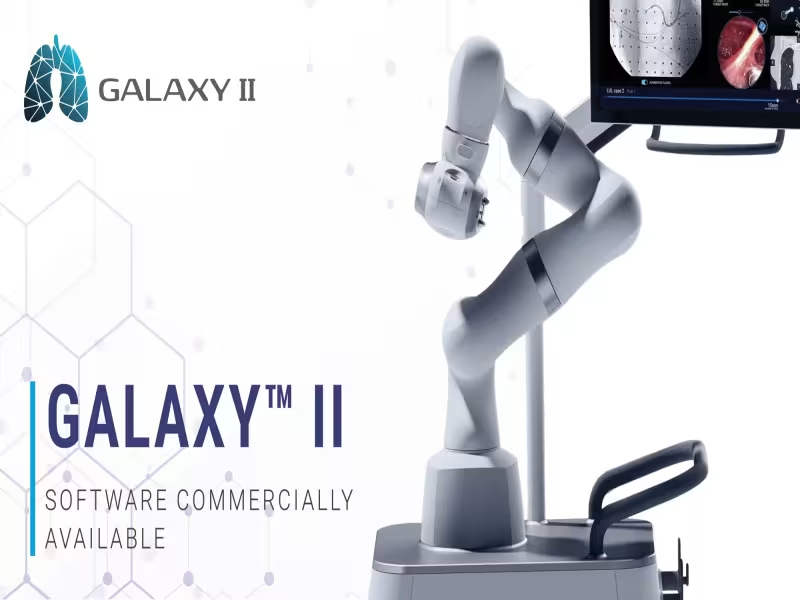
San Jose – October 12, 2026 -- Noah Medical has commercially launched Galaxy II software for its robotic-assisted bronchoscopy (RAB) platform, adding Dual-Mode Imaging that lets physicians switch between High-Definition Digital Tomosynthesis (HD-DT) and Cone-Beam CT (CBCT) at any point in a procedure. The company says the update requires no added capital, complexity, or radiation.
Dual-Mode Imaging gives physicians a choice between HD-DT and CBCT mid-procedure
HD-DT covers the vast majority of cases, and CBCT is available within the same platform when a case demands it. Based on published literature, HD-DT provides effective imaging for most cases at up to 10 times lower radiation dose than CBCT. Physicians can reserve CBCT for cases that need it, which limits radiation exposure for patients and staff.
Noah Medical paired the imaging options with Lesion Focus, a feature that minimizes disruptive imaging artifacts for a clearer view of the target lesion.
Software targets two persistent biopsy accuracy problems in small lung lesions
Noah Medical identifies two challenges in reaching and sampling small pulmonary lesions. CT-to-Body Divergence occurs when the preoperative CT no longer matches the patient's anatomy during the procedure. Tool-Tissue Divergence occurs when a biopsy tool drifts from its intended path even though the catheter is well positioned. Galaxy II addresses both by combining navigation, imaging, and real-time confirmation of the lesion and tool in one platform.
The update also delivers more responsive, predictable control, with improved reach, flexibility, and stability for navigating challenging anatomy. The company says the imaging choice reduces workflow complexity and case time.
Clinical data cited: 96.7% yield in MATCH II, 90% at Cleveland Clinic
Noah Medical points to results for the Galaxy System, the platform on which the new software runs. In the multicenter MATCH II study, real-time lesion localization supported a 96.7% diagnostic yield under ATS strict definitions. A separate evaluation of 100 consecutive patients at Cleveland Clinic reported a 90% diagnostic yield in routine clinical practice.
Founder and CEO Jian Zhang said the software lets physicians choose what each case requires, adapting to patient anatomy while reducing radiation exposure and maximizing procedural efficiency. Dr. Francisco Almeida, an interventional pulmonologist at City of Hope Cancer Center Atlanta, said the system's real-time correction for tool-tissue divergence drives its high diagnostic yield.
Noah Medical frames the launch around lung cancer, the leading cause of cancer death worldwide, where survival depends heavily on early diagnosis.