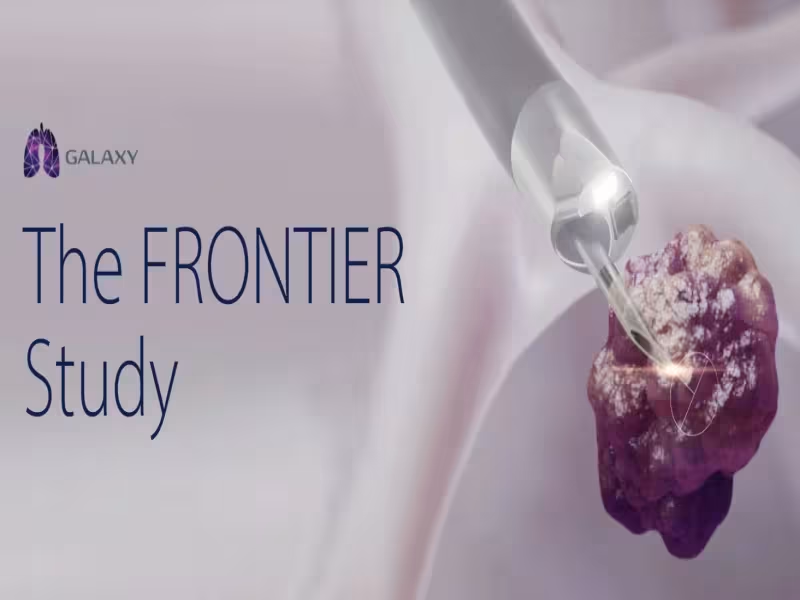
San Carlos – October 12, 2026 -- Noah Medical's Galaxy System robotic bronchoscopy platform achieved 100% tool-in-lesion accuracy and 100% successful navigation to small peripheral lesions in its first-in-human FRONTIER Study, according to final results published in the Official Journal of the Asian Pacific Society of Respirology.
FRONTIER Study reports diagnostic yield of 89.5% to 94.7%
The trial measured diagnostic yield at 89.5% under a strict definition and 94.7% under an intermediate definition. The results are attributed to the platform's TiLT+ Technology.
Interventional pulmonologists at Macquarie University Hospital in Sydney, Australia, conducted the study. It assessed whether the system could reach peripheral pulmonary nodules while maintaining patient safety during bronchoscopy and for up to seven days afterward.
Peer review follows preliminary data shown at AABIP 2023
Preliminary trial data were presented at the American Association of Bronchology and Interventional Pulmonology annual conference (AABIP 2023) in Chicago. Tajalli Saghaie, M.D., co-principal investigator of the study, said the final results reinforce earlier findings on navigating to and biopsying small peripheral lung nodules. He added that physicians worldwide have reported similar results since the system's rollout last year.
Noah Medical cites over 1,000 US procedures and new CT-to-body divergence data
Noah Medical has also shared initial hospital-led findings from more than 1,000 successful procedures in health systems across the United States. Last month, the company released field data on Galaxy's integrated imaging and its ability to overcome CT-to-body divergence in navigated bronchoscopy.
CEO Jian Zhang said the company has worked for years with leading pulmonologists on the challenges of diagnosing lung cancer with existing technologies.
Platform combines TiLT, StrikePoint and single-use bronchoscope
TiLT Technology delivers real-time lesion updates to address CT-to-body divergence and image discrepancies as the body moves, a problem that can leave physicians without a definitive tissue biopsy. StrikePoint technology provides precise distance to target using the c-arm systems already available in hospitals.
The system uses a single-use bronchoscope. Noah Medical states it has the smallest footprint of any commercial lung navigation robotic platform, which it says allows more efficient procedures with reduced risk of contamination and patient infection.