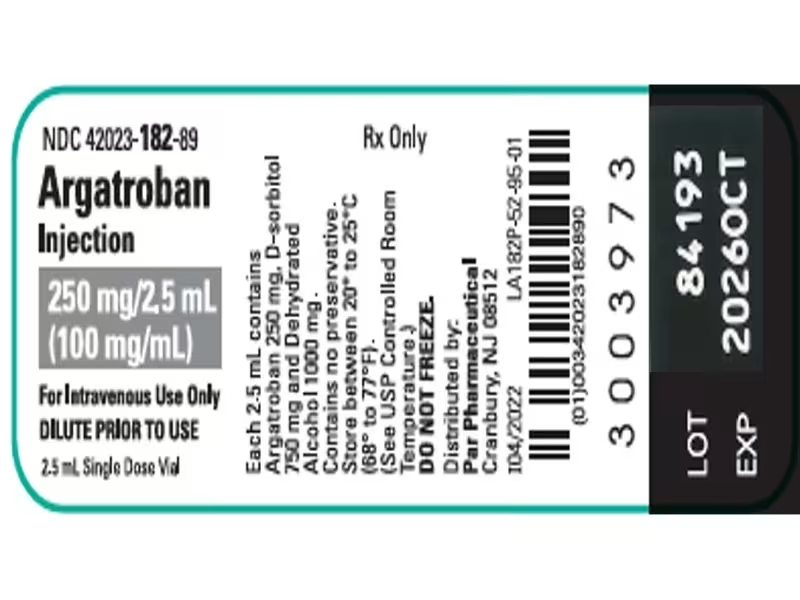
Rochester, Mich. – October 13, 2026 -- Par Health is recalling 22 lots of Argatroban Injection 250 mg/2.5 mL (100 mg/mL) to the hospital/user level after detecting particulate matter in certain lots.
Particulates include cellulose, plastics and stopper material
The company identified the contaminants as cellulose, polystyrene, polyethylene terephthalate, stopper material, and possibly stainless steel. Par Health states that administering product containing particulate matter has a reasonable probability of causing life-threatening adverse health consequences.
The listed risks are pulmonary emboli, occlusions of other blood vessels that can lead to tissue death and possible organ damage, and inflammation of vein walls that may lead to clotting. To date, Par Health has received no reports of adverse events related to the recall.
Lots shipped nationwide over a 16-month window
The affected lots were distributed nationwide to wholesalers and hospitals between December 30, 2024, and May 5, 2026. Par Health Parent entities Par Pharmaceutical, Inc. and Endo USA, Inc. are predecessor companies to Par Health USA, LLC, the current distributor of the product.
Argatroban is a direct thrombin inhibitor indicated for prophylaxis or treatment of thrombosis in adult patients with heparin-induced thrombocytopenia (HIT). It is also indicated as an anticoagulant in adult patients with or at risk for HIT undergoing percutaneous coronary intervention.
Par Health uses Inmar to retrieve all existing inventory
Par Health is sending written notification to wholesale and hospital accounts that received the affected lots and is arranging returns of all existing inventory through Inmar, Inc. Wholesalers and hospital pharmacies holding the product must immediately discontinue use and stop distribution. Accounts that further distributed the product must notify their own customers or other locations that may have received it.
Inmar handles recall questions at 1-855-648-7909, Monday through Friday, 9 a.m. to 5 p.m. ET. The recall is being conducted with the knowledge of the U.S. Food and Drug Administration, and adverse reactions or quality problems may be reported to the agency's MedWatch program.