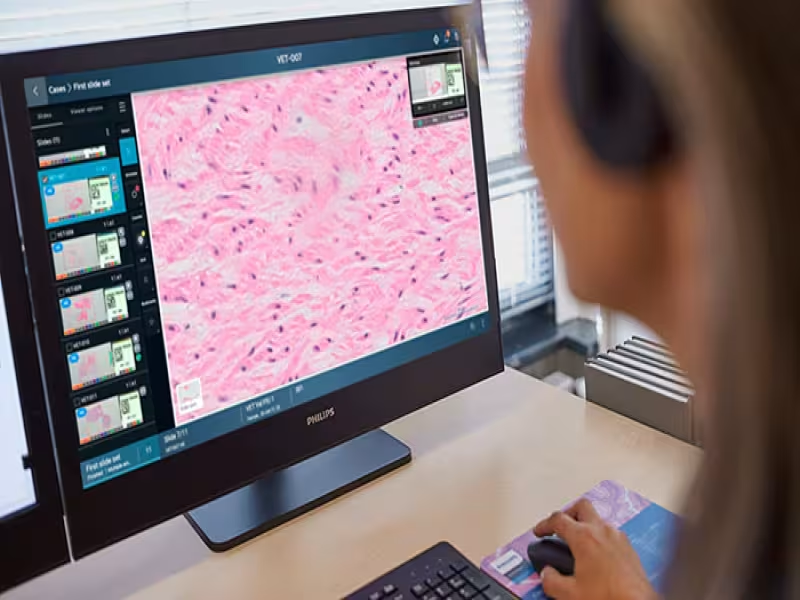
SHERIDAN, WYOMING - April 01, 2026 - Pathology laboratories operating hybrid analog-digital environments face mounting pressure to eliminate on-premise infrastructure bottlenecks as image volumes grow and AI-enabled diagnostics move closer to routine clinical use. Philips' expansion of its digital pathology portfolio with the cloud-enabled Philips IntelliSite Pathology Solution (PIPS) on HealthSuite, powered by Amazon Web Services (AWS), directly addresses this operational gap by removing the requirement for local server infrastructure while enabling secure, remote access to high-resolution whole-slide images across distributed care sites.
Platform architecture and capabilities
PIPS on HealthSuite is designed to securely store, manage, and support analysis of large volumes of high-resolution pathology images. Pathologists can access, review, and collaborate on cases from virtually any location, eliminating the geographic constraints that have historically slowed multi-site adoption. The platform simplifies IT management by shifting infrastructure responsibility to AWS, which was named 2026 Best in KLAS for Public Cloud Infrastructure, and reduces the operational overhead that has prevented many pathology departments from advancing beyond pilot-stage digital deployments.
The solution also supports enterprise integration and AI-enabled applications across health systems. Initial AI interoperability is available with Ibex AI, though this capability remains a work in progress and is not yet available in the United States or other jurisdictions. Ibex AI functions as Research Use Only in the US market. The platform is architected to operate independently or connect across diagnostic domains within the broader Philips HealthSuite Integrated Diagnostics portfolio, which also includes Image Management on HealthSuite with Web Diagnostic Viewer, Cardiovascular Workspace on HealthSuite, and advanced visualization and AI management tools spanning radiology, cardiology, and pathology.
Clinical validation and installed base
Mount Sinai Health System, an early adopter of digital pathology, offers a reference point for the scalability challenge the cloud platform is designed to solve. Dr. Cordon-Cardo, Chair of the Department of Pathology, Molecular and Cell-Based Medicine at Mount Sinai, noted that as programs mature, the ability to scale efficiently across sites and manage growing data volumes becomes central - a problem that on-premise deployments cannot address cost-effectively at enterprise scale. The cloud-enabled model reduces infrastructure dependency while delivering the flexibility and performance required for multi-site collaboration and AI integration.
Philips has built one of the largest installed bases in digital pathology globally, with thousands of users and a growing number of clinical sites operating fully digital workflows. The portfolio underpinning PIPS on HealthSuite includes FDA-cleared whole-slide scanners, an image management system, archive services, and implementation and support services. In January 2026, Frost & Sullivan recognized Philips with the 2025 Global Enabling Technology Leadership Award in Digital Pathology, reflecting the company's established position in the segment.
Market context and adoption barriers
The Signify Research Digital Pathology - World 2025 report identifies a persistent gap: many pathology departments have not yet adopted digital pathology for routine clinical diagnosis and continue to rely on hybrid environments where optical microscopes remain the primary diagnostic tool. Workforce shortages, rising image volumes, and the need for structured data foundations that support AI interoperability are converging to accelerate the shift toward fully digital workflows. Cloud deployment directly lowers the infrastructure investment threshold that has stalled adoption at smaller and mid-tier laboratory sites.
Philips presented the expanded portfolio at HIMSS 2026 in Las Vegas (March 9-12) and at USCAP 2026 in San Antonio (March 21-26), targeting both health IT decision-makers and pathology clinical leadership simultaneously. PIPS on HealthSuite is currently not available in the United States or any other jurisdiction, and future availability cannot be guaranteed, which affects near-term procurement timelines for US-based health systems.
Business impact
Pathology laboratory directors and health system IT procurement leads evaluating digital pathology vendor platforms in 2026 must now account for cloud-native deployment as a baseline expectation rather than an optional add-on. PIPS on HealthSuite shifts the total cost of ownership calculation by removing on-premise server procurement, maintenance contracts, and local IT staffing from the infrastructure equation. For multi-site health systems, this changes vendor selection criteria: scalability across sites and remote access performance become primary evaluation metrics, replacing local throughput benchmarks.
AI integration roadmap managers at health systems currently running hybrid pathology environments face a concrete decision point: AI-enabled diagnostic tools, including early Ibex AI integration with PIPS, require a cloud-ready image management foundation. Health systems that delay cloud migration risk being unable to onboard AI diagnostics modules on vendor timelines. Diagnostic informatics teams should also note that the HealthSuite Integrated Diagnostics portfolio's cross-domain architecture - spanning radiology, cardiology, and pathology - positions Philips as a potential single-vendor consolidation option, which simplifies contract structures but concentrates vendor dependency risk.