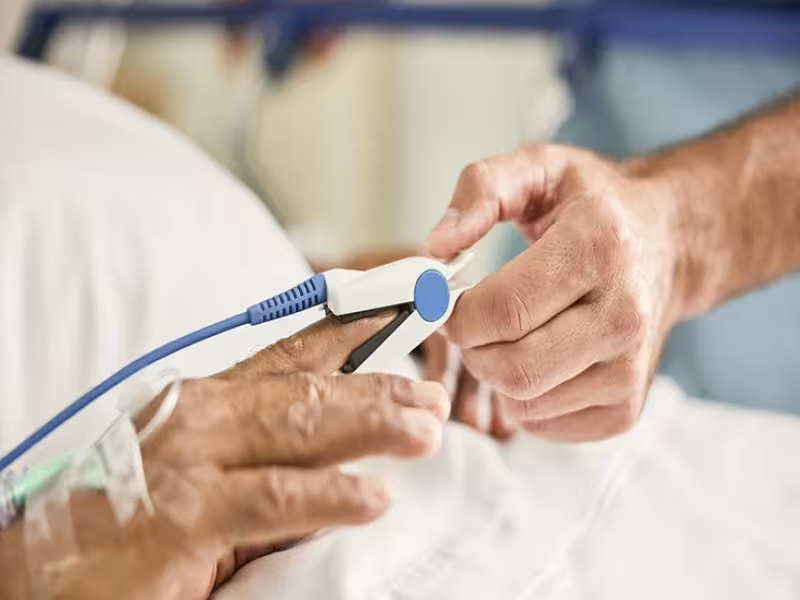
SHERIDAN, WYOMING -- July 22, 2026 -- Royal Philips has received FDA 510(k) clearance for its next-generation reusable SpO₂ clip sensor, a pulse oximetry device built around internal optical refinements that improve signal quality. In desaturation testing, the sensor posted an accuracy result nearly twice as tight as the level recommended by ISO and recognized by the FDA. It also held accuracy within half a percentage point between light and dark skin pigmentation groups tested. The clearance extends Philips' broader pulse oximetry portfolio and follows a validation program built specifically around performance across diverse patient populations.
Optical Refinements Target a Known Weak Point in Pulse Oximetry
Pulse oximetry is one of the most widely used monitoring tools in healthcare, but signal quality can shift depending on physiological, clinical, and technical factors. That variability is the exact problem Philips built the new sensor to address.
The refined internal optics are aimed at improving signal quality and measurement consistency across a broad range of patients and clinical conditions, not just a narrow subset. Philips describes the sensor as reinforcing its existing commitment to trusted oxygen saturation readings rather than introducing an entirely new measurement approach.
Desaturation Testing Produced a Tighter Accuracy Margin
The clearance rests on hard numbers. In desaturation studies, the reusable clip sensor achieved an Accuracy Root Mean Square value of 1.6%. That compares with the 3% ARMS threshold recommended by ISO and recognized by the FDA — roughly half the deviation allowed under the standard.
Accuracy also held steady across skin tone groups. Between light and dark skin pigmentation groups evaluated within an SaO₂ range of 85–100%, accuracy varied by less than 0.5%. That figure matters given ongoing scrutiny of pulse oximetry performance across different skin tones industry-wide.
Validation Program Extends Beyond a Single Device
Philips frames this clearance as one output of a standing validation program rather than a one-off test. The program evaluates sensor performance across varying skin tones and a broad range of physiological and clinical conditions.
That validation approach is built to track evolving FDA recommendations alongside international standards set by the International Organization for Standardization and the International Electrotechnical Commission. Philips states its SpO₂ sensor portfolio consistently meets applicable regulatory performance expectations, positioning this clearance as confirmation of an existing standard rather than an exception.
"Providing clinicians with reliable data to deliver better care to more people is at the heart of everything we do."
Sachin Chaudhari, Category Leader for Clinical Measurements and Specialty Monitoring at Philips, tied the clearance to a longer-term investment plan.
"This FDA clearance reflects our ongoing investment in advancing sensor technology and rigorous validation practices, and we'll continue applying these innovations across our pulse oximetry portfolio so clinicians can make care decisions with even greater confidence."
Philips Positions the Work as Ongoing, Not Finished
Philips says it will keep working with clinicians, researchers, regulators, and standards organizations to strengthen the underlying science behind pulse oximetry. That framing extends past this single sensor toward the evolution of validation practices industry-wide.
Continued investment in research and clinical evidence is what Philips points to as the mechanism for extending consistent performance across diverse skin tones and patient physiological conditions — the same two variables the desaturation study results were built to address.
Rollout Comes Later This Year, Availability Limited at Launch
The FDA-cleared reusable SpO₂ clip sensor will become available in select markets globally later this year. Philips has not specified a full market list or launch date beyond that window.
Buyers evaluating pulse oximetry purchases in the near term should treat this as a forthcoming addition to Philips' existing sensor lineup rather than a product available for immediate ordering everywhere.