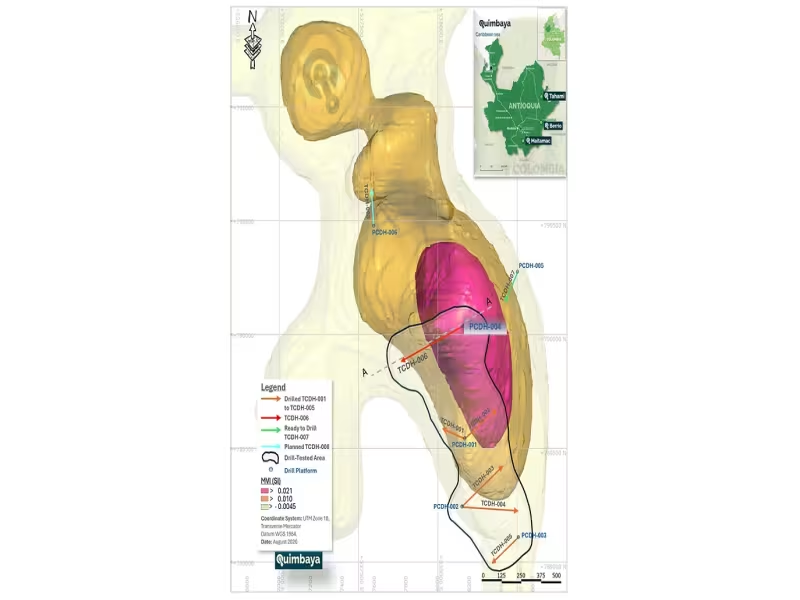
Vancouver – September 12, 2026 -- Quimbaya Gold Inc. (CSE: QIM) (OTCQX: QIMGF) (FSE: K05) reported that all six drill holes completed at its Tahami Center target in Segovia, Antioquia, Colombia intersected a copper-molybdenum porphyry system, with assay results still pending.
The six holes total 2,927.9 meters of a planned 5,000-meter program, drilled from four platforms between May 21 and August 17, 2026.
Hole TCDH-006 shows 563 meters of potassic alteration including 150 meters of principal intramineral porphyry
TCDH-006, the deepest hole at 658.85 meters, intersected potassium feldspar, secondary biotite and magnetite alteration from 96 meters to the bottom of the hole. Within that zone, a 150-meter interval from 294 to 444.40 meters was logged as fine-grained granodiorite porphyry carrying chalcopyrite, molybdenite and pyrite in quartz and biotite-bearing veinlets. Veinlet densities of 50 to 60 per linear meter of core were recorded, though the company stresses all mineral identifications are visual and no grades are yet available.
Five of six holes intersected intramineral porphyry and breccia with variable sulfide content
TCDH-001 ended at 294.30 meters in intramineral porphyry after encountering chalcopyrite and bornite mineralization at 278 meters, terminated early due to poor ground conditions. TCDH-002 and TCDH-003 reached 429.05 meters and 602.25 meters respectively, intersecting hydrothermal breccias and quartz veinlet stockwork with variable chalcopyrite and molybdenite. TCDH-004 reached 552.40 meters with disseminated chalcopyrite and pyrite in chilled-texture porphyry. TCDH-005, at 391.05 meters, intersected crowded-texture intermineral porphyry with high-temperature veinlets carrying chalcopyrite and molybdenite, though mineralization was visually estimated as marginal.
Next hole targets a northwest-southeast trend defined by the six-hole program
TCDH-007 has been collared roughly 410 meters northeast of TCDH-006 on the same mineralized trend and will be drilled to a planned depth of 300 meters. The target system spans approximately 3.1 by 1.3 kilometers, as defined by surface mapping, soil and rock geochemistry, 3D magnetic vector intensity modeling and radiometric data.
President and CEO Alexandre P. Boivin said the drilling confirmed the exploration model built from surface data, with all six holes intersecting the predicted porphyry system and establishing alteration zoning to guide further drilling. Samples have been submitted to SGS, an ISO 17025 accredited independent laboratory, with quality control inserts run at a 15% to 20% rate. Assay results, together with quality control data, are expected in late September or October 2026.