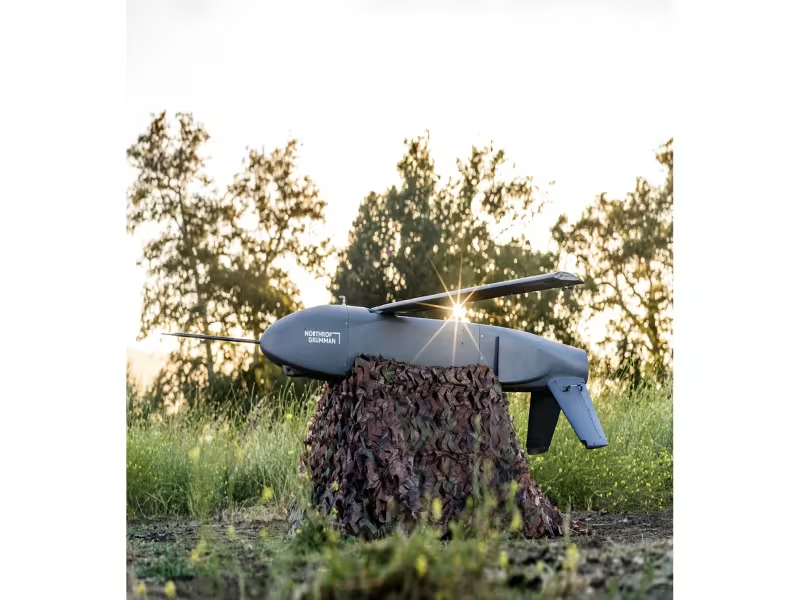
Palo Alto, Calif. – September 15, 2026 -- SandboxAQ has completed what it calls the world's first reported test of a magnetic navigation (MagNav) system on an attritable drone platform, integrating its AQNav software into Northrop Grumman's Lumberjack Group 3 unmanned aircraft system.
Test marks first pairing of MagNav with visual navigation on a one-way attack platform
The flight demonstration also represents the first reported instance of a MagNav system operating alongside a visual navigation system on an attritable, one-way attack drone, according to SandboxAQ. Lumberjack, developed by Northrop Grumman in under 14 months from concept to first flight, is designed as a multi-use loitering munition.
Max Schuster, program manager for Lumberjack at Northrop Grumman, said the collaboration is aimed at equipping autonomous systems with flight-hardened navigation alternatives for contested environments. Luca Ferrara, General Manager of Navigation at SandboxAQ, said the test demonstrates AQNav's ability to integrate at the speed and scale defense organizations require.
AQNav software installs on existing hardware in under one hour
SandboxAQ's engineers installed the AQNav software directly onto Lumberjack's existing onboard systems in less than an hour, avoiding the need for additional processing hardware. The platform runs on a hardware-agnostic, software-first architecture that processes sensor data in real time using physics-based models, and supports open architecture interfaces for integration across current and future defense systems.
AQNav offers OEMs two deployment paths: a full-stack solution built natively into platform architecture, or a software-only version designed to deploy within existing systems. It operates without reliance on satellite signals, functioning over open water, feature-limited terrain, urban landscapes, and GPS-denied or spoofed environments.
Technology has logged three years of testing with the U.S. Air Force
Since 2023, AQNav has been flight-tested by military, government, and commercial aerospace partners including Airbus and Boeing. The company has worked with the U.S. Air Force for more than three years, testing aboard C-17 Globemaster III and C-130J Super Hercules transport aircraft and participating in three large-scale military exercises.
AQNav was selected for the 2025 NATO DIANA cohort and is currently part of the Defense Innovation Unit's Transition of Quantum Sensing program, which evaluates MagNav technologies for military autonomous systems on Group 3 unmanned platforms. The Lumberjack integration builds on that program's testing patterns.