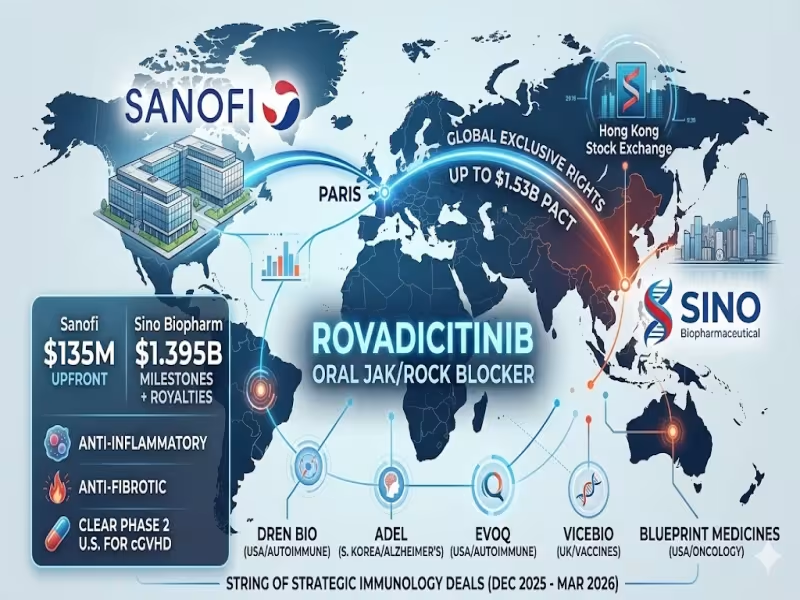
SHERIDAN, WYOMING - March 04, 2026 - Sanofi has signed a worldwide licensing agreement with Sino Biopharmaceutical to secure global exclusive rights to rovadicitinib, an investigational oral small molecule positioned as an anti-inflammatory and anti-fibrotic therapy. The transaction includes a $135 million upfront payment and gives Sanofi the exclusive right to develop, manufacture, and commercialize the product globally, while Sino Biopharm is eligible for up to $1.395 billion in clinical, regulatory, and sales milestones plus double-digit tiered royalties. Operationally, the deal adds an oral candidate with a defined mechanism to Sanofi's immunology buildout and extends a pattern of external sourcing designed to accelerate portfolio depth without waiting for internal discovery timelines.
Deal structure and what changes for global development control
Under the agreement described in a Hong Kong stock exchange filing, Sanofi will fund the upfront payment and assume global control over development, manufacturing, and commercialization. That structure typically matters to operators because it clarifies accountability for development strategy, clinical execution, supply planning, and lifecycle management across regions.
Sino Biopharm retains an economic participation through milestones and royalties, aligning incentives while shifting execution and scale responsibilities to Sanofi. The milestone framework also implies the program will be managed through defined clinical and regulatory gates, with value transfer linked to measurable progress.
Asset profile: oral JAK/ROCK inhibitor positioned for immuno-inflammatory and fibrotic biology
Rovadicitinib is described as a small-molecule inhibitor targeting JAK and ROCK proteins. The text frames JAK/STAT as a well-characterized pathway in inflammatory diseases, with therapeutic effects established across immune-mediated conditions when disrupted. ROCK is described as modulating STAT3 and STAT5 activity, and the filing indicates that targeting this process helps restore immune balance.
From a portfolio design perspective, an oral small molecule can create optionality for treatment sequencing and operational deployment compared with infusion-only approaches, particularly where chronic administration, adherence, and site-of-care requirements are major considerations.
Clinical status and early indication signal
The disclosed material notes uncertainty on which diseases Sanofi will ultimately pursue, but it provides one concrete regulatory and development datapoint: the asset has been cleared for Phase 2 development in the U.S. for chronic graft-versus-host disease (cGVHD). That clearance establishes a near-term pathway for trial planning and site activation if Sanofi prioritizes that program, while leaving room for broader indication strategy as the company integrates the asset into its portfolio governance.
For R&D and clinical operations leaders, Phase 2 readiness also shifts attention to protocol design, endpoint strategy, and operational feasibility, including patient identification and site selection, particularly in specialized indications.
China approval status and the practical implications for global teams
The source states that rovadicitinib is approved in China for the treatment of primary myelofibrosis, post-polycythemia vera myelofibrosis, and post-essential thrombocythemia myelofibrosis. While this does not define outcomes in other jurisdictions, it indicates an established regulatory and clinical history in at least one major market. For global development teams, that can influence how existing data packages, safety experience, and manufacturing knowledge are evaluated for broader development planning.
At the same time, global commercialization introduces additional operational requirements that are not implied by a single-country approval, including multi-region regulatory strategy, pharmacovigilance scaling, and manufacturing validation aligned to target markets.
Fit with Sanofi's recent partnering pattern
The deal is positioned as part of a series of recent transactions by Sanofi to secure innovative medicines and platforms through external partnerships. The source references multiple agreements and acquisitions over the past year, including partnerships and purchases intended to advance autoimmune disease treatments and an anti-tau antibody program in Alzheimer's disease.
For business development and portfolio leaders, this clustering of transactions suggests a consistent operating model: expand therapeutic optionality through licensing and acquisitions, while balancing risk via milestone-based structures and staged investment. In that context, rovadicitinib adds a mechanism-driven, oral asset that can be routed into multiple potential immunology or inflammation-focused strategies, subject to Sanofi's internal prioritization.
Mechanism framing from the partner and how it is being positioned
"synergistic anti-inflammatory and anti-fibrotic effects,"
What decision-makers will watch next
Based strictly on the disclosed information, the near-term execution focus will likely center on how Sanofi defines the initial development path and converts Phase 2 clearance into a clinical program plan, while aligning manufacturing and global rights execution under the licensing framework. Stakeholders across clinical operations, CMC, regulatory, and commercial strategy will typically evaluate: trial initiation pace, clarity of first target indications, and how global manufacturing and supply planning will be structured under the new ownership of development and commercialization responsibilities.
If Sanofi can translate the global control embedded in the license into efficient program execution, rovadicitinib becomes another tangible step in its broader push to secure externally sourced innovation at scale.