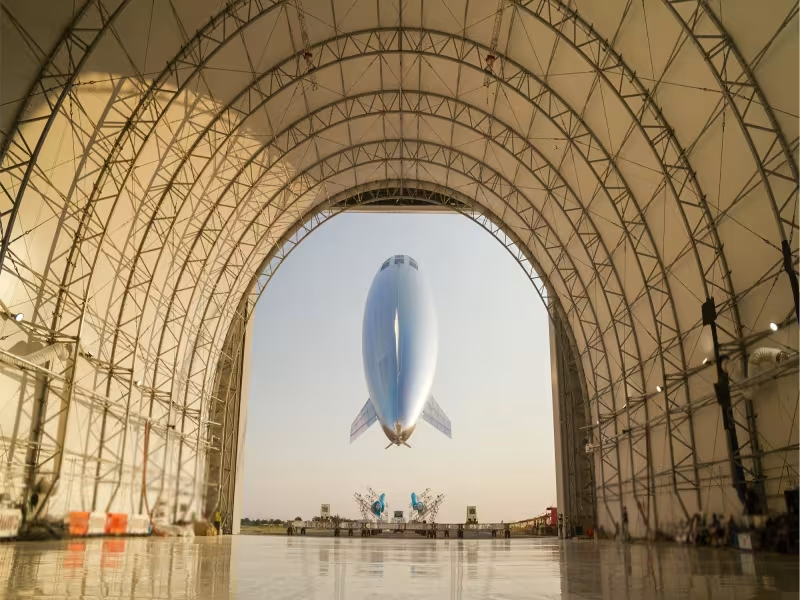
Moriarty, New Mexico – September 15, 2026 -- Sceye's ST1 high-altitude platform has completed a nearly 30,000-km round-trip mission between New Mexico and Japan, landing back near the company's Moriarty headquarters after re-entering continental U.S. airspace on September 4, 2026. The uncrewed stratospheric aircraft reached New Mexico airspace on September 5, 2026, where engineers ran final platform tests before executing a planned flight-termination and descent procedure.
ST1 marks Sceye's first flight to Asia in partnership with SoftBank
The mission was conducted jointly with SoftBank Corp. (TOKYO: 9434), and represented Sceye's first deployment in Asia, as well as a step toward commercial rollout of High-Altitude Platform Systems (HAPS) as stratospheric infrastructure. ST1 carried SceyeCELL, described as a 'base station in the sky,' designed to deliver broadband mobile connectivity directly to standard handsets from the stratosphere. At full-scale deployment, a single Sceye HAPS unit is engineered to cover an area equivalent to roughly 500 ground-based base stations.
Platform held position over Japan for more than seven days
ST1 operated in Japanese-managed airspace for over seven days, maintaining a station-keeping radius as tight as 5 km off the Japanese coast for extended periods. The aircraft flew at altitudes between 16.5 km and 17 km during testing of telecom services, drone communications and emergency alert links.
Broadband service from the stratosphere matched terrestrial network quality
During the mission, Sceye and SoftBank demonstrated mobile broadband connectivity including text messaging, voice calls, internet access and video streaming directly from the stratospheric platform. Teams also tested a disaster-response emergency alert system and drone communications, reporting connectivity quality comparable to ground networks while limiting radio interference with terrestrial base stations.
On-platform server processing cut latency by more than 40%
Sceye and SoftBank installed a server directly on the HAPS unit, processing data onboard rather than routing it through internet cloud infrastructure. The setup achieved an average round-trip response time of 68 milliseconds, cutting communication latency by more than 40% compared with cloud-based processing. The companies say it was the first successful global test in which a mobile core network and a web server for data processing were installed on a HAPS platform, allowing full response processing onboard before results were relayed back to smartphones.
Sceye frames stratosphere as backbone for future 6G infrastructure
Mikkel Vestergaard Frandsen, founder and CEO of Sceye, said the ST1 mission validated the readiness of the company's platform, payload and operational infrastructure to deliver connectivity services, and argued the stratosphere will underlie non-terrestrial infrastructure going forward, including future 6G development. Sceye positions its HAPS as operating like geostationary satellites but at roughly 1,800 times closer proximity to Earth and at a fraction of satellite-system costs.
ST1 opens Sceye's Service Test program
ST1 is the first mission under Sceye's newly launched Service Test program, following the aircraft's operational cycle across New Mexico and Japanese airspace over the course of a month.