Amsterdam – September 18, 2026 -- SDMC (00901.HK) has been selected for Google Cloud's Proactive Physical AI Acceleration Program, deepening a partnership aimed at deploying real-world AI Home services through operator networks.
SDMC unveils cloud-edge architecture combining Cedar AI and NVIDIA-powered edge compute
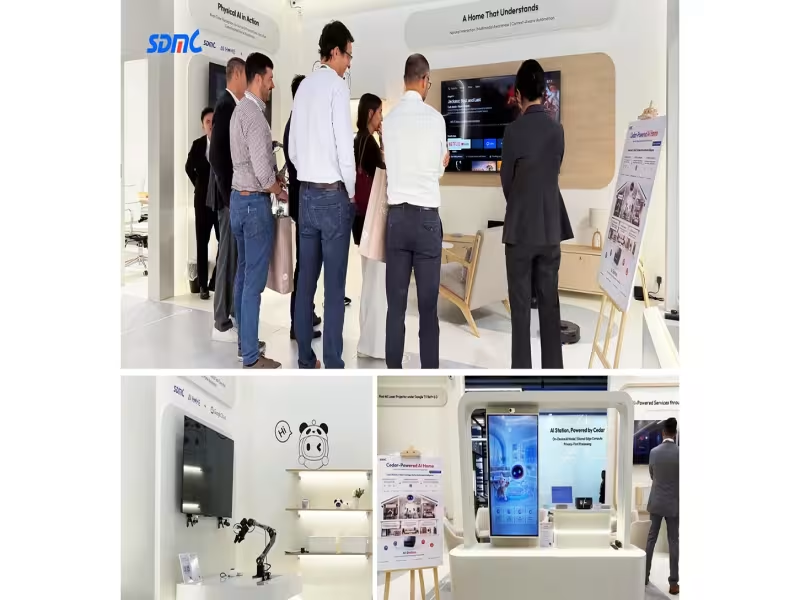
At IBC 2026, the AI Home solutions provider demonstrated an architecture built around two core components: Cedar, a multimodal AI system, and AI Station, a shared edge-computing platform. Cedar is built on Google's Gemma open model and pairs with Cedar Agent to coordinate actions across connected devices, while Gemini handles cloud-based reasoning for more complex tasks.
NVIDIA Jetson T5000 powers shared compute to cut per-device hardware costs
AI Station runs on NVIDIA's Jetson T5000 chip, allowing multiple AI applications to share edge computing resources rather than requiring dedicated high-performance hardware at every household endpoint. The design targets operators, small businesses, and premium households, keeping latency-sensitive and privacy-sensitive workloads processed locally within the home.
Google Cloud collaboration extends beyond pilots into scenario validation
Under the Proactive Physical AI Acceleration Program, SDMC and Google Cloud are co-developing technology, validating use-case scenarios, and running service pilots spanning entertainment and home security applications. The partnership merges Google Cloud's AI infrastructure with SDMC's expertise in home devices, edge computing, and telecom operator delivery channels.
Amlogic partnership brings Edge AI to streaming and display hardware
SDMC showcased Edge AI integration with Amlogic across an AI Home Display and AI Streaming Box, alongside a Google TV 4K Projector for large-screen entertainment. On the network side, SDMC's AI Operation tool targets faster fault diagnosis and autonomous maintenance, while its AI Fiber Gateway combines connectivity management with AI-driven performance optimization.
SDMC positions shared edge compute as path to scaling AI services without added hardware costs
Company discussions at IBC centered on how telecom operators can roll out AI services across existing home device fleets while managing deployment complexity, response times, and data privacy. SDMC said these conversations will shape upcoming customer validation phases, product configuration decisions, and service pilot programs.
The company is also exploring Physical AI applications extending beyond current deployments, including autonomous cleaning robotics and connected home control systems involving robotic manipulation.