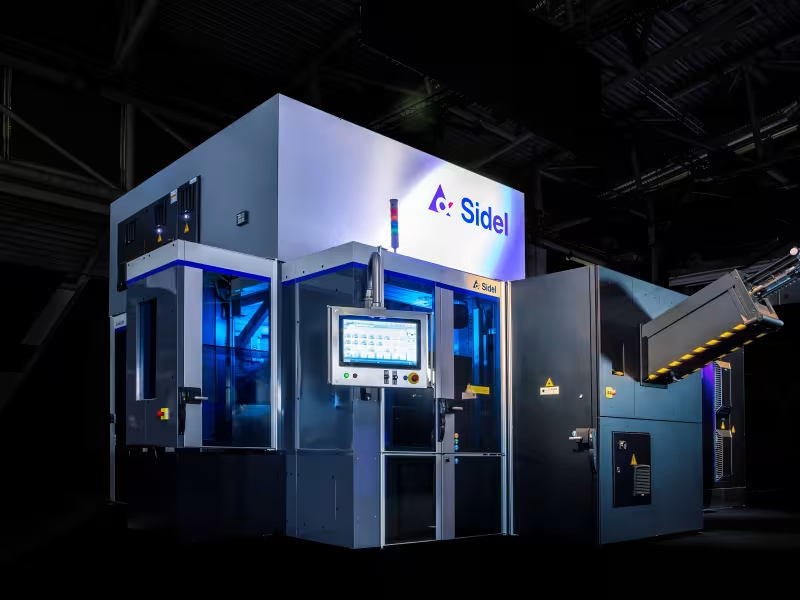
SHERIDAN, WYOMING - March 06, 2026 - Sidel reported two wins at the SEAL Business Sustainability Awards 2026, with recognitions tied to packaging and beverage line technology designed to reduce resource use while maintaining production performance. The company said its EvoBLOW Laser received the Sustainable Innovation Award, while its latest tunnel pasteurizer, SWING® Evo, was recognised with the Sustainable Product Award. For beverage producers, the operational relevance is centered on measurable efficiency drivers described in the release-reduced downtime, lower energy use, lower material consumption, and tighter process control. The announcement also reinforces how equipment vendors are using sustainability awards to validate practical, factory-level improvements rather than purely aspirational targets.
Sidel's dual recognitions and what they indicate for producer decision-making
Sidel framed the two awards as recognition of "game-changing solutions" that support beverage producers' sustainability efforts. The company also positioned the SEAL Awards as a global program intended to highlight measurable contributions and innovative initiatives with long-term environmental impact, noting that prior winners include Apple, IKEA, and Adidas.
For procurement and operations leaders, awards alone do not replace technical validation, but they can influence shortlists-especially when recognitions are tied to concrete performance claims such as energy savings, reduced waste, and improved reliability. In this case, Sidel links both recognitions to core production constraints: uptime, resource consumption, and process repeatability.
EvoBLOW Laser: laser heating positioned as a PET performance and sustainability shift
Sidel described the EvoBLOW Laser as a breakthrough for both performance and sustainability in PET packaging. The release attributes several operating benefits to the system, including reduced downtime, improved PET material distribution and control along the bottle, lower PET usage, energy savings, lower maintenance, and preform waste reduction of around 50% compared with comparable halogen solutions.
For packaging operations, these claims map directly to two high-cost areas: scrap and instability. If preform waste and change-related disruptions are reduced, plants can improve yield and predictability, which typically affects total manufacturing cost, line scheduling, and quality deviations. The release also emphasizes that changes to processes or heating settings can be made immediately with EvoBLOW Laser, positioning it as supportive of faster adaptation without extended ramp or variability.
rPET processing: reducing sensitivity to material variation as a production advantage
Sidel stated that EvoBLOW Laser supports increased and more efficient use of recycled PET (rPET) because it is less sensitive to material property variations. Operationally, that is a significant framing because rPET variability is a practical constraint for many producers when quality consistency must be maintained across shifting feedstock characteristics.
Within the boundaries of the source, Sidel's message is that the heating approach and control enable consistent quality "from the first bottle to the last," even when adjustments are required. For producers, the practical evaluation question is how that claim translates into routine operation: reduced tuning time, fewer off-spec containers, and more stable wall-thickness outcomes as rPET ratios change.
Product leadership perspective on the award rationale
"Sidel's new EvoBLOW Laser represents what's possible when performance and sustainability move forward together", said Alexandre Huet, Product Manager for Blowing at Sidel.
"This award is meaningful, as it recognises the impact of Sidel's work, lighter but stronger packaging, lower electricity use, reduced waste and easier use of rPET. The EvoBLOW Laser is proof that breakthrough innovation can deliver real, immediate benefits for both producers and the planet."
SWING® Evo: tunnel pasteurization efficiency for non-alcoholic beverages and beer
Sidel said SWING® Evo provides sustainability advantages for non-alcoholic beverages and beer producers, highlighting system architecture intended to reduce heat and water inefficiency. The release describes a counterflow configuration and dedicated heat and water circuits designed to minimize heat dispersion and eliminate unnecessary circulation between tanks. It also states that each module is independently controlled, allowing the system to adapt precisely to production needs.
For beverage plants, these design elements typically relate to energy intensity and process stability: better thermal management and modular control can support right-sizing of resource consumption to actual line conditions, rather than running fixed consumption profiles across changing SKUs, ambient conditions, or throughput. The release's emphasis is that sustainability improvement is driven by control and configuration choices that reduce "unnecessary" consumption.
PRINCE-E: control system positioned to reduce under-pasteurization risk and consumption
Sidel stated SWING® Evo can be equipped with PRINCE-E, described as an advanced pasteurization control system. According to the release, PRINCE-E ensures a high-precision bactericidal effect while guaranteeing the absence of under-pasteurization due to a predictive approach, and it incorporates features to further reduce energy and cooling water consumption through fully automated operations.
For operations and quality teams, this positions pasteurization sustainability as inseparable from compliance and product integrity: plants cannot trade safety margins for efficiency. The key operational promise Sidel presents is that predictive control supports both outcomes-maintaining pasteurization reliability while reducing avoidable resource use.
How producers can translate award claims into an evaluation checklist
Based strictly on the release, Sidel's two recognitions center on a practical sustainability narrative: lower resource use achieved through equipment design, control, and reduced waste, while maintaining production performance. For buyers, the most relevant diligence typically includes confirming where and how the claimed improvements appear in daily operations, such as:
- Evidence that downtime reductions and faster setting adaptations translate into more stable OEE patterns
- Quantified PET reduction pathways enabled by improved material distribution and bottle control
- Practical impact of reduced preform waste versus comparable solutions in comparable operating conditions
- How rPET variability is handled operationally without degrading quality consistency
- Pasteurizer energy and cooling-water consumption behavior across production needs, using modular controls and counterflow configuration
The release concludes that the recognition reinforces Sidel's long-standing commitment to driving packaging toward a more resource-efficient future, framing the awards as a milestone in its sustainability trajectory.