Seoul – October 06, 2026 -- SK chemicals has launched a four-partner consortium to build a regional circular economy for waste banners, targeting more than 1,000 tons of annual waste across South Korea's Gyeongsang, Honam and Jeju regions.
Consortium links collection, recycling and manufacturing into a closed loop
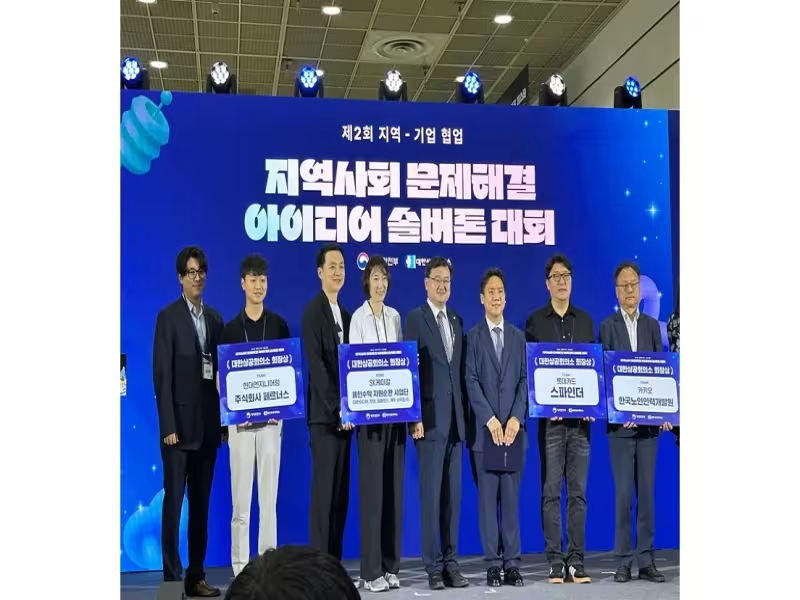
SK chemicals formed the Waste Banner Resource Circulation Consortium with MOA, Daehan Media, Upcloth and the Resource Circulation Team of Seogwipo City in Jeju Special Self-Governing Province. The group emerged from a challenge SK chemicals posed at the Solveathon idea competition, held alongside the Social Value Festa and hosted by the Korea Chamber of Commerce and Industry and the Ministry of the Interior and Safety.
MOA and Daehan Media will collect waste banners in the Gyeongsang region, Upcloth will cover Honam, and Seogwipo City will handle Jeju. Upcloth plans to create local jobs by employing participants from self-sufficiency programs and people with disabilities through its existing collection and sorting infrastructure.
Depolymerization technology converts waste banners back into banner fabric
Collected banners move to MOA for pre-processing before SK chemicals applies depolymerization technology to convert the material into feedstock. Daehan Media then produces the chemically recycled banner fabric and distributes it nationally through its sales network. Seogwipo City will build the institutional framework needed to keep the full cycle, from collection to reuse, contained within the region.
Depolymerization breaks waste plastics down to the molecular level before repolymerization, differing from mechanical recycling, which relies on shredding, washing and remelting. SK chemicals states that mechanical recycling is largely limited to high-quality streams such as clear PET bottles, while depolymerization can recover resources from mixed textile waste like banners without quality degradation across repeated cycles.
Korea generates 6,000 tons of waste banners annually, with 70% landfilled or incinerated
According to the Ministry of Climate, Energy and Environment, Korea produces approximately 6,000 tons of waste banners each year, with about 70% ending up in landfills or incinerators. Banners are typically used once for events and elections, and prior upcycling efforts into tote bags or waste collection bags have been criticized as one-time recycling rather than a sustainable solution.
SK chemicals plans to scale the model to metropolitan and provincial levels
The company intends to standardize provincial-level collection and sorting systems tailored to each region's existing infrastructure, then replicate the model elsewhere. A company representative said collaboration with the participating organizations will broaden the approach to metropolitan and provincial scale to create working examples of banners being turned back into banners.
SK chemicals has expanded local government partnerships on waste banner recovery since signing an MOU with the City of Gunsan and Revelop in August 2024. It followed with MOUs covering the Ministry of the Interior and Safety and the cities of Sejong, Gangneung, Cheongju, Naju and Changwon in June 2025, and the City of Seoul in August 2025.