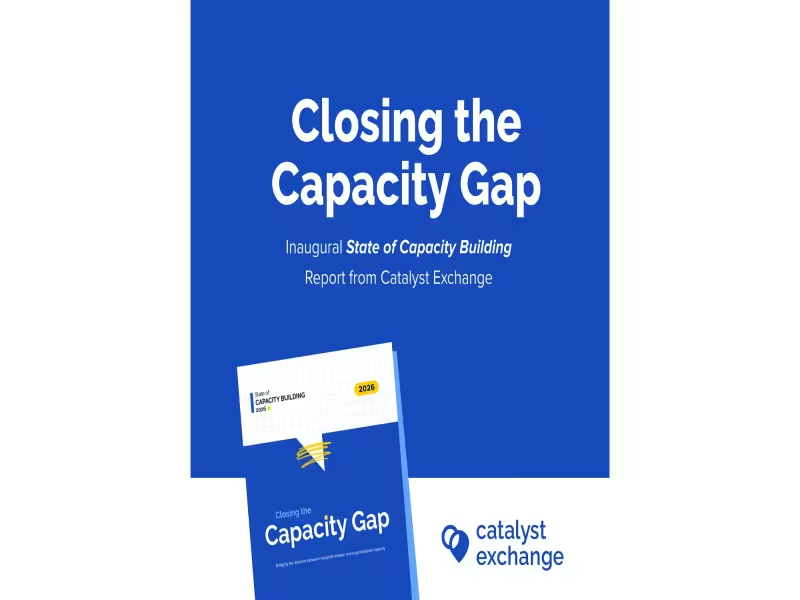
NEW ORLEANS – October 13, 2026 -- Across 18 capacity domains, 57% of identified nonprofit needs received no or very little support, according to the first State of Capacity Building report from Catalyst Exchange. The survey sets a national baseline for tracking sector capacity over time.
The report, titled Closing the Capacity Gap, draws on input from 408 nonprofits, 101 intermediaries and 135 funders working in education and youth development. It also uses focus groups and interviews. Catalyst Exchange describes a sector squeezed by rising demand, funding cuts, burnout and AI transformation.
Funders and nonprofits agree on priorities, but money does not follow
Fund development (66%) and revenue strategy (52%) rank as the top nonprofit capacity needs, and funders name the same areas for support. Yet fewer than half of funders report funding capacity building. Only 19% of nonprofits received a grant designated for it in the past year.
Funders cite a lack of dedicated funding (49%), limited expertise (27%) and capacity building falling outside their priorities (24%) as barriers. Three in five funders have no way to capture capacity-building needs. Only 33% of nonprofits say funders seek feedback on capacity.
Support rarely delivers strong results for nonprofits
Most nonprofits (69%) saw benefit from capacity building in the past 12 months, but only 13% rated the results as highly effective. According to the report, outcomes vary with organizational readiness, finding the right support and how well it fits the organization's needs.
Nearly half of nonprofits are exploring AI without adopting it
Limited staff time (44%), uncertainty about where to start (36%) and funding (33%) are the main barriers to AI adoption. Catalyst Exchange classes AI as an emerging capacity challenge.
Smaller and Black-led organizations face uneven access
Organizations with budgets under $1M have fewer resources and less bandwidth to engage in capacity building, which makes growth harder. Black-led nonprofits show higher organizational readiness and are more likely to report improvements. They also report difficulty accessing funding and culturally responsive providers.
Catalyst Exchange Founder and CEO Leona Christy said the findings show where organizations carry "capacity debt": needs that accumulate when time, funding or support fall short.
Jim Shelton, CEO of Blue Meridian Partners, which supported the research, said: "Chronic underinvestment in capacity is one of the social sector's most persistent, yet solvable problems."
The report was backed by Blue Meridian Partners and informed by more than 600 leaders. Catalyst Exchange plans additional editions to track how capacity-building needs, investments and experiences evolve.