survey_report

Under-30s in Germany Increasingly Miss Payment Deadlines, Study Finds

Image
Under-30s in Germany Increasingly Miss Payment Deadlines, Study Finds

Nuremberg – September 12, 2026 -- Three-quarters of Germans have already financed a purchase, while missed payment deadlines among adults under 30 rose to 23 percent from 14 percent in autumn 2025, according to the TeamBank Liquidity Barometer.

Younger consumers treat financing as routine, survey shows

Some 33 percent of Germans under 30 now consider invoice purchases, installment credit and other financing forms self-evident, a 12-percentage-point jump from autumn 2025. This age group also plans to spend significantly more over the next 12 months than the national average, the survey found.

Payment lapses and tracking problems climb among young borrowers

29 percent of respondents under 30 report losing track when running multiple financing arrangements simultaneously. Despite this, 48 percent of the same group rate their financial knowledge as at least good, a higher share than among older respondents.


AI Mandates Go Unfunded for 92% of Legal Teams, Axiom Report Finds

Image
AI Mandates Go Unfunded for 92% of Legal Teams, Axiom Report Finds

Global – – September 11, 2026 -- Ninety-two percent of in-house legal departments received AI implementation mandates with no accompanying budget in 2027, up sharply from 78% a year earlier, according to the Axiom 2027 In-House Legal Budget Report. The study, conducted by InsightDynamo and commissioned by Axiom, surveyed 510 in-house legal and finance leaders across six countries, with 64% of respondents from companies generating $1 billion or more in annual revenue.

Unfunded AI mandates push costs onto existing technology budgets
Legal teams are absorbing AI implementation costs by pulling funds from other line items, most often existing technology budgets, as adoption spreads across departments without new capital allocation.

AI Boosts Productivity but Culture Gaps Threaten ROI, Study Finds

Image
AI Boosts Productivity but Culture Gaps Threaten ROI, Study Finds

Arlington, Va. – September 11, 2026 -- Eighty-four percent of senior business leaders say at least one cultural factor is limiting their organization's success with artificial intelligence, even as AI adoption delivers measurable productivity and quality gains, according to a new survey from Eagle Hill Consulting.

AI adoption spreads evenly across core business functions

The Eagle Hill Consulting AI Capabilities survey of 306 U.S. director-level and above executives finds organizations deploying AI at nearly equal rates across business operations (73 percent), decision support and analytics (72 percent), and employee productivity and knowledge work (71 percent). Sixty-six percent of respondents report improved employee productivity, 59 percent cite improved operational efficiency, 55 percent report improved quality of work, and 53 percent report improved customer experience.

43% of Employers Plan to Add Staff in Q4 as AI Reshapes Roles

Image
43% of Employers Plan to Add Staff in Q4 as AI Reshapes Roles

Global – September 11, 2026 -- ManpowerGroup's Q4 2026 Employment Outlook Survey shows 43% of employers worldwide plan to increase staffing between October and December, against 14% anticipating cuts and 41% expecting no change, with soft economic conditions rather than AI cited as the main driver behind reductions.

Nearly two-thirds of hiring employers cite changing roles over expansion

Among employers adding staff, 62% point to changing roles and skills -- including new expertise demanded by advancing technology and shifts in service requirements -- as the primary reason. Company expansion remains the single largest driver at 39%, followed by advancing technology at 21%, skills shifts at 16%, and backfilling at 32%.

63% of Congressional Staff Oppose US Equity Stakes in AI Firms

Image
63% of Congressional Staff Oppose US Equity Stakes in AI Firms

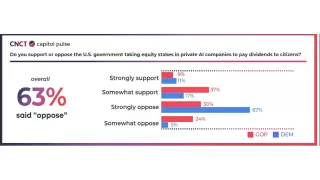
Washington – September 11, 2026 -- A majority of congressional staffers, 63 percent, oppose the U.S. government taking equity stakes in private artificial intelligence companies, according to a CNCT Capitol Pulse survey highlighted by HillFaith, a Capitol Hill fellowship ministry.

Democratic aides show the strongest opposition to federal AI equity stakes

Among Democratic staffers, 67 percent said they "strongly oppose" the government acquiring stakes in AI firms, compared with 58 percent of Republican aides holding the same position. The partisan gap reverses in the "somewhat opposed" category, where 24 percent of Republican staffers registered opposition versus just 5 percent of Democrats.

Study: Half of Consumers Still Unfamiliar With EUDI Wallet

Image
Study: Half of Consumers Still Unfamiliar With EUDI Wallet

Munich – September 11, 2026 -- Only 52% of consumers in Germany and France are aware of the EU Digital Identity (EUDI) Wallet, according to a new consumer study by IDnow, just months before the technology's mandated December 2026 rollout. The digital identity and fraud prevention platform surveyed 1,000 adults in each country and found that trust, not speed, will determine adoption.

Nearly half of consumers abandon transactions over complex verification

48% of respondents said they frequently abandon transactions when identity verification is too complicated or takes too long, exposing a commercial cost that financial institutions already absorb today. IDnow argues this friction creates both the market opportunity and the credibility hurdle the EUDI Wallet must clear.

IDnow Survey: EUDI Wallet Faces Trust Gap Ahead of December Rollout

Image
IDnow Survey: EUDI Wallet Faces Trust Gap Ahead of December Rollout

Munich – September 11, 2026 -- Nearly half of European consumers, 46%, say they frequently abandon a transaction when identity verification is too complex or slow, according to a new IDnow survey released ahead of the EUDI Wallet's mandated December 2026 rollout.

The survey of 2,000 respondents across France and Germany, conducted by Sapio Research in June 2026, found that awareness of the EU Digital Identity Wallet remains low even as EU member states are required to make it available to every citizen by December 2026, with banks obligated to accept it starting December 2027.

Security concerns outweigh speed as the top adoption driver

Forty percent of respondents cited better fraud protection as the decisive factor for accepting the EUDI Wallet, ahead of data control (31%) and transparency over data usage (29%). Faster, simpler processes ranked lower, decisive for only 28% of respondents.

Survey: 46% Abandon ID Checks, EUDI Wallet Faces Trust Gap

Image
Survey: 46% Abandon ID Checks, EUDI Wallet Faces Trust Gap

Munich – September 11, 2026 -- Nearly half of consumers in France and Germany, 46%, abandon a transaction when identity verification is too complex or slow, according to a new survey from IDnow published ahead of the EU Digital Identity Wallet's scheduled December 2026 rollout.

The EUDI Wallet Consumer Survey, conducted by Sapio Research in June 2026 among 2,000 adults aged 18-80 (1,000 in France, 1,000 in Germany), found that awareness of the incoming digital identity system remains low while friction in current onboarding processes is already costing financial services providers customers.

German Fossil Fuel Demand to Persist Longer Than Expected: BearingPoint

Image
German Fossil Fuel Demand to Persist Longer Than Expected: BearingPoint

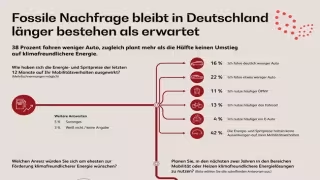
Frankfurt – September 10, 2026 -- Rising energy and fuel prices are changing consumer behavior in Germany but failing to trigger a rapid shift toward climate-friendly energy solutions, according to a new BearingPoint survey. The management and technology consultancy found that 53% of respondents plan no switch to greener mobility or heating options over the next two years, leaving fossil fuel infrastructure under sustained demand for longer than markets anticipated.

Higher prices cut driving but stop short of triggering investment

The survey shows 38% of respondents report driving less due to energy and fuel price increases over the past twelve months. Around a quarter shifted to alternatives: 11% use public transport more often, 13% cycle more, and 4% use electric vehicles more frequently. Meanwhile, 42% say price increases had no effect on their mobility behavior at all.

Study: Catholic College Grads Show Higher AI Adoption, Preparedness

Image
Study: Catholic College Grads Show Higher AI Adoption, Preparedness

San Antonio – September 08, 2026 -- Graduates of Catholic colleges and universities use artificial intelligence daily at a rate of 44%, eight percentage points higher than the 36% reported by graduates of secular institutions, according to the third Holistic Impact Report (HIR 3.0) commissioned by the Center for Catholic Studies at St. Mary's University in partnership with YouGov.