Global – October 27, 2026 -- TDengine is framing Industrial AI as decision support built on three layers (data, context and analysis) rather than as autonomous plant control, with accountability remaining with engineers and operators.
Industrial AI applies standard methods to physical operations
The approach uses machine learning, computer vision and generative AI on data from equipment, sensors, control systems, operational records and engineering documents. What makes an application industrial is the work it supports: pumps, compressors, production lines, energy systems and material flows. Enterprise AI, by contrast, mostly handles digital workflows such as drafting documents or summarizing meetings.
Context determines whether a data point is usable
A temperature value needs an asset, unit, operating state and expected range before it supports a useful answer. Context includes asset hierarchies, upstream and downstream equipment relationships, and earlier fault reports. Data sources often differ in names, formats and update rates, so collecting data does not make it understandable.
Three use cases keep a human in the loop
In the first, a reliability engineer reviews AI-assembled evidence on a centrifugal pump with unusual vibration and decides whether maintenance is needed. In the second, an engineer uses document content and equipment context to find the approved procedure for an alarm code, then verifies it applies to the current equipment. In the third, a model flags a process deviation or forecasts a trend, but the finding is not treated as proof of a root cause.
Projects should start with one operational decision
Teams should define the user, the evidence needed and the safe next step. They should then check four basics: data availability and timeliness, context, governance over access and authoritative sources, and who validates findings.
TDengine ties its platform to time-series data and ontology
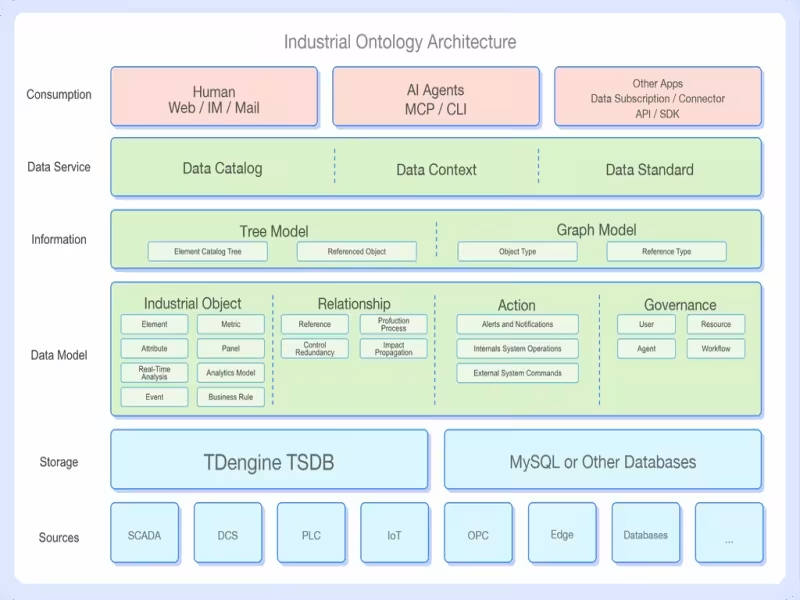
TDengine's Industrial AI platform covers data handling, analytics, modeling, visualization, anomaly detection, forecasting and event investigation. Its Industrial Ontology is documented as a semantic layer for physical assets, their data and their relationships. It differs from the Knowledge Graph in TDengine IDMP, which organizes document-derived entities into a knowledge network.
TDengine states that predictive maintenance is only one use case. Industrial AI can also support process monitoring, quality investigation and engineering knowledge retrieval.