Global – October 27, 2026 -- A historian export of tags and timestamps is rarely a training-ready dataset for Industrial AI, according to TDengine guidance that tells engineers to establish what each measurement means, when it happened, which asset produced it and whether it is reliable before data reaches an external model-training workflow.
Engineers define the pump decision before selecting data
For a centrifugal pump, the guiding question is whether a reliability engineer should review the pump given its recent operating signals. That differs from asking a model to declare the cause of a failure. Records created after a maintenance decision must not become inputs, because they would not exist when the model makes its prediction.
Four data conditions require separate treatment instead of one "missing data" label
A bad value may be a measurement-quality issue. A blank interval may mean the source was offline, the point was not collected or the asset was not running. A delayed or replayed record may be valid but arrive after its event time, and a repeated record may be a duplicate or two legitimate observations.
Filling every gap can hide an outage, while removing every unusual value can erase the event the model needs to learn from. The guidance calls for keeping quality indicators and transformation reasons so the dataset stays reviewable.
Event time stays separate from ingestion time
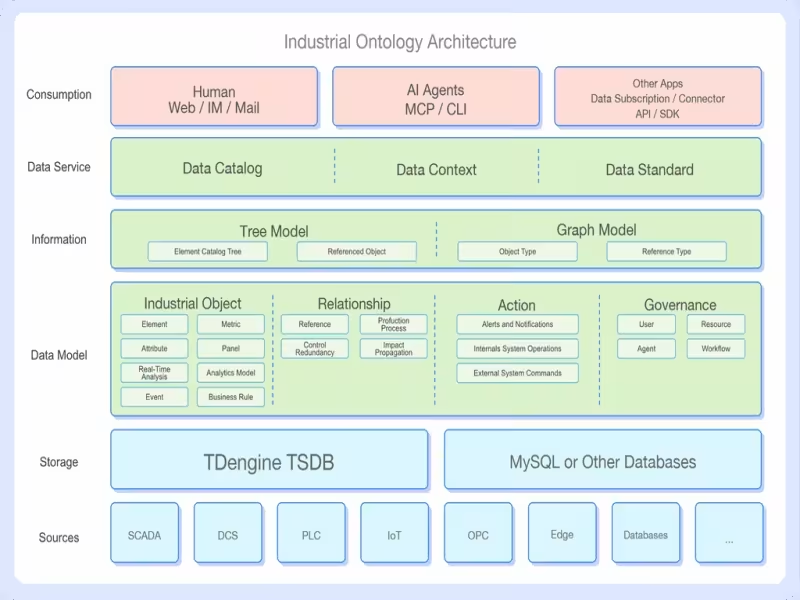
Source or event time should be preserved apart from ingestion time, which can explain delay or replay but should not replace the moment of measurement. Measurements also need links to asset, unit, operating mode and production state. A vibration value during startup can differ from one in stable production, and a standby-pump pressure reading is not equivalent to one under load. TDengine points to its Industrial Ontology, a semantic layer for organizing assets, data and relationships, as one way to supply that context.
Pump features and labels follow task-specific time windows
For the pump example, features could include vibration, suction pressure, discharge pressure, flow, run/stop state and calculated summaries over an agreed window. An alarm qualifies as a label only if it is the defined target outcome, such as a future alarm. Engineer-confirmed maintenance findings must align with the prediction window.
No single resampling interval, missing-value method or split ratio fits every historian. Validation options include chronological holdouts, rolling evaluations and grouped periods, provided future events and post-decision records do not leak into earlier examples.
Handoff package carries six documentation elements to the external environment
The handoff should retain the data dictionary, transformations, time boundaries, quality rules, label definition and source references. TDengine states it does not claim to train or deploy external models. Model selection, training, evaluation and deployment remain separate steps requiring their own tools, validation and operational approval.