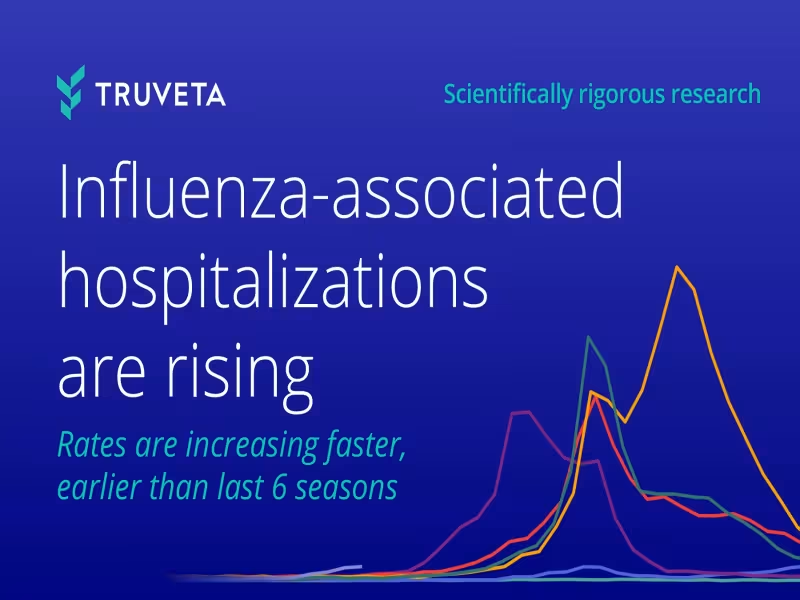
United States – October 29, 2026 -- Influenza-associated hospitalizations reached 3.5 per 1,000 hospitalizations in the week beginning September 21, 2026, nearly three times the next-highest rate recorded at the same point in the prior six flu seasons, according to a Truveta Data analysis.
Hospitalization rate climbs more than 2.5 times faster than in any prior season
From the week beginning August 31 through the week beginning September 21, the rate rose by an average of 0.7 hospitalizations per 1,000 each week. The next-fastest increase over the comparable period was 0.3 per 1,000 per week, in 2022–23.
Across the six prior seasons, the median weekly change at this point was −0.03 per 1,000. Hospitalization rates were generally stable or declining at this stage of past seasons.
2022–23 season set the previous benchmark at 1.2 per 1,000
The highest comparable-point rate in the prior six seasons was 1.2 per 1,000, recorded in 2022–23. The analysis compared the 2026–27 season with seasons dating back to 2020–21.
CDC FluView test positivity points the same direction
The findings are consistent with national surveillance data from the CDC. For the week ending September 26, 2026, FluView reported an increase in test positivity, an early indicator of influenza circulation. Truveta describes both datasets as showing the early stages of rising transmission.
Definition counts positive tests, not primary diagnoses
Truveta defined an influenza-associated hospitalization as one where the patient had a positive influenza lab test from 14 days before admission through discharge, or a positive test directly tied to the hospital encounter. Influenza therefore may not have been the primary reason for admission.
Hospitalizations were grouped into Monday–Sunday weeks, and the study included data through September 26, 2026. Findings reflect data accessed on October 5, 2026, are preliminary and have not been peer reviewed.
Analysts decline to forecast season severity
Truveta states that early activity does not necessarily predict the timing, magnitude or duration of the rest of the season, and that the findings should not be read as a forecast of the 2026–27 peak. Because the analysis covers only hospitalized patients, it does not measure infection or illness in the broader population.
The report cites annual influenza vaccination as a way to reduce the risk of severe illness and hospitalization, and says continued monitoring will be needed as the season develops.