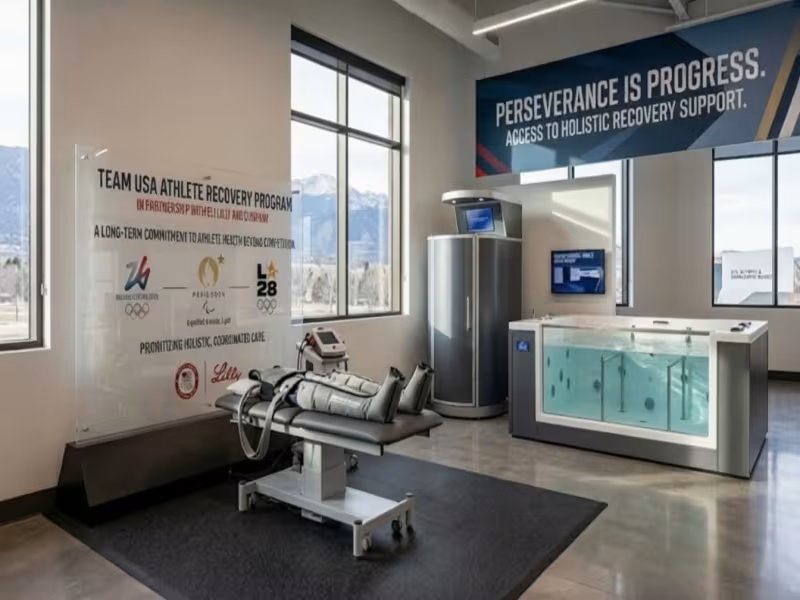
SHERIDAN, WYOMING - March 13, 2026 - The United States Olympic & Paralympic Committee is extending the Team USA Athlete Recovery Program with support from Eli Lilly and Company, turning what began as a pilot into a longer-term recovery model tied to the next major Olympic and Paralympic cycles. The program will continue after the Olympic and Paralympic Winter Games Milano Cortina 2026 and through the LA28 Olympic and Paralympic Games, with a focus on athletes facing complex or extended rehabilitation needs. For sports organizations, governing bodies, and healthcare-adjacent partners, the significance lies less in sponsorship optics than in how recovery services are being structured as an operational layer of athlete support. The announcement points to a more formal approach to coordinated care, continuity, and access beyond the competition window itself.
Program expansion formalizes recovery as an ongoing support function
The Team USA Athlete Recovery Program is described as targeted rehabilitation support for athletes managing complex or extended recovery needs. That framing matters because it moves the discussion beyond short-term treatment and toward a longer support model that can remain relevant well after a major event cycle. In operational terms, the program is being positioned as part of the athlete support system rather than a one-time intervention.
For high-performance organizations, that distinction is important. Recovery timelines do not always align with competition calendars, and fragmented care can create pressure across training, medical, and performance teams. A more centralized model can improve continuity while also giving stakeholders a clearer structure for service delivery.
The 2024 pilot provided a performance-linked proof point
The USOPC said it piloted the program in 2024, supporting 10 Team USA athletes. Six of those athletes qualified for the Olympic and Paralympic Games Paris 2024 and collectively earned four medals, including two gold medals. The source does not claim that the program alone drove those outcomes, but it does give the committee a practical basis for expanding the initiative.
That matters from a program-management perspective. A pilot with defined athlete participation and visible competitive outcomes can make it easier to justify broader rollout, especially when the next phase spans several years. In this case, the program is no longer framed as an isolated trial, but as an expanding support model with a longer planning horizon.
Lilly's role is tied to access and delivery, not only visibility
Lilly will serve as presenting partner and support access to the Team USA Athlete Recovery Program across the next cycle. The source also places this collaboration within Lilly's broader relationship with Team USA, where the company already has a role as an Official Partner in Health Equity. That gives the arrangement more continuity than a stand-alone campaign or short-term promotional tie-up.
For B2B readers, the more relevant point is that the partnership is connected to access and program reach. The announcement is built around a defined support service with rehabilitation and long-term care implications, not simply a branding exercise attached to a sports property. That makes the partnership structurally more interesting for organizations looking at how external partners can support athlete-service delivery.
The operating model centers on coordinated care
The strongest operational signal in the source is the emphasis on coordinated care. Rather than presenting recovery as a series of disconnected medical episodes, the USOPC describes a framework that brings expertise, support, and coordination together for athletes navigating different recovery paths. That model is particularly relevant in cases where injuries, surgeries, or prolonged rehabilitation affect both training and competition readiness.
"Every Team USA athlete faces unique challenges on the road to recovery," said Dr. Jonathan Finnoff, chief medical officer, U.S. Olympic & Paralympic Committee. "The program provides the expertise, coordinated care, and support to help them navigate these journeys, whether returning to sport or finding their next chapter. Together with our partner Lilly, we're proud to share these stories and inspire fans around the world."
From an operator standpoint, coordination is often where recovery programs either hold together or break down. When athletes require support across multiple providers, timelines, and performance demands, a more integrated framework can reduce friction and improve accountability around care delivery.
Athlete testimony supports the case for a centralized model
The athlete examples included in the source strengthen the operational case for expansion because they point to practical value rather than abstract intent. Both cited athletes describe coordinated support as a meaningful factor in their preparation and recovery ahead of Paris 2024. That helps position the program as an applied service model, not simply a symbolic support initiative.
"The Athlete Recovery Program played a huge part in getting me to the start line and ultimately becoming Paralympic Champion in Paris 2024," said U.S. Paralympic triathlete Grace Norman. "I entered the Paralympic year with an injury, but my goal never changed. The program gave me access to a world-class and coordinated team that allowed me to train, recover, and prepare all in one place."
"Surgeries on my injured shoulder, biceps, and elbow threatened my Olympic dream," said U.S. Olympic Wrestler Josef Rau. "The Athlete Recovery Program and the USOPC were pivotal in giving me a dedicated team that coordinated the most comprehensive care I've ever experienced, and I'm forever grateful for the support that got me to Paris."
These examples do not replace formal outcome metrics, but they do illustrate how centralized support can matter in elite-performance environments where timing, care access, and rehabilitation quality all affect readiness.
The initiative also has a broader institutional role
The USOPC said the program and related activities are designed to reach athletes, National Governing Bodies, fans, media, donors, and policymakers. That broad target group suggests the initiative is being positioned not only as an internal athlete service, but also as part of the committee's wider accountability and public-benefit narrative. As the United States moves toward another stretch of Olympic and Paralympic hosting responsibilities, that positioning carries institutional weight.
For the wider market, the announcement offers a useful example of how health-support partnerships in sport can be framed around access, continuity, and long-term impact. The key business implication is that recovery is being treated less as a back-end medical necessity and more as a structured support function with operational and strategic relevance.