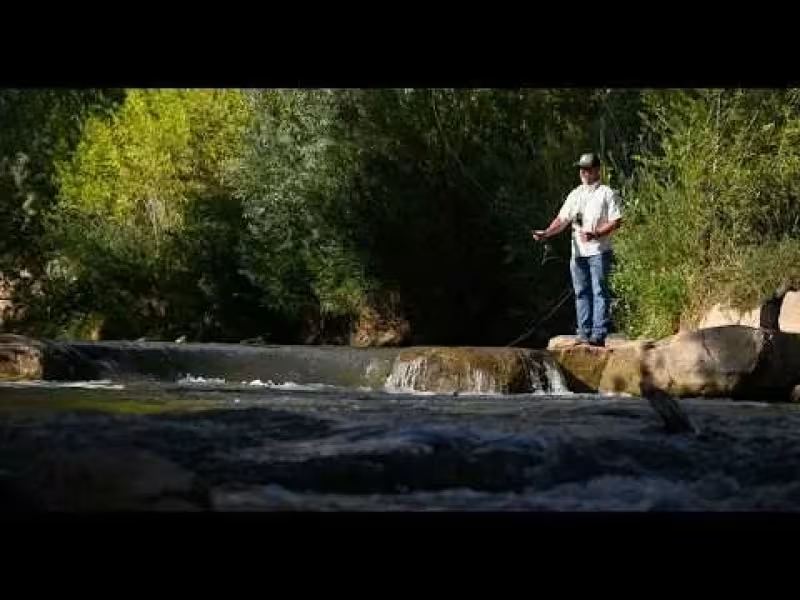
Washington – – September 21, 2026 -- The Walton Family Foundation has launched Human Nature, a storytelling initiative documenting nature-based water projects that a June 2026 University of Georgia study found can deliver returns of up to $8 for every $1 invested when flood reduction, clean water, habitat and recreation benefits are counted.
Foundation expands Environment Program to scale proven water solutions
The initiative pairs on-the-ground restoration work with efforts to shift policy, financing and market conditions, according to Moira Mcdonald, director of the foundation's Environment Program. A 2025 Morning Consult poll cited by the foundation found 80% of Americans want wetland restoration prioritized by state and local governments.
Tri-State Conservation Partnership places 1 million acres into federal wetland easements
In the Mississippi Alluvial Valley, the foundation-backed Tri-State Conservation Partnership has moved more than 1 million acres into USDA Wetland Reserve Easements, paying landowners to convert flood-prone farmland back to wetlands while retaining productive acreage. The Arkansas Delta-based KKAC Organization connects historically underserved landowners to these federal programs, addressing long-standing barriers to land retention.
CoBank-backed loan funds 160,000 acres of Iowa cover crops
The Environmental Defense Fund partnered with CoBank on a sustainability-linked loan with Heartland Co-op that lowers interest rates as farmers adopt conservation practices. The financing has funded 160,000 acres of cover crops and roughly 90 saturated buffers designed to keep nutrient-rich runoff out of the water supply.
Relay cropping adds $51 per acre in farm profit, cuts flooding risk 30%
Working with the American Flood Coalition, farmer Loran Steinlage of FLOLO Farms in Iowa has adopted relay cropping, overlapping crop cycles to keep roots in the ground year-round. The practice reduces erosion and improves water retention, adding an estimated $51 per acre in farm profit while cutting downstream flooding by as much as 30%.
Mexico to triple fish refuge zones after 15 years of community-run conservation
On Mexico's Baja Peninsula, NGOs Niparajá and Comunidad y Biodiversidad have run community-based fish refuges for 15 consecutive years, closing marine zones temporarily to fishing to let depleted stocks recover and training local fishers as scientific monitors. The Mexican government plans to more than triple the number of fish refuge zones in 2026.