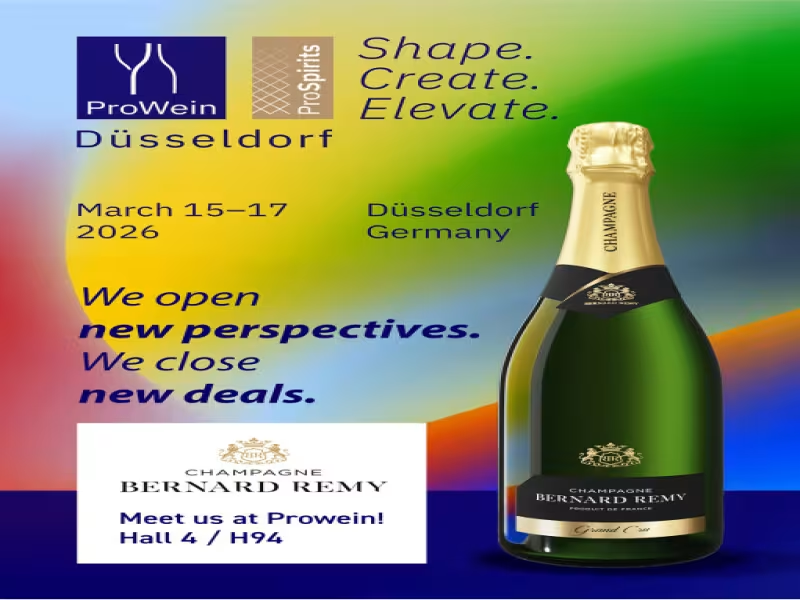
SHERIDAN, WYOMING - March 12, 2026 - Champagne Bernard Remy is taking a ProWein Düsseldorf 2026 stand position to accelerate B2B conversations with importers, distributors, specialist retail, and on-trade buyers ahead of the March 15-17 show. The house is inviting trade visitors to meet at Hall 4 / H94, framing the fair as a practical setting to evaluate portfolio fit, style consistency, and commercial readiness. The ProWein push is supported by two recent Mundus Vini distinctions-Gold for Carte Blanche and Silver for Grand Cru-which can help reduce buyer risk in early account discussions. Alongside awards, the producer is emphasizing origin and process discipline in the Côte des Blancs to support trade storytelling and repeatable category performance.
B2B objective at ProWein: converting meetings into qualified follow-up
For champagne, deal velocity at trade fairs depends on fast qualification: does the range match the buyer's channel mix, and can the producer support consistent supply and positioning over time. Champagne Bernard Remy's Hall 4 / H94 location provides a clear anchor for appointment-setting and booth routing, helping buyers compress discovery and initial evaluation into the fair window.
Operationally, the practical value of a ProWein stand is not "visibility" alone, but structured comparison and decision support. Buyers can validate style and brand narrative in person, while exhibitors can quickly identify the right counterpart for distribution discussions and build a follow-up plan with fewer handoffs.
Export and channel readiness: positioning for multi-market requirements
The producer's export narrative stresses a sustained move beyond the domestic market, with an international build that began in Europe and expanded further across regions. For professional buyers, this matters because multi-market readiness usually correlates with stronger commercial hygiene: clearer positioning, more consistent expectations on how the brand should be presented, and greater familiarity with channel requirements.
In practical terms, exporters that have already navigated different market norms tend to be easier to integrate into a distributor portfolio. That reduces friction in onboarding, account education, and long-term activation, especially in premium sparkling where credibility and consistency are core to repeat purchases.
Origin and estate story: Côte des Blancs as a trade-facing credibility anchor
Champagne Bernard Remy links its identity to production in the Côte des Blancs, with a location and heritage story designed to support trade communication at point of sale and on-premise. For buyers, origin is not just marketing; it is a commercial asset used to justify shelf placement, menu positioning, and staff recommendations.
The materials describe a long-term development path built around vineyard growth, cellar capability, and conditions designed to support bottle aging. This kind of narrative helps distributors and retailers build a coherent selling story that goes beyond a single cuvée and supports portfolio depth over time.
Viticulture context: soil, climate, and grape varieties as a style map
The producer content emphasizes vineyard and climate framing and ties it to the traditional Champagne variety set. For trade visitors, this works as a style map: it helps explain structural elements such as freshness, balance, and aromatic profile, and it supports training materials used by retailers, sommeliers, and brand educators.
The materials also underline Champagne's geographic specificity and the complexity of production across many small plots. In B2B terms, that reinforces provenance and process credibility-two factors that often matter most when buyers compete in premium segments where authenticity is a key purchase driver.
Production workflow: repeatability signals that reduce buyer risk
The vinification overview describes a structured production approach from harvest planning through pressing, fermentation, blending decisions, aging, and finishing steps. For buyers, the main operational takeaway is repeatability: a producer that articulates process discipline tends to be better positioned to deliver consistent quality over time, even as base wine conditions vary by harvest.
The workflow framing also provides distributor-friendly talking points that translate into customer confidence: careful harvest timing, controlled fermentation, blending strategy designed to preserve house style, and cellar aging conditions that support quality development. In premium categories, these "how it's made" details can meaningfully improve conversion because they give sales teams concrete, credible answers during account discussions.
Awards as proof points: using Mundus Vini medals to accelerate listings
The two cited distinctions-Gold for Carte Blanche and Silver for Grand Cru-serve as practical proof points in trade conversations. Awards can reduce the effort needed to open first doors with new accounts by providing an external recognition hook that supports buyer confidence during the initial listing decision.
Commercially, the strongest use of medals is not as a standalone claim, but as a supporting signal alongside a clear cuvée ladder and a consistent brand story. When those elements align, distributors and agents can often shorten early-stage qualification and move faster into sampling, menu trials, or targeted retail placements.
How trade buyers can qualify the brand quickly at ProWein
ProWein provides a straightforward, time-efficient evaluation path for professional visitors looking to decide whether to advance discussions post-show:
- Confirm range fit for your channel mix (retail, on-trade, and food service) and how Carte Blanche and Grand Cru map to your price ladder.
- Validate sales-story assets that matter in premium sparkling (origin framing, house positioning, and process discipline).
- Assess consistency signals that support repeat purchases (style continuity and production workflow clarity).
- Evaluate partnership practicality (meeting access, follow-up responsiveness, and alignment with your market requirements).
For decision-makers, the key question is whether Champagne Bernard Remy can translate heritage, process discipline, and award-backed credibility into a dependable distribution partnership. The ProWein stand presence is positioned to make that qualification step efficient and measurable.