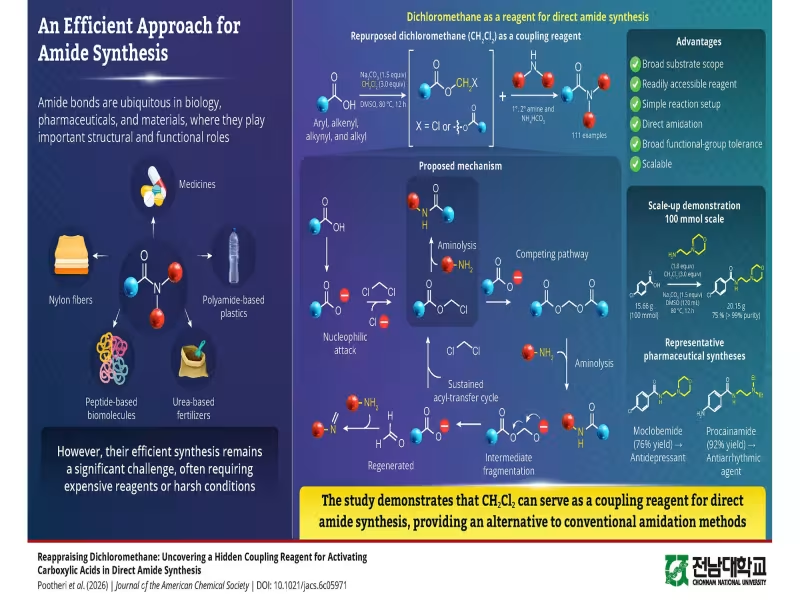
Jeollanam-do – September 25, 2026 -- Researchers at Chonnam National University have demonstrated that dichloromethane, a widely used industrial solvent, can directly drive amide bond formation between carboxylic acids and amines, offering manufacturers a cheaper and less hazardous alternative to conventional coupling reagents. The findings, led by Professor Sunwoo Lee of the Department of Chemistry, were published online on July 6, 2026, and appeared in Volume 148, Issue 27 of the Journal of the American Chemical Society on July 15, 2026.
Team converts a common solvent into a functional coupling agent
Amide bonds underpin peptides, pharmaceuticals and polymers, but standard synthesis routes require stoichiometric coupling reagents that are often corrosive, toxic or waste-generating. The Chonnam team found that under basic conditions, carboxylates attack dichloromethane via an SN2 reaction, forming reactive chloromethyl ester intermediates that then react with amines to yield amides.
Optimized conditions deliver reproducible yields at 80°C
Using benzoic acid and benzylamine as model substrates, the researchers identified sodium carbonate as base, dichloromethane as coupling reagent, and dimethyl sulfoxide as solvent as the optimal combination. Reproducible, high-yield amide formation required 80°C, a 12-hour reaction time and excess amine.
Method produces two pharmaceutical compounds at high yield
The approach synthesized the antiarrhythmic drug procainamide at 92% yield and the antidepressant moclobemide at 76% yield, confirming applicability to active pharmaceutical ingredients. The team also achieved single-step amide synthesis directly from carboxylic acids and ammonium bicarbonate.
Scale-up test yields 20 grams of moclobemide at 99% purity
In a 100-millimole scale reaction combining 4-chlorobenzoic acid and 2-morpholinoethanamine, the method produced more than 20 grams of moclobemide at greater than 99% purity, indicating potential for industrial-scale application. Mechanistic studies showed the primary pathway involves an SN2-activated ester intermediate, with a competing methylene bis(carboxylate) route also contributing to acyl transfer.
Professor Lee said the approach avoids conventional stoichiometric coupling reagents and reduces reagent-derived waste, positioning dichloromethane as a practical, scalable alternative for amide bond formation.