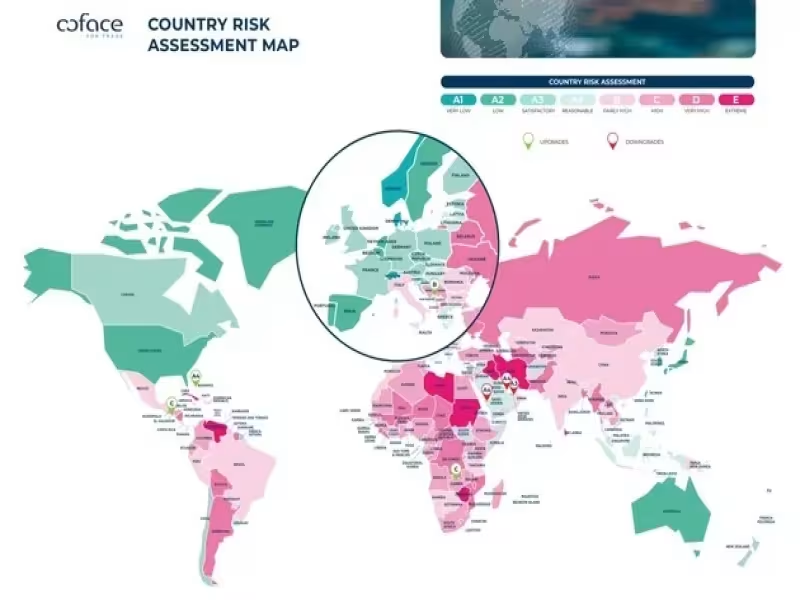
Mainz – October 29, 2026 -- Credit insurer Coface downgraded the country risk ratings of Saudi Arabia, the United Arab Emirates and Qatar, and expects the Middle East conflict alone to cut global growth by a combined 0.5 percentage points in 2026 and 2027. The rating changes, covering seven economies in total, come as escalating geopolitical tensions push up energy, commodity and financing costs.
Oil up more than 50%, gas prices nearly double
Renewed fighting between Iran and the United States and further escalation between Russia and Ukraine have strained global supply chains. Energy prices have climbed sharply despite a clear recovery in oil exports through the Strait of Hormuz and the rerouting of trade flows. Coface economist Markus Kuger said oil has risen by more than 50 percent, natural gas prices have almost doubled and industrial metals remain expensive.
Agricultural commodities show a similar pattern. After attacks on Black Sea ports and heatwaves in Europe, wheat traded at times around 40 percent above the prior-year level.
Fed and ECB each raise rates by 25 basis points
Central banks are holding a restrictive course. The US Federal Reserve and the European Central Bank each raised their key interest rates by 25 basis points most recently, raising financing costs for companies and governments worldwide.
Coface still forecasts global growth of 2.5 percent in 2026, down from 2.8 percent in 2025, and expects stabilization at 2.6 percent in 2027. Kuger attributes the economy's resilience mainly to investment in artificial intelligence and positive financial market performance.
Gulf states bear the sharpest rating cuts
Coface lowered Saudi Arabia from A3 to A4, citing the vulnerability of its energy infrastructure and risks along key export routes. The UAE moved from A2 to A3 and Qatar from A3 to A4. Both depend heavily on shipping through the Strait of Hormuz and are exposed to further disruption.
Four countries were upgraded:
- The Bahamas rose from B to A4, backed by a robust tourism sector and solid fundamentals.
- El Salvador improved from D to C after macroeconomic stabilization.
- Montenegro climbed from C to B on tourism and investment gains.
- Zambia moved from D to C on budget consolidation progress and a steadier debt trajectory.
Regional growth diverges across the US, Europe, Asia
The US economy remains robust, supported by private consumption, AI investment and near-full employment. Europe is performing somewhat better than expected, with Germany and Spain stable, while France's strained budget remains a concern. In Asia, Vietnam and India benefit from infrastructure spending and AI-related demand, while domestic demand in China weakens further. Thailand and the Philippines face rising energy prices and softer consumption. In Africa and Latin America, inflation is the central risk, and El Niño adds to cost pressure.
Coface cuts agrifood outlook in six countries
Coface downgraded the agrifood sector in six countries. Extreme weather in summer 2026 weighed on farming in France, Austria and Poland. In Saudi Arabia and the UAE, heavy reliance on food imports and rising procurement costs drive the downgrade. Argentina's sector faces tough financing conditions, several corporate insolvencies, high costs and shrinking margins.