Geopolitical Risk

State-Backed Hackers Expand Cyber Operations Along Conflict Lines

Jena – November 02, 2026 -- State-backed hacking groups from Russia, Iran, North Korea and China are expanding their activity and tailoring campaigns to global conflicts, according to ESET's latest APT Activity Report. Targets include governments, defense contractors, critical infrastructure, technology providers and institutions in geopolitical crisis regions.

Attackers use AI for malware, phishing and fake websites

Threat actors increasingly use AI tools to develop malicious code, build convincing phishing campaigns and generate fraudulent websites. Jean-Ian Boutin, Director of Threat Research at ESET, says AI makes individual attacks more efficient and partly lowers entry barriers for criminals. Strategic planning, target selection and execution still happen largely by hand, and the expected revolution in cybercrime has not materialized so far.
AerCap files Q3 2026 interim report with SEC, flags geopolitical risks

Image
AerCap files Q3 2026 interim report with SEC, flags geopolitical risks

DUBLIN – October 31, 2026 -- AerCap Holdings N.V. (NYSE: AER) has filed its interim financial report for the quarter ended September 30, 2026, with the U.S. Securities and Exchange Commission. The announcement itself contains no earnings, revenue or fleet figures.

Form 6-K carries unaudited condensed consolidated Q3 statements

The filing includes unaudited condensed consolidated financial statements and accompanying notes. It is available on the Investors section of AerCap's website and on the SEC's website. Investors must consult the Form 6-K for quarterly results.

AerCap serves approximately 300 customers worldwide and is headquartered in Dublin and Miami.

Coface Downgrades Saudi Arabia, UAE, Qatar as Conflict Hits Growth

Image
Coface Downgrades Saudi Arabia, UAE, Qatar as Conflict Hits Growth

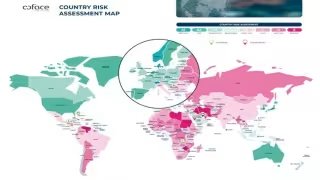
Mainz – October 29, 2026 -- Credit insurer Coface downgraded the country risk ratings of Saudi Arabia, the United Arab Emirates and Qatar, and expects the Middle East conflict alone to cut global growth by a combined 0.5 percentage points in 2026 and 2027. The rating changes, covering seven economies in total, come as escalating geopolitical tensions push up energy, commodity and financing costs.

Oil up more than 50%, gas prices nearly double

Renewed fighting between Iran and the United States and further escalation between Russia and Ukraine have strained global supply chains. Energy prices have climbed sharply despite a clear recovery in oil exports through the Strait of Hormuz and the rerouting of trade flows. Coface economist Markus Kuger said oil has risen by more than 50 percent, natural gas prices have almost doubled and industrial metals remain expensive.

Spot Tanker Rates Hit Record Highs in September on Hormuz, Red Sea Disruption

Image
Spot Tanker Rates Hit Record Highs in September on Hormuz, Red Sea Disruption

Middle East – October 29, 2026 -- Spot tanker rates reached record highs in September as geopolitical disruption in the Strait of Hormuz and the Red Sea lengthened voyages and cut trade efficiency, according to a Teekay Tankers market update.

Hormuz shuttle trade ties up VLCC capacity

Middle East Gulf crude exports have recovered despite continuing attacks on ships. Several producers now run a dedicated fleet of VLCCs through the Strait of Hormuz to transfer crude ship-to-ship (STS) in the Gulf of Oman. The arrangement absorbs a large number of vessels and adds extended waiting times, which pushed VLCC spot rates to record levels.

Port of NEOM bulk calls jump to 25 as war diverts Red Sea cargo

Image
Port of NEOM bulk calls jump to 25 as war diverts Red Sea cargo

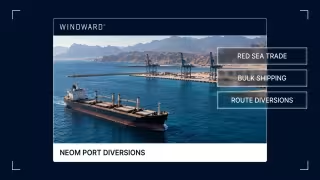
NEOM – October 27, 2026 -- Monthly RoRo vessel calls at the Port of NEOM reached 30 in September 2026, about 70% above the pre-war average of 17. War-diverted cargo is lifting traffic at a port built for a megacity that is shrinking, according to Windward maritime analysis.

The growth runs against NEOM's own trajectory. The Public Investment Fund wrote down its giga-projects by $8 billion at the end of 2024 and ordered spending cuts of more than 20%. The Line was paused in September 2025, and the $2.5 billion NEOM Stadium planned for the 2034 World Cup was shelved in early October 2026.

Hormuz Closure Threatens Chip Output via Helium, Bromine Shortages

Image
Hormuz Closure Threatens Chip Output via Helium, Bromine Shortages

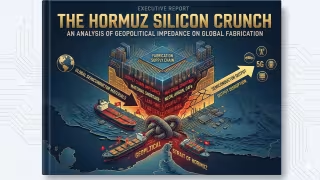
Middle East – October 25, 2026 -- Spot helium prices have doubled after Iranian strikes hit Qatar's Ras Laffan Industrial City, exposing semiconductor fabs to a materials shortage that extends well beyond oil.

Qatar produced roughly one-third of the world's helium as a byproduct of LNG processing. QatarEnergy has declared force majeure, and repairs are estimated at three to five years.

Stranded cryogenic containers put a 35-to-48-day clock on Asian fabs

Roughly 200 specialised cryogenic containers are stranded near the Strait of Hormuz. They keep helium liquid for only 35 to 48 days before it warms and escapes. The last scheduled shipments to Asian fabs are arriving now.

Egan-Jones: Cheap Drones Give Shiite Groups Oil Chokepoint Leverage

Image
Egan-Jones: Cheap Drones Give Shiite Groups Oil Chokepoint Leverage

New York – October 13, 2026 -- Egan-Jones Ratings says inexpensive missiles and drones have given Shiite groups leverage over the chokepoints that carry Middle East petroleum exports, with consequences for global trade and credit markets.

Houthis seize Mayun island as drone strike shuts Saudi pipeline

Yemen-based Houthis have taken control of Mayun, a strategic island in the Red Sea. Saudi Arabia's cross-peninsula pipeline was shut after drones launched from Iraq struck it. Saudi Arabia has fought the Houthis for the past decade without success, which Egan-Jones attributes partly to Yemen's mountainous terrain and the fighters' persistence.

US Investors Eye NATO Eastern Flank Infrastructure, Demand Risk Clarity

Image
US Investors Eye NATO Eastern Flank Infrastructure, Demand Risk Clarity

New York – September 28, 2026 -- American investors identified NATO's Eastern Flank as one of the decade's major infrastructure investment opportunities, on condition that projects carry clearly allocated risk and rely on local partners capable of long-term construction and maintenance. The assessment emerged from a roundtable held on the sidelines of the UN General Assembly, hosted by Romanian infrastructure firm Concelex and Atlantic Council Romania, and addressed by Romania's President Nicușor Dan.

Ukraine's rapid infrastructure repairs reshape crisis-readiness standards

Participants examined how the war in Ukraine has redefined infrastructure requirements near NATO's eastern border. Restoring a railway bridge, transformer substation or hospital hinges on heavy equipment, compatible structural components and certified response teams already positioned on-site, since these capabilities cannot be mobilized within days once a crisis begins.

Forus Hits $3B Valuation on $150M Raise as NYSE Hosts UNGA Week

Image
Forus Hits $3B Valuation on $150M Raise as NYSE Hosts UNGA Week

NEW YORK – September 22, 2026 -- Forus, an AI-driven healthcare startup, has reached a $3 billion valuation after closing a $150 million Series C funding round earlier this month, CEO Sahir Jaggi confirmed during a NYSE Live broadcast tied to the trading floor's pre-market advisory.

Forus raises $150 million to link doctors, pharmacies and biopharma data

Jaggi said the capital will support the company's platform connecting physicians, pharmacies, payers and biopharmaceutical firms to accelerate access to new treatments for patients.

Oil Splits: IEA Cuts Demand, EIA Lifts Brent as Refiners Post Record Margins

Image
Oil Splits: IEA Cuts Demand, EIA Lifts Brent as Refiners Post Record Margins

NEW YORK – September 18, 2026 -- Crude settled near $100 a barrel Friday after Iranian state media said Tehran would meet Gulf states in Oman to discuss the Strait of Hormuz, capping a second consecutive weekly gain despite the pullback. The International Energy Agency now forecasts global oil demand will fall by 2.5 million barrels a day in 2026, roughly 940,000 barrels a day deeper than its estimate a month earlier, while the U.S. Energy Information Administration raised its second-half 2026 Brent forecast by $8 to around $90 a barrel in its September 9 Short-Term Energy Outlook. OPEC cut its 2026 demand growth forecast for a fifth consecutive time.