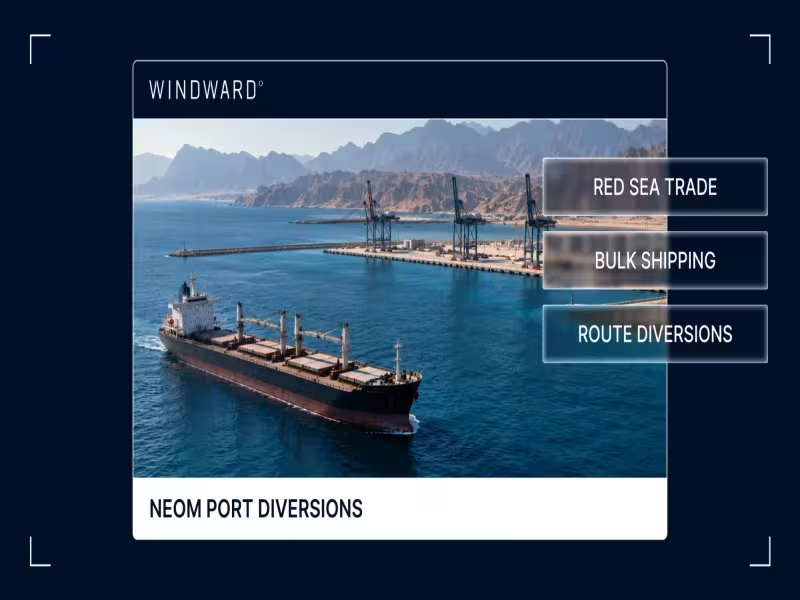
NEOM – October 27, 2026 -- Monthly RoRo vessel calls at the Port of NEOM reached 30 in September 2026, about 70% above the pre-war average of 17. War-diverted cargo is lifting traffic at a port built for a megacity that is shrinking, according to Windward maritime analysis.
The growth runs against NEOM's own trajectory. The Public Investment Fund wrote down its giga-projects by $8 billion at the end of 2024 and ordered spending cuts of more than 20%. The Line was paused in September 2025, and the $2.5 billion NEOM Stadium planned for the 2034 World Cup was shelved in early October 2026.
Gulf closures push Saudi cargo west to the Red Sea
Conflict in the Red Sea and Gulf escalated on 28 February 2026 into direct targeting of commercial shipping along the Saudi coast. The Houthis declared a campaign against Saudi-affiliated vessels on 20 July 2026. Dammam and Jubail were cut off from normal routes, and Saudi Red Sea exports rose from 29.6M tons to 54.8M tons year on year in April–May, while Gulf cargo fell by 41.2M tons.
Bulk carrier calls rise from one to 25 in five months
NEOM logged a single bulk carrier call between October 2025 and April 2026. It recorded 25 between May and September, peaking at 9 in September. The ships are mostly 52,000–82,000 DWT and often stay for weeks. Most arrive from the Black Sea, Turkey and Asia and then leave for Indian ports. Windward reads the long stays as slow discharge of cargo that would otherwise have gone to Saudi Gulf ports.
RoRo growth tracks the Safaga shuttle launched with DFDS
Almost all of the RoRo increase runs on the Safaga shuttle route to Egypt. The route likely reflects the corridor NEOM launched with Pan Marine and DFDS in April 2026, which pairs the ferry with trucking to Gulf markets and avoids both Hormuz and Bab el-Mandeb.
Container calls fall from seven to zero
NEOM recorded seven container calls in the five months before the war, mostly regional feeders. It logged two between March and July 2026 and none since mid-July. Diverted container cargo is likely flowing via Jeddah and King Abdullah, where MSC launched a land-bridge service in May. NEOM's new container terminal is due to open by the end of 2026 and ramp up through 2027.
Saudi service vessels go dark for four days in July
Saudi-flagged pilot boats and tugs averaged about 80 calls a month, in a range of 42 to 155, before they stopped transmitting AIS between 20 and 23 July. They logged zero calls in August and September. Windward says the abrupt stop points to a deliberate decision rather than a gradual decline.
Netherlands-flagged construction and dredging vessels peaked at 69 calls in November 2025 and held at 42–44 a month through February. Calls fell to 4 in March, when Boskalis completed the channel works, and have stayed under 10 a month since.
Hormuz recovery would hit bulk calls first
If Hormuz transits approach pre-war levels, bulk calls are likely to fall first, and RoRo would settle toward about 17 calls a month. If the security situation persists into 2027, bulk calls are likely to climb past September's 9, and container carriers may begin testing calls as Terminal 1 ramps up.
Windward positions NEOM bulk calls as a leading indicator of Gulf route confidence: falling calls would mean confidence is returning, and rising calls the opposite.