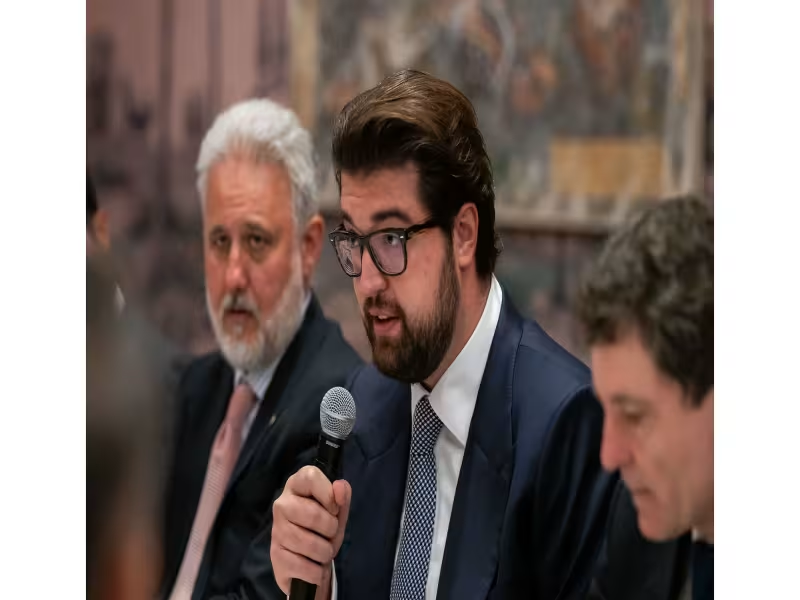
New York – September 28, 2026 -- American investors identified NATO's Eastern Flank as one of the decade's major infrastructure investment opportunities, on condition that projects carry clearly allocated risk and rely on local partners capable of long-term construction and maintenance. The assessment emerged from a roundtable held on the sidelines of the UN General Assembly, hosted by Romanian infrastructure firm Concelex and Atlantic Council Romania, and addressed by Romania's President Nicușor Dan.
Ukraine's rapid infrastructure repairs reshape crisis-readiness standards
Participants examined how the war in Ukraine has redefined infrastructure requirements near NATO's eastern border. Restoring a railway bridge, transformer substation or hospital hinges on heavy equipment, compatible structural components and certified response teams already positioned on-site, since these capabilities cannot be mobilized within days once a crisis begins.
Concelex CEO calls for a Sovereign Infrastructure Index tracking rebuild capacity
"Ukraine has shown us that an asset is brought back into service by the capacity that exists before a crisis," said Radu Pițurlea, CEO of Concelex and a member of the Atlantic Council's Board of Directors. Concelex proposed adding delivery capacity as a qualification criterion for strategic projects, alongside existing financial and regulatory tests, and prioritizing long-term, availability-based public-private partnerships along strategic corridors where regional infrastructure firms co-invest with transatlantic capital. Both proposals would be underpinned by a Sovereign Infrastructure Index for NATO's Eastern Flank, designed to record who can build and restore each asset, how quickly, and under which jurisdiction.
Atlantic Council warns infrastructure planning can no longer proceed country by country
Frederick Kempe, President and CEO of the Atlantic Council, opened the discussion, which was moderated by Landon Derentz, the organization's Vice President for Energy and Infrastructure. "Developments in the international environment are passed on through energy prices, transport routes, supply chains and the cost of capital, and they reach every project in this region," Kempe said, arguing that infrastructure, energy and communications must now be prioritized and integrated across borders rather than planned nationally.
Romanian officials and US development finance representatives joined the talks
Attendees included Romania's Minister of Finance Alexandru Nazare, Presidential Advisors Marius Lazurca and Radu Burnete, Romania's Ambassador to the United States Andrei Muraru, Washington-based ambassadors from several Central and Eastern European countries, representatives of the U.S. International Development Finance Corporation, investment banks, global funds, and American and Romanian energy, engineering and infrastructure companies.
Participants agreed to continue the discussion at a follow-up event in Bucharest before the end of the year, with Concelex's proposals to be developed further alongside the Atlantic Council.