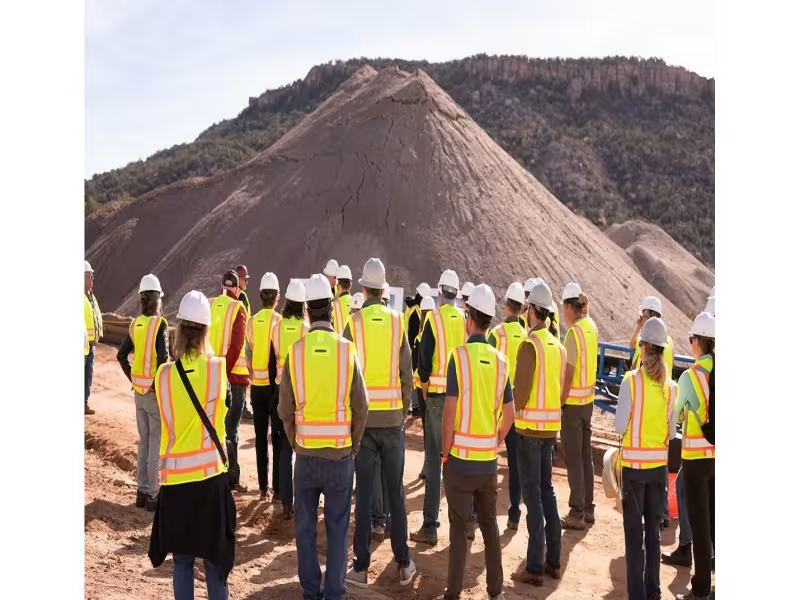
Casper – November 04, 2026 -- DISA Uranium Corporation has started its first abandoned uranium mine (AUM) cleanup under its U.S. Nuclear Regulatory Commission (NRC) license at the Mary Ann site in Montrose County, Colorado, while holding agreements that cover more than 375 legacy AUM sites, primarily in Colorado and Utah.
Mary Ann is the first project under a license issued in September 2025
The NRC Service Provider License authorizes DISA Uranium to deploy its mobile, patented HPSA technology directly at AUM sites. The company describes it as the first and only license of its kind.
Mary Ann sits on Bureau of Land Management (BLM) land outside Nucla. DISA Uranium says the project establishes a regulatory pathway for recovering uranium from legacy mine waste on federal land, developed with the NRC, the BLM and the State of Colorado.
On October 29, 2026, the company hosted representatives of the Navajo Nation and the Pueblo of Laguna, plus Colorado's Division of Reclamation, Mining and Safety and its Department of Public Health and Environment. The BLM, the Montrose County Commission, the San Juan County Commission in Utah, the Colorado Mining Association and staff from the U.S. Senate and House of Representatives also attended.
HPSA separates uranium-bearing fines from waste rock using water
The process is water-based and mechanical. Cleaned coarse material is returned to the site for restoration, and the concentrated uranium-bearing fines are prepared for removal and later recovery. DISA Uranium frames this as a potential domestic uranium source from material otherwise left as an environmental liability.
CEO Greyson Buckingham said the company aims to apply the approach more broadly across the American West and help reduce reliance on foreign uranium.
Navajo Nation EPA schedules a Phase 2 verification study for Spring 2027
Navajo Nation EPA Executive Director Stephen B. Etsitty said the agency has taken a measured approach to HPSA since a 2022 USEPA-funded treatability study. The Navajo Nation is funding a commercial field-scale Phase 2 verification study, which USEPA has approved and which will be fully implemented in Spring 2027.
Etsitty said Navajo cleanup will follow 4 N.N.C. § 2305, which requires treating and then removing remaining hazards. He contrasted this with the current USEPA approach, which he said passes legacy waste problems from one generation to the next. He called HPSA "a positive step" away from leaving hundreds of disposal repositories near Navajo communities and watersheds.
Dr. Richard Luarkie, a former two-term Governor of the Pueblo of Laguna and advisor at the Payne Institute at the Colorado School of Mines, said Tribal nations must have a real voice in shaping new AUM approaches, including consultation and community engagement.
Agreements covering more than 375 AUM sites form the project pipeline
DISA Uranium says these agreements give it a substantial pipeline of uranium-bearing material for its mobile HPSA units. The company plans to use Mary Ann to demonstrate a repeatable remediation and recovery model across that portfolio.