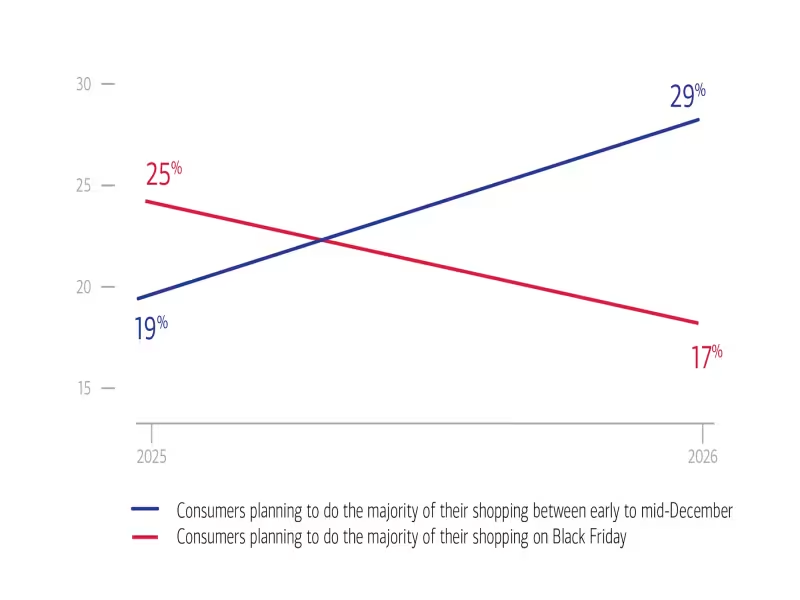
CHARLOTTE, N.C. – October 29, 2026 -- Twenty-nine percent of U.S. consumers plan to do most of their holiday shopping in early to mid-December, up from 19% in 2025, while Black Friday's share fell from 25% to 17%, according to the Bank of America 2026 Holiday Spending Survey.
Fewer shoppers also plan to start early. Only 38% say they have shopped or will shop earlier this year, down from 52% in 2025. Bank of America Institute's Consumer Checkpoint nonetheless shows holiday spending increasing at a solid rate through September, so sentiment is running cooler than actual spending.
Mary Hines Droesch, Head of Consumer and Small Business Products and Analytics at Bank of America, said consumers are being "more deliberate" this year, even as the bank's spending data shows a healthy season start.
Share of shoppers planning flat spending rises to 48% as only 12% plan to spend more
Nearly half of consumers (48%) expect to spend about the same as last year, up from 39% in 2025. The share planning to spend less slipped to 39% from 42%, and those planning to spend more dropped to 12% from 19%. Combined, 87% expect spending to hold steady or decline.
Budget discipline is widespread: 63% base holiday spending strictly on their own budget rather than on what friends or family spend, rising to 78% among baby boomers. The leading strategies to avoid overspending are shopping sales events (30%), setting a firm per-person limit (27%) and using credit card rewards, points or cash back (21%).
AI shopping tools lose ground as 72% of consumers opt out
Nearly three-quarters of consumers (72%) do not plan to use AI tools for holiday shopping, compared with 49% in 2025. Social commerce shows a steeper retreat: 14% plan to buy gifts directly through social media, down from 35% last year, with the sharpest declines among younger generations. Sixty-two percent say viral content has no effect on their purchase decisions.
Traditional channels hold firm. E-commerce remains the most common way to shop at 74%, and 54% still plan to visit brick-and-mortar stores.
Credit cards gain as preferred payment method, rising to 49% from 32%
Credit cards are the preferred holiday payment method, ahead of debit cards, cash and Buy Now, Pay Later, for 49% of consumers. Among higher-income Americans the figure reaches 67%, versus 24% for lower-income consumers. The shift is strongest among older consumers, while 33% of millennials and 38% of Gen Z still prefer debit cards.
Scam exposure reaches 37% of consumers, led by retailer phishing at 18%
Thirty-seven percent of consumers report encountering at least one holiday shopping scam tactic in recent years. Phishing emails posing as retailers were most common (18%), followed by fake shipping or delivery notifications (16%) and too-good-to-be-true deals (16%). Gen X and baby boomers are more than twice as likely as Gen Z to report retailer phishing attempts.
Ipsos conducted the survey online from Sept. 10-12, 2026, using its probability-based KnowledgePanel. The sample comprised 2,062 U.S. adults, with a margin of sampling error of ±2.2 percentage points at the 95% confidence level.