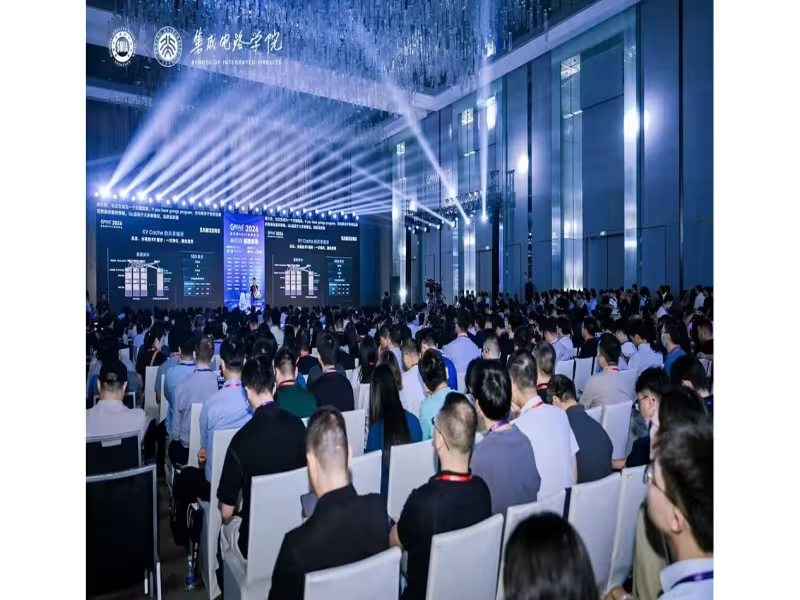
Shenzhen – October 12, 2026 -- The 5th Global Memory Innovation Forum (GMIF2026) has named 18 companies across memory, compute, packaging and testing equipment, test systems and end applications in its first GMIF2026 Annual Awards, led by Samsung Semiconductor, Sandisk, CXMT and Lenovo.
The summit was held at the Renaissance Shenzhen Bay Hotel and co-hosted by the Shenzhen Memory Industry Association and the School of Integrated Circuits at Peking University. Its theme was "The Future Built on AI Memory and Storage," with the token economy as a key lens. Winners were judged on technology innovation, industry contribution, market service and application results.
Samsung, Sandisk and CXMT take the core memory awards
Samsung Semiconductor received the Outstanding AI Memory & Storage Industry Leadership Award, with the organizers citing zNAND-O 3D architecture, V10 NAND with more than 400 layers, and CXL memory. Sandisk won the NAND Technology Breakthrough Award for its CBA scaling strategy and its work on high-bandwidth flash (HBF). Solidigm took the AI SSD Technology Innovation Award.
CXMT won the DRAM Technology Innovation Award for the first full-platform launch of LPDDR6. The organizers also credited its IDM model, R&D investment and volume production with helping make China's DRAM supply chain self-reliant.
Lenovo, Arm and Paratera are honored for AI compute infrastructure
Lenovo won the AI Infrastructure Leadership Award for its hybrid AI strategy, covering AI servers, liquid cooling and AI factory solutions. Arm received the AI Computing Ecosystem Contribution Award; its "Arm Total Design" ecosystem has brought together more than 22 million developers worldwide.
Paratera won the AI Computing Service Award. Its cross-cluster scheduling orchestrates heterogeneous compute across millions of CPU cores and tens of thousands of GPUs, lifting utilization above 85%. NEXWISE won the AI Infrastructure Pioneer Award for compute clusters of roughly 50,000P across East, South and North China, sold through a pay-per-use "token factory" model.
Controller and HDD makers post performance and share claims
Maxio Technology won the AI Storage Ecosystem Contribution Award. It ranks second worldwide in independent third-party SSD controller shipments and first in China, and serves more than 100 leading customers. Silicon Motion took the Controller Technology Pioneer Award.
Numbers Law won the HDD Technology Breakthrough Award. Its PMD technology delivers 30x bandwidth and more than 1,000x random IOPS, according to the organizers. Dify won the AI Open-Source Platform Contribution Award, and SYNCORE, a GAC Group and iFLYTEK venture, won the Intelligent Cockpit Technology Innovation Award.
Genstoraige claims 10x token throughput and 1/67 of cloud inference cost
Genstoraige won the Outstanding Emerging Enterprise in AI Storage Innovation Award. Its edge AI 90 token factory moves KV cache from GPU memory to AI SSDs and schedules data across HBM, DRAM and SCM. The company says the architecture raises token throughput 10x and cuts measured inference cost to 1/67 of the cloud.
BIWIN won the Enterprise Memory & Storage Innovation Award for PCIe 5.0 SSDs, CXL memory and RDIMMs, with core enterprise products in the supply chains of leading OEMs, AI server makers and internet companies. Infplane won the Intelligent Storage Achievement Award for an AI SSD that enables KV cache persistence and expert prefetching for MoE models.
Topdisk won the Market Potential Award. KingSpec, founded in 2007, won the Storage Testing Innovation Award for its ZD102 automated memory module tester, which tests 60 UDIMM DDR4 modules per batch with 14 selectable test items and syncs reports to MES for traceability.