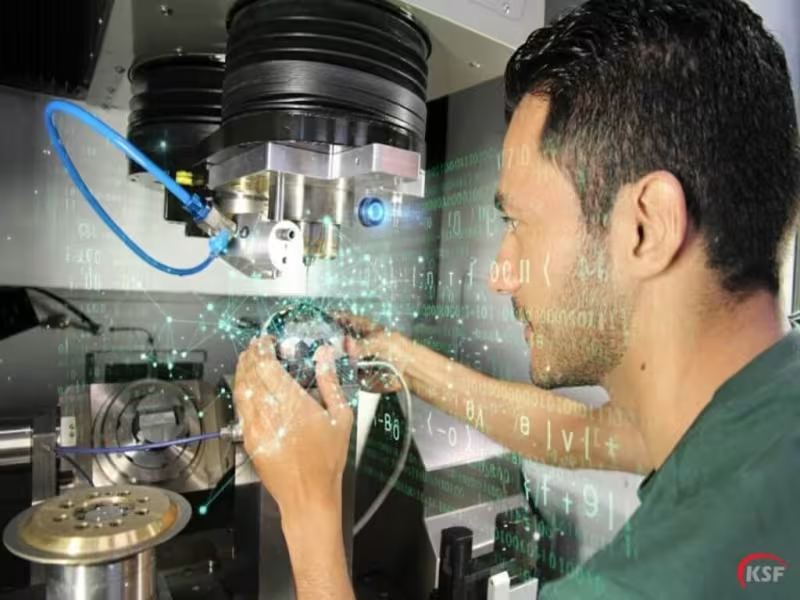
SHERIDAN, WYOMING - April 13, 2026 - GrindingHub 2026, scheduled for May 5-8 in Stuttgart, Germany, positions precision grinding at the intersection of AI-driven process control, full automation, and advanced sensor integration, with exhibitors demonstrating systems capable of unmanned closed-loop manufacturing, digital production orchestration, and high-precision grinding for humanoid robot components. The event, organized under the umbrella of VDW (Verein Deutscher Werkzeugmaschinenfabriken), brings together machine tool builders, process engineers, and end-users to evaluate technologies that replace reactive maintenance with predictive, data-driven manufacturing. Three exhibitor cases-Adelbert Haas, Anca, and Erwin Junker-illustrate how the industry is operationalizing these shifts ahead of the show. Furtwangen University's KSF Institute adds academic framing on where sensor-AI integration is heading.
Closed-loop automation at Adelbert Haas
Adelbert Haas GmbH, based in Trossingen, runs fully automated grinding cells across 21 unmanned shifts per week, cycling through grinding, in-process measurement, and corrective re-grinding without operator intervention. Managing Director Marie-Sophie Maier frames this as a structural shift: traditional complete machining has been overtaken by intelligent automation that tolerates zero compromise on precision or flexibility.
The company's Customer Care Center deploys AI agents that continuously analyze machine data, detect anomalies, and trigger corrective actions before downtime occurs-automatically generating service tickets, prioritizing critical alarms, and surfacing log files on demand. The outcome is a service model built on prevention rather than response, which Maier describes as a genuine competitive differentiator rather than a support function.
Digital production control and server-based workflow orchestration at Anca
Anca Europe GmbH, headquartered in Weinheim and part of an Australia-based group, will exhibit a server-based digital production control system that coordinates tool grinding cells in a manner comparable to air traffic control for manufacturing floors. The platform assigns each pallet and machine its next task per order and delivers step-by-step instructions to operators via app or portable device, eliminating manual file searches and most manual data entry.
A closed measurement loop with automatic compensation keeps batches within tolerance without requiring operators to calculate or track offsets manually. The system runs on existing Anca and Zoller hardware, lowering the migration barrier for shops already invested in those platforms. The net operational result: a single skilled worker can supervise more machines simultaneously, new employees reach productivity faster, and shift output becomes more predictable with reduced scrap.
High-precision thread grinding for humanoid robotics at Erwin Junker
Erwin Junker Maschinenfabrik GmbH, based in Nordrach in Germany's Black Forest, is targeting the emerging humanoid robotics sector with specialized grinding solutions for transmission elements-components that transfer motion and force across joints, fingers, arms, and legs. These parts demand tightly controlled dimensional accuracy and surface finish to minimize noise and ensure dynamic precision in combined linear and rotary drive systems.
Junker's approach covers internal thread grinding from solid material-including cone, ball, and special profiles-down to internal thread diameters below 10 mm. Thread spindle grinding accommodates high pitch angles through a flexible machine concept, while thread roll grinding completes external geometry, thread, and gear teeth in a single clamping setup using ceramic and electroplated CBN grinding wheels and pins. Head of Engineering Jan Schmid cites the company's long experience in thread grinding as the foundation for customized solutions across these complex geometry classes.
Business impact
Procurement leads evaluating grinding equipment now face a vendor landscape where machine intelligence-AI anomaly detection, automated compensation loops, and real-time sensor monitoring-is becoming a baseline expectation rather than a premium option. Sourcing decisions made in 2026 budget cycles that default to conventional CNC grinding platforms without integrated data infrastructure risk locking facilities into reactive maintenance models as the broader industry migrates to self-optimizing systems.
Automation managers and manufacturing engineering directors can use GrindingHub to benchmark competing closed-loop architectures before committing to capital expenditure. Furtwangen University's KSF Institute notes that the central operational constraint is full integration of sensor, measurement, and AI control layers into existing production environments-both technically and organizationally. Facilities that begin this integration in 2026 build internal process databases that compound over time, partially offsetting the skilled-worker shortage by storing process expertise independently of individual employee experience.