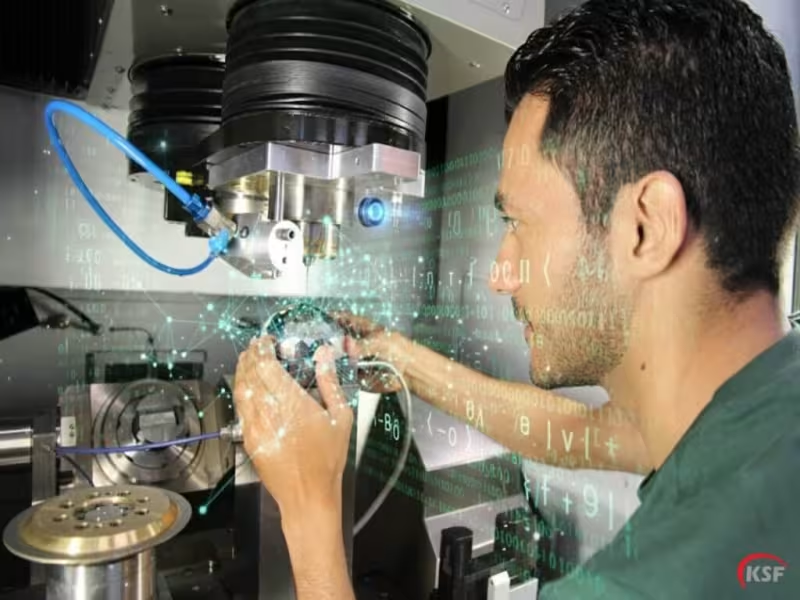
SHERIDAN, WYOMING - March 31, 2026 - Precision grinding investment decisions in 2026 are shifting toward automated, closed-loop production systems that reduce operator dependence, improve traceability and keep tight-tolerance output stable across longer unattended runs. GrindingHub 2026, scheduled for May 5 to 8 in Stuttgart, is framed by VDW around that transition, with examples spanning unmanned manufacturing at Adelbert Haas, digital production control at Anca, specialized thread grinding for humanoid robot components from Erwin Junker, and sensor- plus AI-driven process optimization described by Furtwangen University's KSF Institute.
Technology direction
VDW describes grinding as moving beyond standalone machine capability toward integrated production systems. Adelbert Haas says fully automated closed-loop manufacturing is already standard in its environment, with grinding, measuring and regrinding organized for 21 shifts per week in unmanned operation. The company also highlights preventive service workflows in which AI agents analyze machine data in real time, detect anomalies and trigger actions before a shutdown, including automatic ticket creation, alarm prioritization and log-file handling.
Anca Europe focuses on production control rather than only machine hardware. Its server-based system for digital production control uses app-based worker guidance together with automated measurement and compensation. The setup is designed to work with existing Anca and Zoller machines, while centralizing workflow organization and traceability. Operators receive digital instructions showing which pallet to load, which machine program is prepared, when measurements are required and how to respond to measurement results. VDW says this reduces file searching, limits manual data entry, simplifies compensation and quality checks, and helps keep batches within tolerance through a closed measurement loop.
Application areas and process capability
One prominent application highlighted in the source is component manufacturing for humanoid robotics. Erwin Junker links future robotics demand to grinding requirements for transmission elements, joints and drives that need dimensional accuracy, geometric precision and surface quality while also helping limit noise. The company points to its thread-grinding experience for producing customized solutions across thread types used in such assemblies.
The source details several process capabilities: internal thread grinding directly from solid material; precision production of cone and ball threads and special profiles; reliable machining of internal thread diameters below 10 mm; and the ability to handle nuts with unfavorable diameter-to-length ratios. For threaded spindles, Junker says even high pitch-angle threads can be produced because of the machine concept's flexibility. It also cites both single-tooth and multi-tooth machining options, and describes grinding thread rolls in a single clamping process that combines external geometry, thread and gear-tooth production.
Business impact
Procurement leads and operations directors in 2026 need to evaluate grinding platforms less as isolated capital equipment and more as connected process cells with measurement, compensation, workflow software and service intelligence built in. The source makes clear that vendor selection now affects staffing models, because digital work instructions, centralized data storage and automated compensation allow one skilled worker to oversee more machines and shorten onboarding for new employees. That changes ROI calculations for machine replacement, retrofits and software-layer upgrades on existing installed bases.
Automation managers and manufacturing engineering teams also face roadmap decisions around sensor integration, in-situ measurement and AI-supported anomaly detection. Furtwangen University's KSF Institute identifies closed control loops, force and vibration sensing, drive monitoring and process databases as the route to preserving know-how despite skilled-labor shortages. For companies producing robotics parts, tooling components or other high-precision parts, the practical consequence is a stronger case for investments that improve unattended stability, predict wheel wear, document every process step and maintain consistent quality without relying on individual operator memory. In Europe, where GrindingHub is positioned as a central meeting point for industrial manufacturing, that directly affects competitiveness, sourcing strategy and factory modernization priorities.